
国际多元化配置

Search documents
“抛售美国 2.0”?美银分析师:全球再平衡升温,非美资产走俏
Zhi Tong Cai Jing· 2026-02-13 13:25
Group 1 - Michael Hartnett, a strategist at Bank of America, indicates that U.S. trade policies are creating a "new world order," leading investors to shift from U.S. dollars and stocks to non-U.S. assets [1] - Hartnett notes that the Trump administration's policies have resulted in a new trading environment focused on "everything except the dollar," suggesting a global rebalancing [1] - Emerging market commodity-producing countries are expected to benefit from the growth in artificial intelligence demand, while investor allocations to China and India remain insufficient [1] Group 2 - Since the announcement of significant tariffs by President Trump in April 2024, U.S. assets have experienced volatility, raising concerns about the end of U.S. dominance in the global economy [4] - Despite the withdrawal of several tariff measures, the S&P 500 has underperformed compared to international indices, with the dollar index declining by approximately 10% since late 2024 [4] - Hartnett's preference for non-U.S. stocks has proven prescient, as the S&P 500 has risen by 15% but lagged behind the MSCI global index (excluding the U.S.) which has increased by 39% [4] Group 3 - The trend of capital flow towards international markets has continued into 2026, with European, Japanese, Korean, and emerging market indices collectively outperforming U.S. stocks [4] - The decline of the dollar has enhanced the attractiveness of overseas markets, increasing the relative value of foreign corporate earnings and boosting returns on international stocks [4] - In January, investors saw a net inflow of $51.6 billion into international equity ETFs, indicating a significant rise in monthly capital inflows since late 2024 [4] Group 4 - Some investors label the current trend of overseas allocation as "Sell America 2.0," but fund managers clarify that this buying spree in international stocks does not equate to a complete abandonment of U.S. equities [5] - Many still believe that U.S. stocks will continue to lead global markets, although the extent of that leadership may diminish compared to recent years [5] - Investors are increasingly questioning the rationale behind a singular focus on U.S. stocks, suggesting a potential shift towards international diversification in their portfolios [5]

“抛售美国2.0”?美银:全球再平衡升温,非美资产走俏
Zhi Tong Cai Jing· 2026-02-13 11:08
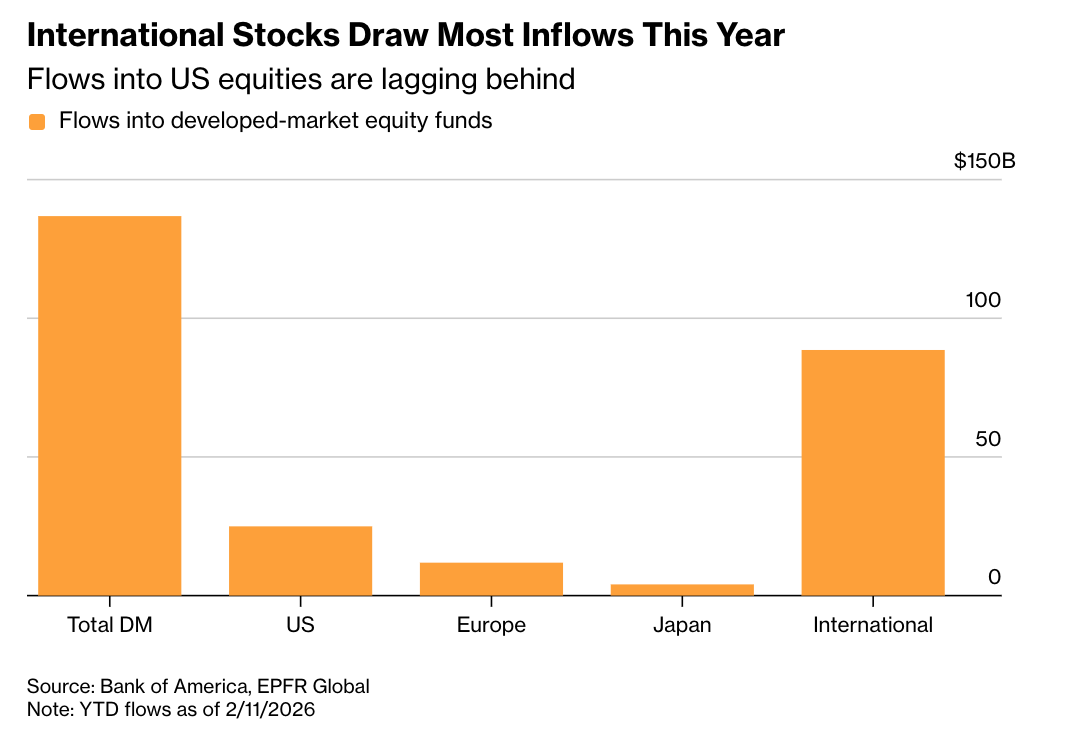
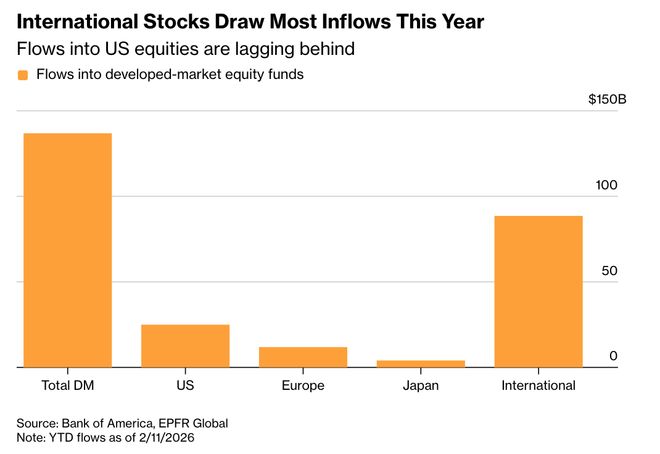
Group 1 - The core viewpoint of the article is that U.S. trade policies are creating a "new world order," leading investors to shift from U.S. assets to non-U.S. assets, particularly benefiting emerging market commodity-producing countries due to rising AI demand [1][4] - According to Bank of America strategist Michael Hartnett, the trend of moving away from U.S. stocks is supported by significant capital flows, with $104 billion flowing into international developed market equity funds compared to only $25 billion into U.S. equity funds this year [1] - Since the announcement of significant tariffs by former President Trump, U.S. assets have been volatile, and despite the withdrawal of some tariffs, the S&P 500 has underperformed compared to international indices, with the MSCI global index (excluding the U.S.) outperforming by 39% [4] Group 2 - The trend of capital shifting towards international markets has accelerated, with European, Japanese, Korean, and emerging market indices collectively outperforming U.S. stocks since the beginning of 2026, driven by a weaker dollar enhancing overseas returns [4] - Fund managers indicate that the perception of U.S. stocks as the only viable investment option is changing, with a growing interest in diversifying into international equities [5][6] - Despite some investors labeling the current trend as a "sell-off of America 2.0," many still believe that U.S. stocks will continue to lead the global market, albeit with a reduced advantage compared to previous years [5][6]

M&G英卓投资管理与国泰海通证券建立战略合作关系
Di Yi Cai Jing· 2025-07-11 07:37
Core Viewpoint - M&G Investments and Guotai Junan Securities have signed a strategic cooperation memorandum to expand channels for Chinese investors to participate in global markets, combining M&G's global expertise with Guotai Junan's local market leadership [1][2]. Group 1: Strategic Cooperation - The cooperation will focus on four key areas: information sharing, asset management development, client engagement, and investment market promotion, laying a solid foundation for future collaboration in investment research, product innovation, and global distribution [2]. - M&G aims to leverage Guotai Junan's market position to reach a broader local investor base, while Guotai Junan seeks to enhance its global investment management capabilities through M&G's expertise [2][3]. Group 2: Market Context and Growth Potential - The partnership comes at a critical time for China's asset management industry, which is undergoing regulatory reforms and increasing demand for international asset allocation due to global market volatility and geopolitical changes [1]. - The Chinese asset management industry is projected to reach $40.4 trillion by 2030, highlighting significant growth opportunities [1]. Group 3: Product Development and Future Plans - Both companies are jointly developing a brand-focused fixed income investment solution targeting the Asian market, set to launch in the coming months [2]. - They are also exploring other collaborative projects, including QDII-compliant products and investment consulting mechanisms, to maximize their strengths in global investment management and local market knowledge [2]. Group 4: Leadership Statements - M&G's CEO emphasized the long-term commitment to the Asian market, particularly China, and the opportunity to provide quality investment solutions for Chinese investors [3]. - Guotai Junan's representative highlighted the synergy between their deep understanding of the Chinese market and M&G's global investment expertise, aiming to offer diversified overseas investment solutions [3].
