地缘安全

Search documents
特朗普:中国正在接管加拿大!话音刚落扬起100%关税大棒
Sou Hu Cai Jing· 2026-01-27 07:11
Group 1 - The article discusses the escalating tensions between the U.S. and Canada regarding China's influence, particularly in the context of a recent trade agreement between Canada and China [1][3] - Canada signed a significant agreement with China, the "China-Canada Economic and Trade Cooperation Roadmap," which includes cooperation in agriculture, energy, and electric vehicles, marking a new phase in bilateral relations [3] - The Canadian government has removed a 100% additional tax on Chinese electric vehicles and established an import quota, which is expected to allow Chinese brands to capture a 10% market share in Canada's electric vehicle sector [3] Group 2 - President Trump's reaction to the Canada-China agreement was swift, threatening to impose 100% tariffs on all Canadian goods if Canada continued its trade relations with China [5] - Canadian Prime Minister Carney responded to Trump's comments by emphasizing Canada's independence and the importance of supporting domestic products, indicating a strong stance against U.S. pressure [7] - The article highlights the strategic shift in Canada's foreign policy as it seeks to balance its relationship with the U.S. while pursuing pragmatic cooperation with China, reflecting broader geopolitical dynamics [10]


德国失业率持稳于6.3% 但经济复苏步伐仍然疲软
智通财经网· 2025-11-28 11:28
Group 1 - The latest statistics from the German labor department indicate that the unemployment rate in Germany remains stagnant, with a slight increase of about 1,000 people in November, bringing the total to 2.973 million, which is lower than economists' expectations of a 5,000 increase [1] - The seasonally adjusted unemployment rate in Germany remained unchanged at 6.3%, aligning with expectations, highlighting the ongoing weakness in the labor market and insufficient economic growth momentum [1] - The German economy ministry has slightly revised its overall economic growth forecast for this year from stagnation (0% growth) to 0.2%, with a projected growth of 1.3% for the following year [1] Group 2 - Germany is pursuing a strategy of "large-scale infrastructure and defense investment" to support its economy, utilizing modified fiscal rules and special funds to create significant borrowing capacity [2] - A special infrastructure fund has been established with a scale of approximately €500 billion, aimed at public infrastructure projects over the next 10-12 years, focusing on transportation, utilities, energy transition, and climate projects to enhance competitiveness and stimulate medium to long-term growth [2] - The core budget for defense spending in the latest German government budget for 2026 is approximately €82.7 billion, with total defense spending exceeding €108 billion when including a special defense fund, indicating a clear intention to stimulate overall demand and support the military-industrial chain [2]
14亿人饭碗稳了?老挝钾肥“横空出世”全球第二,破中国钾肥困局
Sou Hu Cai Jing· 2025-05-17 03:52
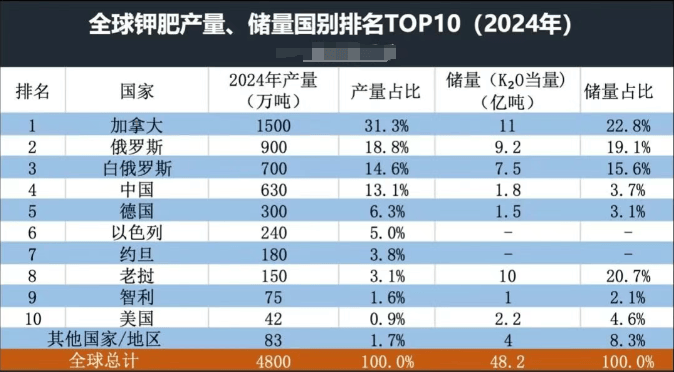
Core Insights - Laos has emerged as a significant player in the global potash market, with its potash reserves being upgraded from 75 million tons to 1 billion tons, making it the second-largest potash reserve holder globally, surpassing Russia and Belarus [1][4][15] - China, the world's largest consumer of potash, relies heavily on imports to meet its agricultural needs, with domestic production only covering about one-third of its consumption [2][4] - The discovery of Laos' potash resources is crucial for China's food security, as it can potentially alleviate the country's dependence on imports from other nations [4][15] Potash Market Dynamics - In 2024, China is expected to consume 18.72 million tons of potash, accounting for 48.2% of global consumption, while its domestic production is only 6.3 million tons [2][4] - Laos' potash reserves are estimated to be 1.33 billion tons, which is 13 times that of China's reserves, indicating a significant opportunity for China to secure a stable supply [4][6] - The strategic location of Laos, being a neighboring country to China, provides a more reliable and secure source of potash compared to imports from Canada, Russia, and Belarus [6][15] Investment Opportunities - Over 20 Chinese companies are currently investing in potash mining projects in Laos, with several projects expected to significantly increase production capacity by 2027 [6][9] - Notable projects include those by Zhongnong Potash, Dongfang Tieta, Cangge Mining, and Yuntianhua, which collectively aim to produce over 1 million tons of potash annually [9][11] - The transportation of potash from Laos to China can be facilitated through the China-Laos Railway or via sea routes, enhancing logistical efficiency [11][15] Geopolitical Implications - The emergence of Laos as a potash supplier is seen as a strategic advantage for China, reducing its vulnerability to supply disruptions from traditional potash-exporting countries [13][15] - The shift in potash supply dynamics could disrupt the existing oligopoly in the global potash market, which has been dominated by a few countries [13][15] - The increased import of potash from Laos, which has already risen to 2.07 million tons in 2024, reflects a growing reliance on this new source [11][14]