
经济刺激

Search documents
美连遭两大噩耗,特朗普面临特赦,八国联合发声,白宫开始画大饼
Sou Hu Cai Jing· 2026-02-24 02:19
Group 1: Political Challenges - Trump's political situation is facing unprecedented challenges due to multiple issues, including the Federal Reserve nomination being blocked by both parties, the refusal of Epstein's ex-girlfriend to testify, and strong international condemnation of Israel's actions [1][3][16] - Each of these issues reflects Trump's political calculations, but they have turned into significant challenges that complicate his decision-making [3][21] Group 2: Federal Reserve Nomination - Trump has nominated Waller for the Federal Reserve chair position, which aligns with his goal of lowering interest rates to 1% [10] - However, Trump's support for Waller appears uncertain, as he has threatened to withdraw the nomination if Waller advocates for interest rate hikes, indicating his anxiety regarding the Federal Reserve [12][19] - The internal conflict within the Republican Party regarding the Federal Reserve's independence complicates the nomination process, with some members opposing Trump's interference [19] Group 3: International Relations and Israel - The joint statement from eight countries condemning Israel's actions in the West Bank puts Trump in a difficult position, as he must balance U.S. support for Israel with international pressure [5][16] - Trump's attempts to navigate the Israel-Palestine issue are complicated by the strong opposition from the international community, including the UN and EU, which calls for Israel to retract its measures [16] Group 4: Epstein Case - The ongoing Epstein case presents a dilemma for Trump, as Maxwell's refusal to testify and her lawyer's request for a pardon create political risks for him [12][17] - Trump's ambiguous stance on whether to grant a pardon reflects his desire to avoid political backlash while managing the case's implications [21]

青岛银行首席经济学家刘晓曙荣膺“2025年度十大意见领袖”
Xin Lang Cai Jing· 2026-02-11 08:40
Core Insights - The "Top Ten Opinion Leaders of 2025" list has been announced, highlighting influential figures in the context of China's economic transformation and recovery [1][2] - The evaluation criteria for the selection included professionalism, influence, innovation, foresight, and activity level, with results based on a voting process and data analysis [2] Group 1: Opinion Leaders - Liu Xiaoshu, Chief Economist of Qingdao Bank, has been awarded the title of "Top Ten Opinion Leaders of 2025" [3] - Liu Xiaoshu's key viewpoints include a positive outlook on the Chinese capital market through the lens of dual-cycle resonance [3] - He emphasizes that short-term aggregates do not equate to long-term outcomes, advocating for a rational approach to economic stimulus [3] Group 2: Economic Perspectives - Liu Xiaoshu discusses asset allocation strategies, questioning whether to invest in gold or U.S. stocks [3] - He presents a rebalancing perspective on the Chinese economy, indicating a nuanced understanding of economic dynamics [3]

日本40年期国债收益率冲破4%! 创2007年发行以来新高
Zhi Tong Cai Jing· 2026-01-20 02:49
Group 1 - The yield on Japan's 40-year government bonds has surpassed 4%, marking the highest level since its issuance in 2007 and the first time any maturity of Japanese sovereign bonds has reached this level in over 30 years [1] - The 40-year bond yield increased by 6 basis points in a single day, while the 20-year bond yield rose by 9.5 basis points to 3.35%, indicating a significant shift in the Japanese bond market [1] - The current state of the Japanese bond market is characterized by a lack of buyers and ongoing sell-offs, as investors anticipate that Prime Minister Fumio Kishida's party will secure more seats in the upcoming elections, allowing for more economic stimulus measures [1] Group 2 - Japanese insurance companies recorded a net sell-off of 822.4 billion yen in bonds with original maturities over 10 years, the largest since records began in 2004, contributing to bearish sentiment in the bond market [2] - The newly formed "Center Reform Alliance," consisting of Japan's largest opposition party and former ruling coalition members, plans to raise funds to reduce the food sales tax to zero, increasing the risk in the upcoming elections [2] - Investors are cautious ahead of the 20-year bond auction, as the results will be a critical test to determine if the recent rise in yields can offset concerns about fiscal deterioration affecting bond values [2]
新一批重大项目获批复,中国基础设施投资拉动经济效果立竿见影
Huan Qiu Wang· 2025-12-31 00:58
Group 1 - The National Development and Reform Commission has approved a new batch of major projects with a total investment exceeding 400 billion yuan, including significant infrastructure initiatives such as the Guangzhou New Airport and the Dadu River Danba Hydropower Station [1] - Former advisor to the People's Bank of China, Yu Yongding, highlighted that while direct consumption stimulus has some effectiveness, challenges such as slow income growth and weak confidence may hinder demand recovery, making infrastructure investment crucial for immediate economic stimulation [1] Group 2 - Following the 2008 financial crisis, China implemented ten measures to expand domestic demand, estimating an investment of 4 trillion yuan, which was 12% of the GDP at that time; if similar measures were to be applied now, it would require approximately 16 trillion yuan based on 2024 GDP [4] - In the first half of 2025, infrastructure investment in China is projected to grow by 4.6% year-on-year, with significant increases in water management (15.4%) and water transportation (21.8%), indicating a shift in investment focus towards these sectors amid a slowdown in real estate and traditional infrastructure [4]

Fed's Bostic: Concerned rate cuts could unanchor inflation expectations
Youtube· 2025-12-16 21:08
Core Viewpoint - Outgoing Atlanta Fed President Raphael Bostic expresses concerns about potential rate cuts impacting inflation expectations, emphasizing the need for the Fed to maintain a restrictive policy to control inflation [1][2]. Group 1: Inflation Concerns - Bostic believes that cutting rates could unanchor inflation expectations, with surveys indicating firms plan to continue raising prices into 2026 [2]. - He stresses the importance of the Fed prioritizing inflation control before making further economic moves, reflecting a hawkish stance [5]. Group 2: Employment and Economic Risks - Bostic acknowledges the risks associated with employment and inflation, noting that there are no riskless choices in monetary policy [4]. - He highlights the potential impact of upcoming economic stimulus, including higher refunds and Fed cuts, which could influence inflation dynamics [6]. Group 3: Labor Market Insights - The recent unemployment rate data has garnered attention, with Bostic indicating that while he expected the numbers, there is concern about future trends [3].

美联储哈玛克:特朗普相关法案明年将带来 “可观的” 经济刺激。
Sou Hu Cai Jing· 2025-12-12 14:30
Group 1 - The core viewpoint of the article is that the legislation related to Trump is expected to bring "considerable" economic stimulus next year according to Federal Reserve's Harker [1] Group 2 - The anticipated economic stimulus is likely to have a significant impact on various sectors, potentially leading to increased consumer spending and investment [1] - The Federal Reserve's comments suggest a positive outlook for economic growth, which may influence market sentiment and investment strategies [1] - The legislation could also affect monetary policy decisions as the Federal Reserve assesses the implications of the economic stimulus on inflation and interest rates [1]
刚刚,美联储降息25个基点!为啥特朗普嫌少,鲍威尔却偏要“抠门”?
Sou Hu Cai Jing· 2025-12-11 04:23
Group 1 - The Federal Reserve announced a 25 basis point interest rate cut, bringing the federal funds rate to a range of 3.5%-3.75% [1] - This marks the third interest rate cut for 2025, following three cuts in 2024, indicating a trend in monetary policy adjustments [3] - The U.S. economy is facing challenges, with a significant drop in non-farm employment growth and inflation rates exceeding the Fed's target, creating a dilemma for policymakers [3] Group 2 - Trump criticized the Fed's decision, arguing that a 50 basis point cut is necessary to stimulate the economy, as he believes the current economic growth rate is insufficient [5] - The Fed's cautious approach, led by Powell, aims to maintain independence and avoid political pressure, especially given ongoing inflation concerns [5] - The political landscape is influencing monetary policy, with Trump's push for lower rates linked to his electoral strategy amid legal challenges [5] Group 3 - Predictions suggest that the Fed may pause rate cuts in January 2026, with potential for further cuts depending on economic conditions and political factors [7] - Goldman Sachs anticipates two additional rate cuts in 2026, while JPMorgan warns that political and economic dynamics will complicate future decisions [7] - The recent rate cut reflects a complex interplay between economic stimulus needs, inflation control, and the independence of the central bank [9]
德国失业率持稳于6.3% 但经济复苏步伐仍然疲软
智通财经网· 2025-11-28 11:28
Group 1 - The latest statistics from the German labor department indicate that the unemployment rate in Germany remains stagnant, with a slight increase of about 1,000 people in November, bringing the total to 2.973 million, which is lower than economists' expectations of a 5,000 increase [1] - The seasonally adjusted unemployment rate in Germany remained unchanged at 6.3%, aligning with expectations, highlighting the ongoing weakness in the labor market and insufficient economic growth momentum [1] - The German economy ministry has slightly revised its overall economic growth forecast for this year from stagnation (0% growth) to 0.2%, with a projected growth of 1.3% for the following year [1] Group 2 - Germany is pursuing a strategy of "large-scale infrastructure and defense investment" to support its economy, utilizing modified fiscal rules and special funds to create significant borrowing capacity [2] - A special infrastructure fund has been established with a scale of approximately €500 billion, aimed at public infrastructure projects over the next 10-12 years, focusing on transportation, utilities, energy transition, and climate projects to enhance competitiveness and stimulate medium to long-term growth [2] - The core budget for defense spending in the latest German government budget for 2026 is approximately €82.7 billion, with total defense spending exceeding €108 billion when including a special defense fund, indicating a clear intention to stimulate overall demand and support the military-industrial chain [2]
海外高频 | 特朗普下调食品关税,高市早苗推出财政刺激草案 (申万宏观·赵伟团队)
Sou Hu Cai Jing· 2025-11-23 10:55
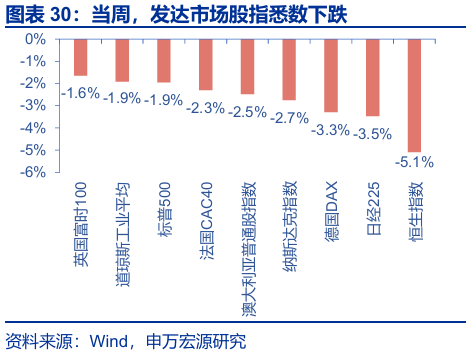
Group 1: Economic Policies and Stimulus - The U.S. announced a trade framework agreement with Argentina, Ecuador, Guatemala, and El Salvador to lower food tariffs, aiming to alleviate rising food prices due to tariffs and supply shocks [45][47] - Japan's government introduced a comprehensive economic stimulus plan worth 21.3 trillion yen, focusing on short-term subsidies, crisis management investments, and defense spending to boost GDP [64] Group 2: Market Performance - Major equity markets experienced declines, with the Hang Seng Technology Index down 7.2% and the Nasdaq down 2.7% [3][12] - The S&P 500 sectors showed mixed results, with communication services, healthcare, and consumer staples rising by 3.0%, 1.8%, and 0.8% respectively, while information technology and consumer discretionary fell by 4.7% and 3.3% [8] Group 3: Employment Data - The U.S. added 119,000 non-farm jobs in September, exceeding market expectations, but the unemployment rate rose to 4.4% [73]
X @外汇交易员
外汇交易员· 2025-11-21 03:50
Fiscal Stimulus Package - Japan's cabinet approved a 213 trillion JPY (approximately 1354 billion USD) economic stimulus package [1] - The package includes 177 trillion JPY in general expenditures [1] - The general expenditures significantly exceed last year's 139 trillion JPY, marking the largest fiscal stimulus since the pandemic [1] - The plan also incorporates 27 trillion JPY in tax cuts [1] Government Debt - New government bond issuance is expected to surpass the 669 trillion JPY used for a similar plan last year [1] Legislative Timeline - The cabinet plans to approve a supplementary budget案 as early as November 28 [1] - The government aims to secure parliamentary approval before the end of the year [1]