
地缘政治与贸易风险

Search documents
百利好丨2026年全球经济展望
Sou Hu Cai Jing· 2026-01-09 08:24
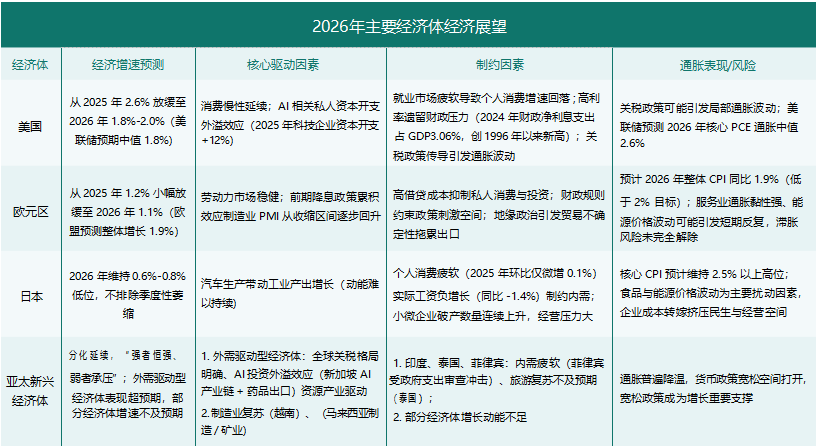
Global Economic Outlook - In 2026, the global economy is expected to continue developing under a moderate slowdown, with emerging markets gradually replacing developed economies as the key growth drivers [1] - The monetary policy will shift from accommodative to a wait-and-see approach, focusing on structural differentiation, policy window management, and tail risk control as the main strategies for 2026 [1] Economic Projections for Major Economies - The US economy is projected to slow down from 2.6% in 2025 to a range of 1.8%-2.0% in 2026, driven by chronic consumption issues and AI-related private capital expenditure [2] - The Eurozone is expected to grow at 1.1% in 2026, with manufacturing PMI gradually recovering but facing challenges from geopolitical tensions and weak personal consumption [2] - Japan's growth is anticipated to remain low, with potential quarterly fluctuations, as real wages decline and small businesses face increasing operational pressures [2] - Emerging economies in the Asia-Pacific region are showing mixed performance, with some exceeding expectations while others struggle with weak domestic demand and external pressures [2] Global Central Bank Monetary Policy Outlook - The Federal Reserve is likely to implement three rate cuts of 25 basis points each, bringing the benchmark rate down to 3.00%-3.25% [3] - The European Central Bank is expected to maintain a stable interest rate policy, with no clear plans for rate adjustments, while monitoring inflation close to the 2% target [3] - The Bank of Japan is likely to keep the benchmark rate at a low level of 0.5%, facing challenges in balancing inflation control and economic growth [3] - Emerging market central banks will continue a high-accommodation cycle, with varying policy rhythms based on local economic conditions [3] Investment Bank Perspectives - The IMF reports that global economic growth will continue to slow down moderately in 2026, with structural differentiation intensifying due to weakened growth momentum in developed economies [4] - OECD forecasts a decline in global economic growth from 3.2% in 2025 to 2.9% in 2026, with the US economy expected to slow to 1.7% [5] - The Eurozone is projected to grow only 1%, indicating a relatively weak performance compared to other regions [5] Core Risk Overview - Geopolitical and trade risks include uncertainties from global tariff restructuring and regional conflicts that could disrupt supply chains and commodity prices [6] - Financial vulnerabilities are high in the Eurozone, with rising debt levels in emerging markets potentially leading to localized financial risks during interest rate adjustments [6] - Commodity price volatility, particularly in energy and food sectors, may disrupt central bank policy rhythms due to external factors like geopolitical conflicts and extreme weather [6] Summary - Globalization is significantly impacted by tariff conflicts, leading to disruptions in global trade chains and a high probability of economic slowdown [7] - The Federal Reserve is expected to maintain a loose monetary policy, but the interplay between the Fed and the US government may heighten global financial risks [7] - Precious metals, particularly gold, are likely to benefit, with potential prices reaching between $5000-$5200, while the dollar index may decline below 90 [7] - Commodity markets show mixed signals, with energy prices struggling but potential rebounds in the second half of the year, while non-ferrous metals may rise due to increased global electricity demand and AI development [7]

国际金价单日重挫逾3%,创三个月最大跌幅,后市承压
Sou Hu Cai Jing· 2025-08-12 03:35
Core Event Overview - On August 11, gold futures on the New York Commodity Exchange fell by 2.48% (86.6 USD), closing at 3404.7 USD/ounce, marking the largest single-day drop since May 12 [1] Price Movement - Spot gold also declined, hitting a low of 3341.02 USD/ounce, with a daily drop of 1.62% [2] - Domestic gold jewelry prices followed suit, with Chow Sang Sang's gold jewelry dropping by 3 CNY per gram and Lao Miao's gold jewelry decreasing by 9 CNY per gram to 1004 CNY per gram [2] Immediate Triggers - The reversal of tariff policy was a direct catalyst, as Trump clarified on August 11 that "gold will not be subject to tariffs," eliminating confusion over the U.S. Customs' decision to impose tariffs on imported gold bars, leading to a rapid disappearance of market premiums [3] - Expectations of a ceasefire in the Russia-Ukraine conflict, with Trump scheduled to meet Putin on August 15 to discuss ending the war, significantly reduced safe-haven demand [4] Underlying Factors - Short-term bearish factors were concentrated, including a structural change in the market [5] - A liquidity imbalance in futures, with COMEX gold inventory accounting for 86% of open contracts (normal range is 40%-45%), exacerbated price volatility [5] - The largest global gold ETF (SPDR) increased its holdings by 4.58 tons on the day of the drop, indicating some investors were buying the dip [6] Future Key Variables - The Federal Reserve's policy path is crucial, with current market expectations showing a 89.4% probability of a rate cut in September. However, if CPI data exceeds expectations, it may delay the rate cut, putting pressure on gold prices [7] - Trump's nomination of Stephen Miran to the Federal Reserve Board is interpreted as a tilt towards accommodative policy, which could be beneficial for gold in the long term [8] Geopolitical and Trade Risks - The outcomes of the Russia-Ukraine talks on August 15 and the decision on U.S.-China tariff extensions (due August 12) will reshape risk sentiment [9] - U.S. tariffs on chips and pharmaceuticals (potentially up to 250%) could increase inflation and reinforce gold's anti-inflation properties [10] Influencing Logic - The clarification of tariff policies eliminated the previously inflated futures premium of 130 USD, as the arbitrage opportunity vanished [11] - Easing geopolitical risks led to reduced attractiveness of gold as a safe-haven asset amid market bets on progress in Russia-Ukraine negotiations [11] - Fluctuations in Fed rate cut expectations are influenced by the upcoming U.S. July CPI data (to be released on August 12), with a core CPI forecast of 3.0% potentially weakening the rate cut probability [11] Technical Analysis - Key support levels are at 3300 USD (psychological level) and 3289 USD (100-day moving average) [12] - Resistance levels are at 3400 USD (trendline conversion level) and 3453 USD (previous high). A breakthrough above 3400 USD could restart an upward trend [13] Long-term Logic - Central bank gold purchases provide a floor, despite Q2 global central bank gold purchases hitting a three-year low, as the demand for reserve diversification remains amid geopolitical turmoil [14] - The trend of "de-dollarization" and the expansion of the U.S. fiscal deficit support the long-term bullish outlook for gold [15] - Institutional holdings are undervalued; with a gold price of 750 CNY per gram, gold stocks have a 2025 PE of only 15 times, below the growth rate of production at 10% [16]