
全球经济展望

Search documents
第19届亚洲金融论坛在港开幕
Yang Shi Xin Wen· 2026-01-26 16:02
Group 1 - The 19th Asian Financial Forum, co-organized by the Hong Kong SAR Government and the Hong Kong Trade Development Council, aims to promote international financial cooperation and policy coordination, gathering over 150 global political and business leaders, investors, and regulatory representatives [1] - Hong Kong's Chief Executive, John Lee, emphasized that the "One Country, Two Systems" framework provides unique advantages for Hong Kong, making it a preferred location for global enterprises, with the number of companies from overseas and mainland China in Hong Kong reaching 11,070 by 2025, an 11% year-on-year increase, marking a historical high [1] - The forum's theme, "Collaborating for a Win-Win Situation Amidst Change," will introduce a new "Global Industry Summit" focusing on high-growth sectors such as artificial intelligence, robotics, biopharmaceuticals, healthcare, and renewable energy, aiming to stimulate innovation and promote sustainable economic growth through financial innovation and industry collaboration [1] Group 2 - The Hong Kong Monetary Authority and the Shanghai Gold Exchange signed a cooperation agreement to establish a high-level governance framework for a Hong Kong gold central clearing system, aiming to enhance physical infrastructure collaboration and market connectivity [1] - The People's Bank of China, represented by Deputy Governor Zou Lan, expressed strong support for the development of Hong Kong's offshore RMB market, including increasing the scale of RMB business funding arrangements and supporting the construction of an international gold trading center in Hong Kong [2] - The two-day forum will feature over 40 thematic speeches, lunch and breakfast sessions, and workshops focusing on global economic outlook, asset and wealth management, fintech, trade financing, gold and precious metals trading, and green finance [2]

专访世界经济论坛代表:期待在更多全球议题中听到中国声音
第一财经· 2026-01-18 08:26
Core Viewpoint - The World Economic Forum (WEF) 2026 Annual Meeting will focus on the theme of "spirit of dialogue," aiming to create a platform for discussions among governments, businesses, and society amidst rising geopolitical tensions and global economic uncertainties [3][6]. Group 1: Global Economic Context - The meeting will address key topics such as global growth dynamics, geopolitical issues, artificial intelligence (AI), energy security, and employment challenges [3][4]. - The agenda reflects a growing interest in China's role as the world's second-largest economy and the largest single emerging market, emphasizing the importance of integrating Chinese perspectives into global discussions [4][7]. Group 2: AI and Employment - AI will play a significant role in this year's agenda, with discussions highlighting its impact on global economic growth; for instance, nearly 40% of economic growth in the U.S. over the past year is attributed to AI-related investments [8]. - The forum will explore the relationship between productivity growth driven by AI and the challenges of job creation, particularly in emerging markets, where there is an estimated employment gap of around 800 million people [8]. Group 3: Long-term Trends and Economic Outlook - The "Global Economic Outlook" session will gather major economic thought leaders to provide insights into potential global economic directions, which are crucial for policymakers and business leaders [9][10]. - The discussions aim to offer valuable reference points for understanding the resilience of the global economy amidst uncertainties, with past predictions, such as a growth rate of 3% to 3.2% for 2025, being validated [9].

大摩2026全球展望:美国强经济推迟降息,日央行全年按兵不动,中国出口持续扩大...
Hua Er Jie Jian Wen· 2026-01-16 11:08
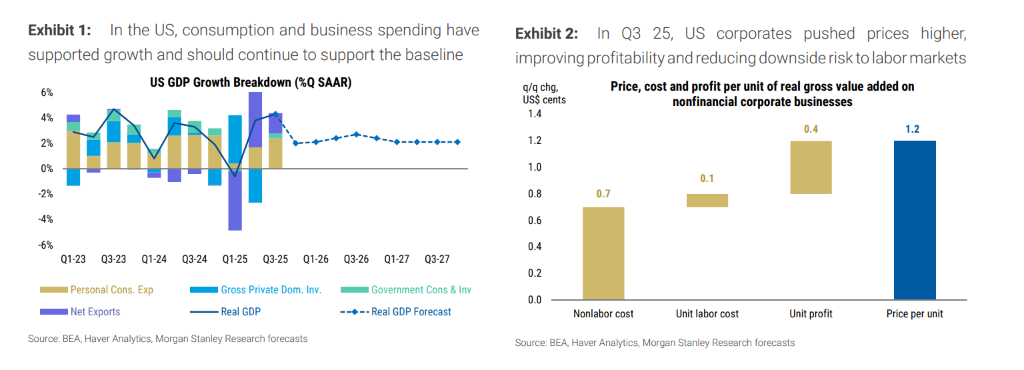
Core Viewpoint - Morgan Stanley indicates that the global economy is at a highly differentiated crossroads, with market expectations for liquidity easing potentially diverging from reality [1] Group 1: US Economic Outlook - The US economy shows a confusing yet resilient divergence, with strong consumer spending growth at an annualized rate of 3.5% despite signs of labor market weakness [2][5] - The Federal Reserve's path has been altered due to strong demand and tariff-induced inflation, leading to a significant delay in interest rate cuts to mid-2026 [5] - The resilience of the US economy poses inflation as a more pressing threat than recession, with the Fed expected to maintain restrictive rates until a clear downward trend in inflation is confirmed [1][5] Group 2: Eurozone and UK Economic Conditions - The Eurozone is experiencing stagnation, with a composite PMI decline from 52.8 to 51.9, indicating a loss of growth momentum [6] - Core inflation in the Eurozone has dropped to 2.3%, supporting the case for potential rate cuts by the European Central Bank in June and September [8] - The UK economy remains weak, with labor demand softening, and the Bank of England is likely to cut rates in February as inflation is expected to return to target levels by April 2026 [8] Group 3: Japan's Monetary Policy - Morgan Stanley's view on Japan's monetary policy contrasts with market expectations, predicting that the Bank of Japan will keep rates unchanged throughout 2026 despite prior rate hikes [9][10] - A projected decline in core CPI from 3% to 2% and political uncertainties are cited as reasons for the lack of tightening [10] Group 4: China's Economic Strategy - China is expected to increase its global export market share from 15% to 16.5% by 2030, supported by fiscal policy continuity and a rebound in PMI data [11][13] - The economy's recovery from deflation is anticipated to be slow, relying more on commodity prices than broad demand recovery [13] Group 5: Emerging Markets Dynamics - India is projected to grow at 7.4% in FY2026, driven by policy easing and strong demand, while the current rate cut cycle is seen as nearing its end [16] - Latin America is poised for a policy shift towards more market-friendly approaches, with Brazil expected to cut rates significantly while facing moderate economic slowdown [16]

全球经济在贸易与政策不确定性中展现韧性 中国2026年增长率预计为4.4%
Sou Hu Cai Jing· 2026-01-14 03:35
Global Economic Outlook - The World Bank's latest Global Economic Prospects report indicates that despite ongoing trade tensions and policy uncertainties, global economic resilience exceeds expectations, with growth rates projected to remain stable over the next two years, declining to 2.6% in 2026 and rebounding to 2.7% in 2027, an upward revision from previous forecasts [2] - China's growth rate for 2026 is expected to be 4.4%, reflecting fiscal stimulus, resilient exports, and stabilized trade policies [2] East Asia and Pacific Economic Outlook - The East Asia and Pacific region's economic growth is projected to slow from 5.0% in 2024 to 4.8% in 2025, with China's growth expected to decelerate to 4.9%, supported by fiscal stimulus and resilient exports, although real estate investment continues to contract [3] - By 2026, the region's growth rate is expected to decline to 4.4%, primarily due to slowing growth in China, while growth outside of China is projected to slightly decrease to 4.5% in 2026 before rebounding to 4.7% in 2027 [3] Developing Economies - Growth in developing economies is anticipated to slow from 4.2% in 2025 to 4% in 2026, with a potential recovery to 4.1% in 2027, while low-income countries are expected to grow faster, averaging 5.6% during 2026-2027 due to solid domestic demand and export recovery [4] - The income gap between developing and developed economies remains significant, with per capita income growth in developing economies projected at 3%, which is about 1 percentage point lower than the average from 2000-2019, resulting in per capita income being only 12% of that in developed economies [4]

高盛闭门会-亚洲和中国经济2026展望-中国印度引领增长日本-闪辉谈中国新增长和结构性转型
Goldman Sachs· 2026-01-12 01:41
Investment Rating - The report maintains an optimistic outlook for global economic growth in 2026, projecting a growth rate of 2.8%, which is above the market consensus of 2.5% [2] Core Insights - The report highlights that the global economic growth in 2026 will benefit from a loose financial environment, reduced policy uncertainty, AI investments, and fiscal stimulus from tax and spending legislation passed in 2025 [1][2] - It emphasizes the resilience of the Indian economy, forecasting a GDP growth rate of 6.7% for 2026, which is higher than global consensus expectations [10] - The report notes that China needs to find new growth engines beyond real estate and expand into emerging markets outside the U.S., with actual export growth expected to remain at 5% to 6% annually [6][14] Summary by Sections Global Economic Outlook - The global economic growth is expected to exceed market consensus, driven by a favorable financial environment and AI investments [1][2] - Inflation pressures in emerging markets are anticipated to ease, aided by falling oil prices and reduced food price pressures [1] U.S. Economic and Policy Outlook - The Federal Reserve is expected to lower interest rates twice in the first half of 2026, supported by fiscal stimulus from the 2025 tax and spending legislation [3][2] Asian Economic Conditions - The report expresses optimism about the overall economic situation in Asia, with median and average growth rates around 5% [4] - It highlights strong performance in AI chip exports from China and India, which is expected to exceed market consensus [4] China’s Economic Transition - China is projected to maintain a 5% to 6% annual growth in actual exports, with a current account surplus expected to rise to 4.2% of GDP [6][14] - The "14th Five-Year Plan" focuses on integrating AI with manufacturing and modern industrial infrastructure, indicating a sustained investment in AI technologies [15] Japan’s Economic Outlook - Japan's growth rate is forecasted at 0.8% for 2026, supported by rising wages and easing inflation [7] - The Bank of Japan may accelerate interest rate hikes, with a potential increase of 25 basis points in July 2026 [7] India’s Economic Trends - India is expected to show strong resilience with a projected GDP growth rate of 6.7% for 2026, driven by rural and urban consumption recovery [10][12] - The Reserve Bank of India has implemented measures to support economic growth, including interest rate cuts and liquidity measures [9]


百利好丨2026年全球经济展望
Sou Hu Cai Jing· 2026-01-09 08:24
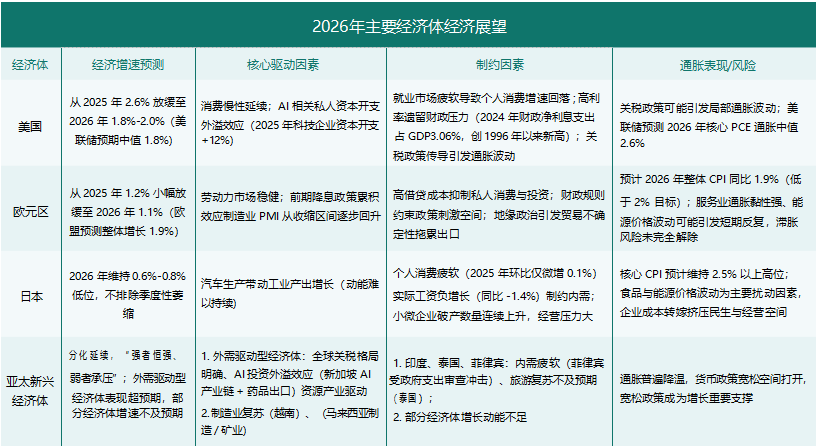
Global Economic Outlook - In 2026, the global economy is expected to continue developing under a moderate slowdown, with emerging markets gradually replacing developed economies as the key growth drivers [1] - The monetary policy will shift from accommodative to a wait-and-see approach, focusing on structural differentiation, policy window management, and tail risk control as the main strategies for 2026 [1] Economic Projections for Major Economies - The US economy is projected to slow down from 2.6% in 2025 to a range of 1.8%-2.0% in 2026, driven by chronic consumption issues and AI-related private capital expenditure [2] - The Eurozone is expected to grow at 1.1% in 2026, with manufacturing PMI gradually recovering but facing challenges from geopolitical tensions and weak personal consumption [2] - Japan's growth is anticipated to remain low, with potential quarterly fluctuations, as real wages decline and small businesses face increasing operational pressures [2] - Emerging economies in the Asia-Pacific region are showing mixed performance, with some exceeding expectations while others struggle with weak domestic demand and external pressures [2] Global Central Bank Monetary Policy Outlook - The Federal Reserve is likely to implement three rate cuts of 25 basis points each, bringing the benchmark rate down to 3.00%-3.25% [3] - The European Central Bank is expected to maintain a stable interest rate policy, with no clear plans for rate adjustments, while monitoring inflation close to the 2% target [3] - The Bank of Japan is likely to keep the benchmark rate at a low level of 0.5%, facing challenges in balancing inflation control and economic growth [3] - Emerging market central banks will continue a high-accommodation cycle, with varying policy rhythms based on local economic conditions [3] Investment Bank Perspectives - The IMF reports that global economic growth will continue to slow down moderately in 2026, with structural differentiation intensifying due to weakened growth momentum in developed economies [4] - OECD forecasts a decline in global economic growth from 3.2% in 2025 to 2.9% in 2026, with the US economy expected to slow to 1.7% [5] - The Eurozone is projected to grow only 1%, indicating a relatively weak performance compared to other regions [5] Core Risk Overview - Geopolitical and trade risks include uncertainties from global tariff restructuring and regional conflicts that could disrupt supply chains and commodity prices [6] - Financial vulnerabilities are high in the Eurozone, with rising debt levels in emerging markets potentially leading to localized financial risks during interest rate adjustments [6] - Commodity price volatility, particularly in energy and food sectors, may disrupt central bank policy rhythms due to external factors like geopolitical conflicts and extreme weather [6] Summary - Globalization is significantly impacted by tariff conflicts, leading to disruptions in global trade chains and a high probability of economic slowdown [7] - The Federal Reserve is expected to maintain a loose monetary policy, but the interplay between the Fed and the US government may heighten global financial risks [7] - Precious metals, particularly gold, are likely to benefit, with potential prices reaching between $5000-$5200, while the dollar index may decline below 90 [7] - Commodity markets show mixed signals, with energy prices struggling but potential rebounds in the second half of the year, while non-ferrous metals may rise due to increased global electricity demand and AI development [7]
摩根大通2026年全球经济展望:65%概率扩张,35%概率衰退
Xin Lang Cai Jing· 2025-12-23 07:31
Core Viewpoint - The article does not provide specific insights or data regarding any company or industry, focusing instead on the editorial aspect without substantial content [1]. Group 1 - No relevant company or industry information is available in the document [1].

野村:2026年全球经济有望强劲增长 预计美联储将额外降息两次
Sou Hu Cai Jing· 2025-12-22 12:06
Core Viewpoint - Nomura's 2026 Global Economic Outlook report expresses optimism for the global economy, driven by AI-led investment and supportive monetary and fiscal policies [1] Group 1: Economic Growth Projections - The U.S. is projected to have a real GDP growth rate of 2.4% in 2026, supported by easing labor supply pressures and accelerated AI-driven business investments [1] - AI infrastructure investments are expected to contribute approximately 1% to 1.5% growth to the U.S. economy annually [1] - The unemployment rate in the U.S. is anticipated to decline to 4.0% in 2026, lower than the Federal Reserve's or market's expectations [1] Group 2: Inflation and Monetary Policy - U.S. inflation is expected to remain sticky, averaging closer to 3% throughout 2026, with a significant decline only anticipated in the fourth quarter [1] - The current interest rate cut cycle by the Federal Reserve is considered over, with two additional rate cuts expected in 2026, bringing the federal funds rate down to 3.125% by September [2] Group 3: Regional Economic Outlook - Europe is projected to maintain a GDP growth rate of 1.25% in 2026, with the European Central Bank expected to keep its policy unchanged [2] - Asia's GDP growth is forecasted to average 3.6% in 2026, supported by strong tech product exports and rising storage chip prices [2] - Economic growth in Asia will show divergence, with countries like South Korea, Singapore, Malaysia, and India likely to exceed market expectations, while Thailand and the Philippines may underperform [2] Group 4: AI and Commodity Markets - Concerns about an "AI bubble" are acknowledged, with the focus on whether investments in AI will yield reasonable returns [3] - The AI investment trend is expected to continue into 2026, with significant initial investments and the importance of first-mover advantages [3] - Various commodities, including precious metals and agricultural products, are anticipated to perform strongly in 2026, driven by increasing demand [3]
全球经济展望及投资策略
工银国际· 2025-11-24 12:04
Global Economic Outlook - The global economy is at a critical inflection point with the Federal Reserve restarting its interest rate cut cycle[10] - Geopolitical tensions, tech rivalries, and tightening U.S. fiscal conditions are significant challenges[10] - Risk assets are experiencing increased volatility due to stretched valuations[10] China Economic Insights - China's economy is navigating through complex environments, achieving steady growth under the "14th Five-Year Plan"[10] - The "15th Five-Year Plan" will further unleash China's economic potential through industrial upgrades and technological innovation[11] - Hong Kong's capital market has shown robust recovery, with the Hang Seng Index leading global performance and IPO fundraising reclaiming the top position[10] Investment Strategy - Hong Kong is positioned as a key gateway for global capital allocation into Chinese assets, enhancing its role as a "super-connector" and "super value-adder"[11] - The convergence of internal and external forces will spotlight China's strategic advantage in value investing[11] - The ongoing capital market reforms and expansion of interconnection programs will bolster Hong Kong's financial market status[11]
2026年全球经济展望:在混沌中构建秩序
工银国际· 2025-11-18 12:00
Economic Outlook - Global economic growth is projected at 3.2% for 2025 and 3.1% for 2026, an improvement from earlier forecasts of 2.8% and 3.0% respectively[3] - The growth forecast for 2026 has been downgraded by nearly 0.2 percentage points compared to October 2024, indicating a phase of moderate growth intertwined with high uncertainty[3] Structural Changes - The global economy is experiencing a shift from a linear trajectory to a complex system characterized by non-linearity, path dependence, and adaptability[2] - External shocks, such as the pandemic and geopolitical tensions, have disrupted the global order, leading to a divergence in economic cycles among major economies[3] Market Sensitivity - The sensitivity of the economic system to disturbances has significantly increased, resulting in heightened instability yet retaining resilience[2] - Financial markets are reacting more rapidly to policy signals, creating a feedback loop that can amplify economic fluctuations[5] Policy Implications - Fiscal policy is expected to take precedence over monetary policy in driving economic growth, as high debt levels limit the effectiveness of interest rate adjustments[13] - The anticipated monetary policy for the U.S. is to maintain a neutral rate around 3.00% to 3.25% by the end of 2026, with inflation projected at 2.9%[26] Regional Insights - The U.S. economy is expected to grow at 1.8% in 2026, with inflation remaining a concern due to external cost pressures[20] - The Eurozone is projected to grow at approximately 1.1% in 2026, with inflation expected to stabilize around 1.8%[20] - Japan's growth is forecasted at 0.7% for 2026, with inflation anticipated to be around 1.8%[26] Emerging Markets - Emerging markets are expected to maintain relatively robust growth, supported by service sector expansion and domestic consumption recovery[24] - However, these markets face challenges from high external financing costs and potential geopolitical tensions impacting supply chains[24]