外汇储备重构

Search documents
金价跌破4600美元是洗盘 4900是下一目标
Jin Tou Wang· 2026-02-02 06:11
Core Viewpoint - Gold prices have significantly declined after reaching historical highs, driven by a recovery in market risk appetite and changes in expectations regarding U.S. monetary policy and political uncertainty [1][2] Group 1: Market Dynamics - The nomination of Kevin Warsh as the next Federal Reserve Chair by Trump has led to a rapid decrease in expectations for aggressive monetary easing, which is seen as a key signal reducing political interference in monetary policy [1] - As the credibility of Federal Reserve policies stabilizes, the relative attractiveness of gold as a non-yielding asset has decreased, leading to profit-taking among long positions and downward pressure on gold prices [2] Group 2: Geopolitical Factors - Tensions between the U.S. and Iran have escalated, with Iran warning that any military action would be considered the start of war, while the U.S. has increased its military presence in the Persian Gulf [2] - The ongoing geopolitical risks continue to reinforce gold's status as a "super-sovereign safe-haven asset" [2] Group 3: Central Bank Activity - In 2025, global central bank net gold purchases reached 863 tons, a record high, with the trend of increasing gold holdings continuing into 2026 [2] - Countries like China, India, and Poland are increasing their gold reserves, providing a long-term buffer against downward pressure on gold prices [2] Group 4: Technical Analysis - After a rapid rise to historical highs, gold has entered a technical correction phase, which is seen as a necessary adjustment to the previous overextension [3] - Key support is identified around $4600, and if maintained, gold prices may stabilize; however, a return above $4900 is needed to resume a bullish trend [3] - The current market correction is primarily a response to the stabilization of Federal Reserve personnel expectations, leading to a decrease in the pricing of extreme monetary easing and institutional risks [3]
【2026年汇市展望】2025年欧元强势反弹13% 未来却仍深存结构性风险
Xin Lang Cai Jing· 2026-01-14 08:18
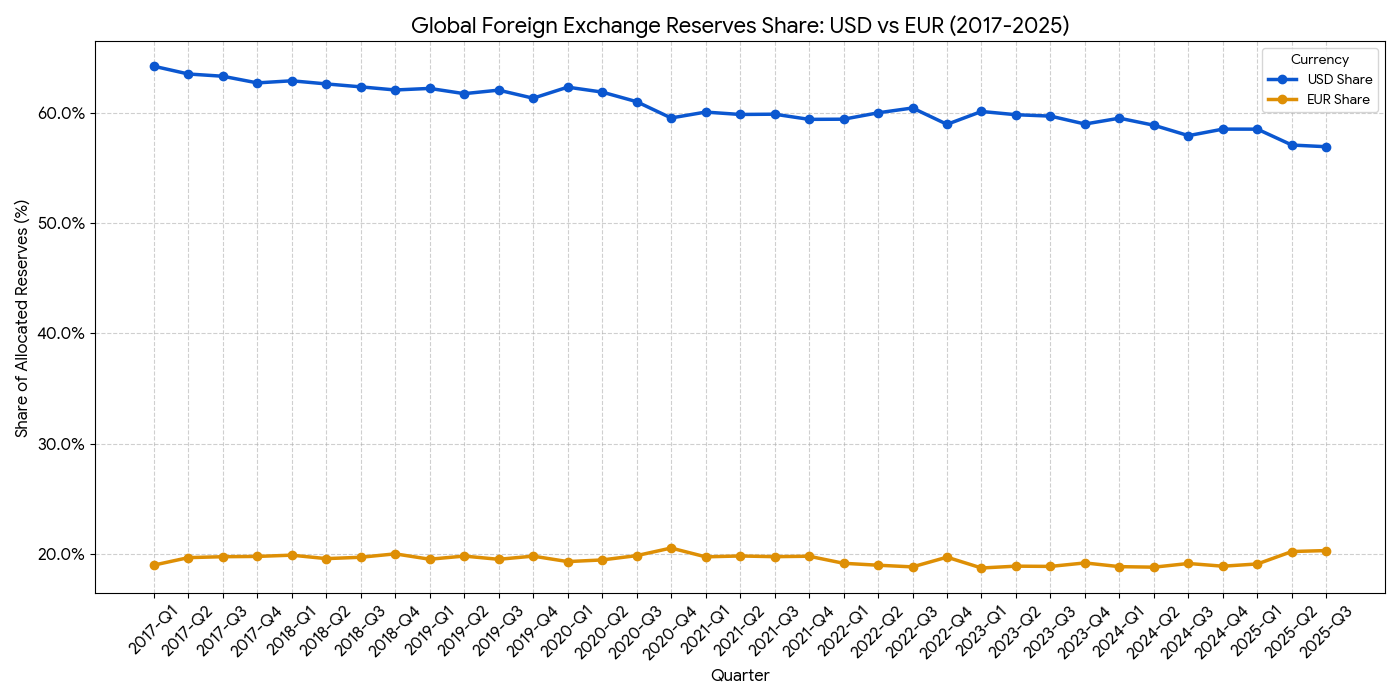
Group 1: Core Insights - The international monetary system is undergoing structural changes due to high interest rates, fiscal sustainability debates, and geopolitical conflicts, leading to a reassessment of "safe assets" like U.S. Treasury bonds [1] - Global official gold reserves surpassed the value of foreign-held U.S. Treasury bonds for the first time in Q2 2025, with gold spot prices increasing nearly 70% [1] - The share of the U.S. dollar in global foreign exchange reserves fell to 56.92% by Q3 2025, marking a 30-year low and indicating a search for a new balance in the global reserve system [2] Group 2: Euro's Position - The euro's share in global foreign exchange reserves reached 20.33% by Q3 2025, maintaining its position as the second-largest reserve currency [3] - The euro's strength against the dollar increased by 13% in 2025, closing the year at 1.16-1.17, despite underlying structural issues within the eurozone [8] - The European Central Bank's monetary policy has diverged from the U.S. Federal Reserve, with the ECB cutting rates multiple times while the Fed also lowered rates, contributing to the euro's appreciation [10] Group 3: Economic Outlook - The eurozone's GDP growth forecast for 2025 was downgraded to 1.3%, with Germany's growth expected to be only 0.3%, highlighting economic vulnerabilities [11] - Significant fiscal measures, such as Germany's €500 billion infrastructure fund and the EU's €800 billion rearmament plan, are seen as crucial for the euro's long-term valuation, though their short-term effectiveness is questioned [11] - Predictions for the euro's exchange rate against the dollar in 2026 vary, with estimates ranging from 1.10 to 1.25, influenced by interest rate differentials and economic recovery [12][13]