
美欧货币政策分化

Search documents
【2026年汇市展望】2025年欧元强势反弹13% 未来却仍深存结构性风险
Xin Lang Cai Jing· 2026-01-14 08:18
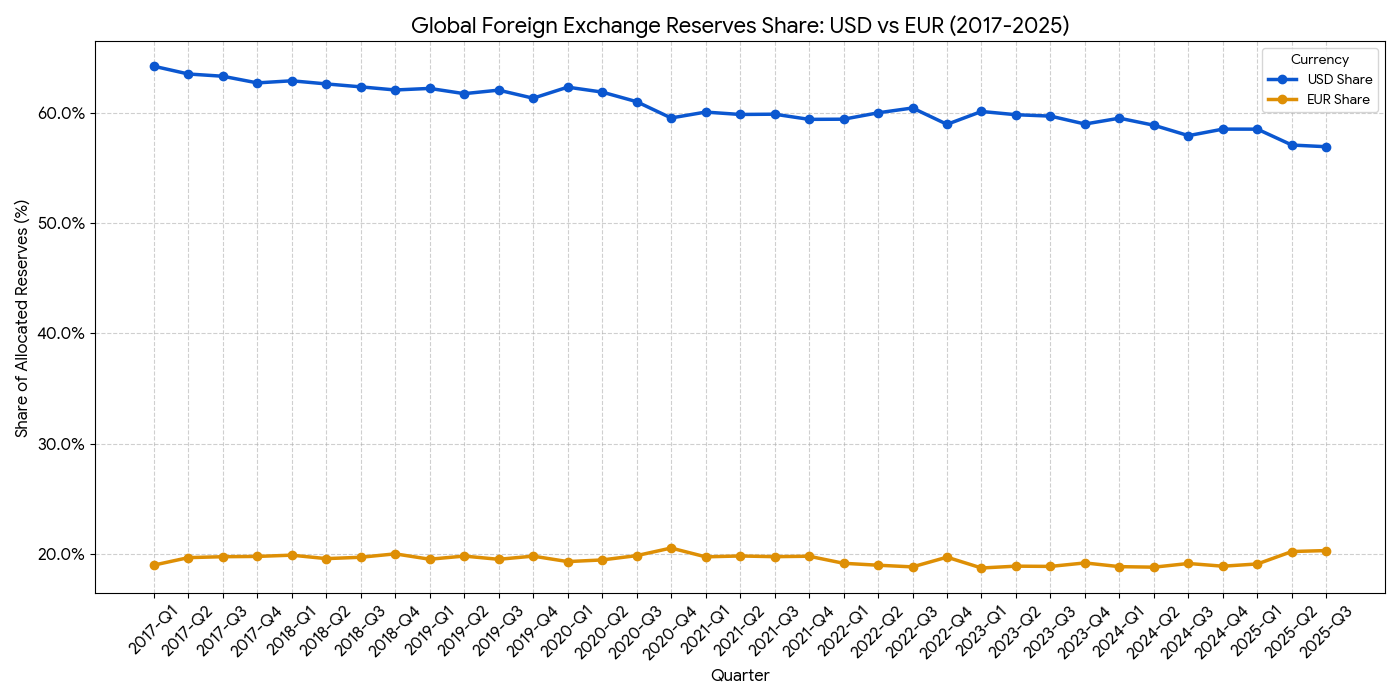
Group 1: Core Insights - The international monetary system is undergoing structural changes due to high interest rates, fiscal sustainability debates, and geopolitical conflicts, leading to a reassessment of "safe assets" like U.S. Treasury bonds [1] - Global official gold reserves surpassed the value of foreign-held U.S. Treasury bonds for the first time in Q2 2025, with gold spot prices increasing nearly 70% [1] - The share of the U.S. dollar in global foreign exchange reserves fell to 56.92% by Q3 2025, marking a 30-year low and indicating a search for a new balance in the global reserve system [2] Group 2: Euro's Position - The euro's share in global foreign exchange reserves reached 20.33% by Q3 2025, maintaining its position as the second-largest reserve currency [3] - The euro's strength against the dollar increased by 13% in 2025, closing the year at 1.16-1.17, despite underlying structural issues within the eurozone [8] - The European Central Bank's monetary policy has diverged from the U.S. Federal Reserve, with the ECB cutting rates multiple times while the Fed also lowered rates, contributing to the euro's appreciation [10] Group 3: Economic Outlook - The eurozone's GDP growth forecast for 2025 was downgraded to 1.3%, with Germany's growth expected to be only 0.3%, highlighting economic vulnerabilities [11] - Significant fiscal measures, such as Germany's €500 billion infrastructure fund and the EU's €800 billion rearmament plan, are seen as crucial for the euro's long-term valuation, though their short-term effectiveness is questioned [11] - Predictions for the euro's exchange rate against the dollar in 2026 vary, with estimates ranging from 1.10 to 1.25, influenced by interest rate differentials and economic recovery [12][13]

欧洲央行利率稳定欧元走强
Jin Tou Wang· 2025-12-24 03:01
Core Viewpoint - The Euro is strengthening against the US Dollar due to the divergence in monetary policies between the European Central Bank (ECB) and the Federal Reserve (Fed), with the ECB maintaining stable interest rates while the Fed continues its easing policy [1][2]. Group 1: ECB's Policy and Economic Outlook - The ECB decided to keep the Eurozone deposit facility rate at 2.00%, the main refinancing rate at 2.15%, and the marginal lending rate at 2.40%, marking the sixth consecutive pause in rate cuts since July 2025 [1]. - The Eurozone economy and inflation are stabilizing, with core inflation gradually approaching the 2% medium-term target and a slight economic recovery observed in the first three quarters [1]. - The ECB's latest forecast indicates that inflation rates will stabilize near the target range over the next two years, providing a foundation for policy stability [1]. Group 2: Fed's Easing Policy and Market Sentiment - The Fed lowered the federal funds rate target range by 25 basis points to 3.5%-3.75%, marking the third consecutive cut since September 2025 and a total reduction of 75 basis points for the year [2]. - There is a divergence in market expectations regarding the Fed's future policy, with some institutions predicting further rate cuts while others believe the current rate is appropriate [2]. - The contrasting monetary policies between the Fed and the ECB are expected to continue benefiting the Euro [2]. Group 3: Market Predictions and Technical Analysis - Market sentiment is leaning towards Euro bullishness, with Goldman Sachs predicting the Euro to rise to 1.25 against the Dollar in the next 12 months, and JPMorgan forecasting a rise to 1.22 by March 2026 [3]. - The bullish outlook is supported by three main factors: the persistent divergence in monetary policies, the relatively high valuation of the Dollar, and stronger-than-expected economic resilience in the Eurozone [3]. - Technically, the Euro has established a bullish trend after stabilizing above the 1.17 level, with key support between 1.1750-1.1780 and resistance at 1.1850 [4].
美欧货币政策愈显分化
Sou Hu Cai Jing· 2025-12-21 19:53
Core Viewpoint - The European Central Bank (ECB) decided to maintain its key interest rates unchanged, reflecting market expectations amid geopolitical tensions, energy price fluctuations, and changes in the global trade environment, which contribute to significant uncertainty in the European economy and inflation outlook [1][2]. Group 1: Monetary Policy Decisions - The ECB's deposit facility rate, main refinancing rate, and marginal lending rate remain at 2.00%, 2.15%, and 2.40% respectively [1]. - The ECB's current neutral policy stance is evident as it has kept rates unchanged for four consecutive meetings, contrasting with the U.S. Federal Reserve's three rate cuts [2][3]. Group 2: Economic Forecasts - The ECB forecasts that the overall inflation rate in the Eurozone will be 1.9% in 2026 and 1.8% in 2027, both slightly below the 2% medium-term target, with a rebound to 2.0% expected in 2028 [2]. - Economic growth in the Eurozone is projected to be 1.4% in 2025, 1.2% in 2026, and 1.4% in both 2027 and 2028, with domestic demand expected to be the main growth driver [2]. Group 3: Risks and Challenges - The ongoing geopolitical tensions and a challenging global trade environment may hinder economic growth in the Eurozone over the next two years [2]. - The divergence in monetary policy between the ECB and the Federal Reserve could lead to a stronger euro, which may negatively impact the competitiveness of Eurozone exports and exert pressure on economic growth [3].
综述|欧洲央行“按兵不动” 美欧货币政策愈显分化
Sou Hu Cai Jing· 2025-12-19 07:01
Group 1 - The European Central Bank (ECB) decided to keep the three key interest rates unchanged, aligning with market expectations, amidst geopolitical tensions, energy price fluctuations, and changes in the global trade environment [1] - ECB President Christine Lagarde highlighted that the uncertain international environment could disrupt supply chains and suppress exports, leading to potential impacts on consumption and investment [1][2] - The divergence in monetary policy between the US and Europe is widening, which may weaken the competitiveness of Eurozone exports and create ripple effects on the global economy [1][3] Group 2 - Lagarde noted the significant potential of artificial intelligence (AI) in enhancing productivity and driving economic transformation, although it is premature to assess its impact on inflation and economic growth [2] - The ECB's latest forecasts indicate that the Eurozone's overall inflation rate is expected to be 1.9% in 2026 and 1.8% in 2027, slightly below the 2% medium-term target, with a rebound to 2.0% anticipated in 2028 [2] - Economic growth in the Eurozone is projected to be 1.4% in 2025, 1.2% in 2026, and 1.4% in both 2027 and 2028, with domestic demand expected to be the main growth driver [2] Group 3 - The true risk for the European economy lies in controlling inflation, with structural constraints on the supply side being a significant concern [3] - The ECB's neutral policy stance contrasts with the US Federal Reserve's recent rate cuts, which may lead to changes in exchange rates, capital flows, and trade channels affecting the global economy [3] - The potential strengthening of the Euro due to interest rate differentials poses a risk to Eurozone export competitiveness, thereby impacting economic growth [3]
综述丨欧洲央行“按兵不动” 美欧货币政策愈显分化
Xin Hua Wang· 2025-12-19 06:38
Group 1 - The European Central Bank (ECB) decided to keep the three key interest rates unchanged at 2.00%, 2.15%, and 2.40%, aligning with market expectations amid geopolitical tensions and economic uncertainties [1] - ECB President Christine Lagarde highlighted that the ongoing international turmoil could disrupt supply chains and suppress exports, leading to uncertainties in inflation and economic growth [1][2] - The divergence in monetary policy between the US and Europe is widening, with the ECB maintaining a neutral stance while the Federal Reserve has implemented rate cuts, potentially impacting global economic dynamics through exchange rates and trade [3] Group 2 - Lagarde noted the potential of artificial intelligence to enhance productivity and drive economic transformation, but emphasized that it is premature to assess its impact on inflation and economic growth [2] - The ECB's latest forecasts indicate that the eurozone's inflation rate is expected to be 1.9% in 2026 and 1.8% in 2027, slightly below the 2% medium-term target, with a projected rebound to 2.0% in 2028 [2] - Economic growth in the eurozone is projected to be 1.4% in 2025, 1.2% in 2026, and 1.4% in both 2027 and 2028, with domestic demand expected to be the main growth driver despite challenges from global trade [2]
政策分化定调走势 欧元区经济温和复苏
Jin Tou Wang· 2025-12-14 03:21
Core Viewpoint - The article discusses the impact of the Federal Reserve's recent interest rate cut on the Euro against the US Dollar, highlighting the divergence in monetary policies between the US and the Eurozone as a key driver for the Euro's strength [1][2]. Group 1: US Monetary Policy - The Federal Reserve completed its third interest rate cut of the year on December 12, 2025, with a 9:3 voting split indicating a heated debate between hawkish and dovish members [1]. - Despite the rate cut being accompanied by a "hawkish signal," the market anticipates continued easing in 2026, leading to a short-term decline in the US Dollar index [1]. - The Fed's decision to restart the purchase of $40 billion in short-term Treasury bonds, interpreted as implicit easing, has further pressured the Dollar [1]. Group 2: Eurozone Economic Resilience - The European Union forecasts a GDP growth of 1.3% for the Eurozone in 2025, with a notable acceleration in the third quarter and strong performances from economies like France and Spain [1]. - The unemployment rate in the Eurozone remains at historically low levels, and consumer recovery is supporting the economic fundamentals [1]. - The European Central Bank (ECB) has maintained interest rates steady for three consecutive meetings, with President Lagarde stating that current rates are "appropriate," indicating a likelihood of no changes in December [1]. Group 3: Inflation and Export Pressures - The Euro's ascent faces dual constraints: inflation risks, with the Eurozone's core inflation at 2.4% in November, and potential downward pressure on inflation from a stronger Euro [2]. - Export pressures are heightened as the Euro is at a trade-weighted high, complicating the situation for German companies and increasing external uncertainties due to global trade barriers and rising tariffs on exports to the US [2]. Group 4: Technical Analysis and Market Sentiment - The Euro has stabilized above the 60-day moving average, forming an upward trend line, but is approaching a dense trading zone between 1.16 and 1.17, leading to increased market caution and reduced trading volume [2]. - A breakout above this range could confirm an upward trend, while failure to do so may trigger profit-taking and test the lower bounds of the trading range [2]. Group 5: Upcoming Events - Key upcoming events include the ECB's year-end meeting on December 18, where economic and inflation forecasts will be discussed, and the Federal Reserve's officials' speeches and US economic data releases to clarify the pace of Dollar easing [2]. - Predictions suggest that the Fed's rate cuts will slow in 2026 while the ECB is likely to maintain its current stance, which could lead to continued strength in the Euro against the Dollar by year-end [2].
每日机构分析:10月10日
Zhong Guo Jin Rong Xin Xi Wang· 2025-10-10 11:38
Group 1 - The Swedish Nordea Bank suggests that the market's expectation of over 100 basis points rate cuts by the Federal Reserve by the end of 2026 may be overly aggressive, considering inflation risks [1] - The French bank Société Générale indicates that the yield spread between French and German 10-year bonds may stabilize around 80 basis points, but political risks could widen this spread if the French government collapses [1] - Citigroup believes that the U.S. government shutdown could mask real risks and delay market reactions, while the outlook for the euro against the dollar may improve significantly once French political turmoil subsides and U.S. interest rates face downward pressure [3] Group 2 - Bridgewater's founder Ray Dalio warns that the rising U.S. debt relative to income will severely squeeze government and other sectors' spending capabilities, posing a threat to the global monetary order [2] - Analysts from Pantheon Macroeconomics predict that Germany may have entered a technical recession due to trade uncertainties and declining industrial production, with preliminary GDP data expected by the end of the month [3] - Analysts from China International Capital Corporation (CICC) state that the Federal Reserve's resumption of rate cuts in September marks a new phase of dollar easing, prioritizing growth over inflation control due to rising employment risks [3]
