
多能互补发展

Search documents
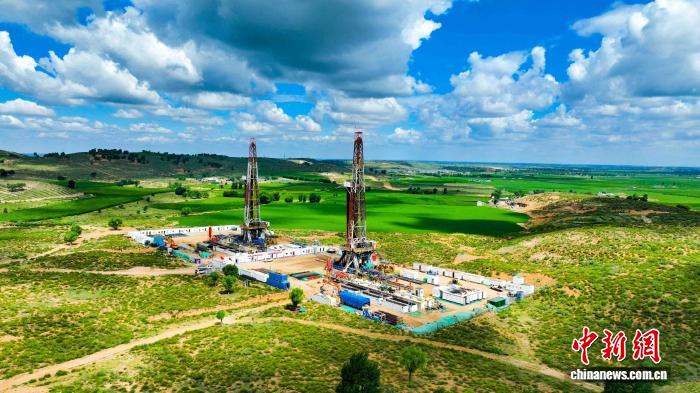
中国第一大油气田五年生产油气当量超3亿吨
Zhong Guo Xin Wen Wang· 2026-01-08 13:24
Core Insights - China's largest oil and gas field, Changqing Oilfield, is projected to produce over 300 million tons of oil and gas equivalent from 2021 to 2025, demonstrating strong operational momentum [1][3]. Group 1: Production and Development - Changqing Oilfield has addressed the challenges of low permeability, low pressure, and low abundance in oil and gas reservoirs through in-depth research on oil and gas distribution patterns [1]. - The oilfield has established five oil-rich areas with a scale of ten billion tons and five gas-rich areas with a scale of trillion cubic meters, laying a solid resource foundation for increased production [1][3]. - The gas field's comprehensive decline rate has been reduced to 19.5%, with stable annual natural gas production capacity maintained at 50 billion cubic meters [3]. Group 2: Technological Advancements - Changqing Oilfield has implemented key projects focusing on low-permeability oil extraction technology and has enhanced the management of aging wells [3]. - The oilfield has built China's largest shale oil production base, achieving over 300,000 tons of growth for five consecutive years, with a historical high expected in shale oil production by 2025 [3]. Group 3: Environmental Initiatives - Over the past five years, Changqing Oilfield has proactively shut down more than 14,000 oil and gas wells and has given up 460,000 tons of oil and gas equivalent in ecologically sensitive areas [3]. - The oilfield has planted over 2.1 million trees and established 2,900 solar power stations, with a total installed capacity of 364,000 kilowatts and cumulative power generation exceeding 1.1 billion kilowatt-hours, promoting a multi-energy complementary development model [3]. Group 4: Contribution to Energy Security - Changqing Oilfield has maintained a stable production of over 60 million tons of oil and gas equivalent for six consecutive years, providing a solid guarantee for China's energy security [3].

突破1亿千瓦:四川水电装机规模创新纪录
Xin Hua She· 2025-12-19 02:58
Core Insights - Sichuan province has become the first in China to surpass 100 million kilowatts in hydropower installed capacity, accounting for approximately one-fourth of the national total and equivalent to about 4.4 Three Gorges dams [1][2] Group 1: Hydropower Development - The last unit of the Yinjing Hydropower Station was successfully connected to the grid on December 19, marking a significant milestone in Sichuan's hydropower development [1] - Sichuan's hydropower development has a history of over 100 years, with the first hydropower station built in 1925 [1] - Major projects such as the Baihetan and Wudongde hydropower stations have been completed in recent years, showcasing advancements in high-end equipment manufacturing [1] Group 2: Energy Transmission and Environmental Impact - Sichuan is a key base for the "West-to-East Power Transmission" initiative, with approximately one-third of its annual electricity generation exported to other provinces [1] - Since 1998, Sichuan has delivered over 1.9 trillion kilowatt-hours of clean energy to regions such as Central and Eastern China, equivalent to the annual electricity consumption of Jiangsu, Zhejiang, and Anhui provinces combined [1] - The Yinjing Hydropower Station has a total installed capacity of 390,000 kilowatts and is expected to deliver over 1.6 billion kilowatt-hours of clean energy annually, reducing carbon dioxide emissions by 1.3 million tons [2] Group 3: Future Energy Strategy - Sichuan is accelerating the planning and construction of a new energy system that promotes the complementary development of hydropower, wind, solar, hydrogen, and natural gas [2] - The province aims to transition from merely generating power to stabilizing and optimizing its energy system, enhancing its role in supporting national carbon neutrality goals [2]
太阳能行业双周报:能源局推动新能源入市 加快136号文落地
Xin Lang Cai Jing· 2025-07-28 00:32
Group 1 - The core viewpoint of the report indicates that the photovoltaic industry is experiencing steady policy advancement, with rising prices for silicon materials, silicon wafers, and batteries, while the sector remains undervalued [1][2]. Group 2 - The National Energy Administration is promoting the implementation of the "Document 136" to enhance the ability of renewable energy to participate in the market, addressing issues such as irrational competition and power consumption conflicts [2]. - Silicon material prices have continued to rise, with stable long-term transactions and some companies controlling production, leading to price increases [2]. - The average price of polysilicon dense material is 42.0 RMB/kg, up 5.0 RMB/kg; N-type 182 silicon wafers average 1.10 RMB/piece, up 0.10 RMB/piece; PERC battery 182 averages $0.037/W, up $0.003/W [3]. Group 3 - The photovoltaic sector's recent weekly performance shows a 2.61% increase, outperforming the CSI 300 index by 0.70 percentage points, while the year-to-date performance is a 3.32% increase, underperforming the CSI 300 index by 4.57 percentage points [4]. - As of July 25, 2025, the TTM overall valuation of the photovoltaic sector is 20.23 times, ranking in the lower middle compared to other sectors [4]. - The valuation trend indicates a continuous decline from the end of 2021 to the end of 2023, with a gradual increase starting in early 2024 [4].
