大模型适配

Search documents
龙虾最佳适配模型,OpenClaw之父给出了推荐
量子位· 2026-03-09 04:13
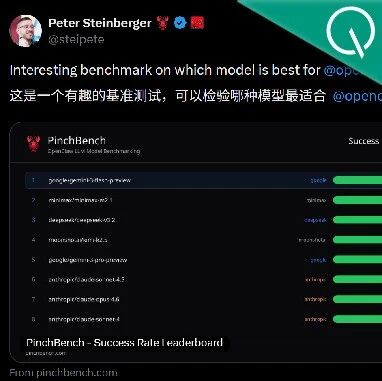
Core Insights - The article discusses the rising popularity of lobster-related AI models and the challenges in selecting the most suitable model for OpenClaw, with a recommendation to refer to the PinchBench ranking system [1][3]. Group 1: PinchBench Overview - PinchBench is a benchmark specifically designed for evaluating AI models based on their success rate, speed, and cost, providing real-time updates [3][6]. - The benchmark has gained traction since its introduction in February, particularly due to the impressive performance of Chinese models [3][20]. - The ranking highlights that Chinese models excel in success rate and speed, although they lag behind in pricing compared to models from OpenAI and Google [7][15]. Group 2: Model Performance - The top three models in terms of success rate are: 1. Google Gemini 3 Flash with a success rate of 95.1% 2. MiniMax M2.1 with a success rate of 93.6% 3. Kimi K2.5 with a success rate of 93.4% [11]. - In terms of speed, MiniMax M2.5 outperformed other models, achieving the fastest completion time of 105.96 seconds [12][10]. - However, in pricing, the cheapest model from OpenAI, GPT-5-nano, offers significantly lower costs compared to the MiniMax models, with input prices at $0.05 per million tokens versus MiniMax M2.1's $2.1 [15][17]. Group 3: Evaluation Methodology - PinchBench employs a combination of automated checks and LLM evaluations to assess model performance across various real-world tasks, focusing on the ability to complete entire workflows rather than just answering questions [25][29]. - The benchmark includes 23 real tasks across categories such as productivity, research, writing, coding, analysis, email management, memory, and skills [26][28]. - The results indicate that larger models do not always outperform smaller, more efficient models, which has sparked discussions within the community [31][32].

摩尔线程2025年实现营业收入超15亿元 同比增长243.37%
Zheng Quan Ri Bao Wang· 2026-02-28 03:47
Core Viewpoint - In 2025, Moole Technology achieved significant revenue growth and improved financial metrics despite a net loss, indicating a positive development trend in the company's operations [1] Financial Performance - Moole Technology reported a revenue of 1.505 billion yuan in 2025, representing a year-on-year increase of 243.37% [1] - The net profit attributable to the parent company was -1.024 billion yuan, showing a narrowed loss compared to the previous year [1] - Basic earnings per share and weighted average return on net assets both improved year-on-year, reflecting a robust financial performance [1] Product Development - In 2025, the company focused on the research and innovation of full-function GPUs, successfully launching the flagship MTTS5000 GPU computing card [1] - The MTTS5000 achieved market-leading performance and entered mass production, supporting large-scale clusters for efficient training of trillion-parameter models [1] - The computing efficiency of the MTTS5000 is on par with advanced foreign GPU clusters of the same generation [1] Technological Advancements - By early 2026, the Moole Technology S5000 efficiently completed deep adaptation for several state-of-the-art models, showcasing the excellent ecological compatibility and extensive operator library of the MUSA architecture [1]
太初元碁完成智谱GLM-5.0及阿里千问双开源模型深度适配
Xin Lang Cai Jing· 2026-02-19 04:31
Core Viewpoint - "Tai Chi Yuan Qi" has completed deep adaptation work for several mainstream domestic open-source large models, indicating significant progress in AI model development and compatibility within the industry [1] Group 1: Company Developments - "Tai Chi Yuan Qi" has successfully adapted multiple mainstream domestic large models, including Zhipu GLM-5.0 and Alibaba Qwen 3.5-397B-A17B [1] - The adaptations were conducted on the company's self-developed T100 acceleration card, showcasing its technological capabilities [1] Group 2: Industry Impact - The introduction of a tiered development toolchain within the SDAA software stack aims to meet diverse development needs, from beginner to advanced levels [1] - This toolchain is designed to help developers quickly build high-performance operators, facilitating seamless compatibility with mainstream AI ecosystems [1] - The initiative significantly reduces the technical barriers and costs associated with migrating from the CUDA ecosystem [1]
摩尔线程MTT S5000完成对智谱GLM-5的适配
Bei Jing Shang Bao· 2026-02-12 03:32
Core Viewpoint - Moores Threads announced the official release of the new generation large model GLM-5, which has been fully adapted and verified on the flagship AI training and inference integrated GPU MTT S5000 on Day-0 [1] Group 1: Product and Technology - The MUSA architecture provides extensive operator coverage and strong ecological compatibility, enabling Moores Threads to successfully complete the full model inference chain [1] - The MTT S5000's native FP8 acceleration capability has been deeply leveraged, significantly reducing memory usage while ensuring model accuracy, thus achieving high-performance inference for GLM-5 [1] - The rapid adaptation of GLM-5 on MTT S5000 demonstrates the maturity of the MUSA software stack and showcases the support capabilities of domestic full-function GPUs for the latest large models [1] Group 2: Developer Experience - The combination of GLM-5 and MTT S5000 offers developers an exceptional programming experience that can compete with top international models [1] - This collaboration excels in various scenarios such as function completion, vulnerability detection, and debugging, significantly enhancing logical planning capabilities to tackle complex long-range task challenges [1]
摩尔线程MTT S5000完成智谱GLM-5大模型适配
Cai Jing Wang· 2026-02-12 02:18
Core Insights - Moore Threads has completed the full-process adaptation and verification of the latest large model GLM-5 on its flagship AI training and inference GPU, the MTT S5000 [1] Group 1: Product Development - The MTT S5000 is designed specifically for large model training, inference, and high-performance computing [1] - The GPU is built on the fourth-generation MUSA architecture, known as "Pinghu" [1] - The MTT S5000 offers a maximum AI computing power of 1000 TFLOPS per card [1]

摩尔线程MTT S5000率先完成对GLM-5的适配
Xin Lang Cai Jing· 2026-02-12 00:53
Core Viewpoint - The release of the new generation large model GLM-5 by Zhiyu marks a significant advancement in AI capabilities, showcasing the effective integration of the MTT S5000 GPU with the SGLang inference framework for high-performance model inference [1] Group 1 - Zhiyu officially launched the GLM-5 model on February 11, demonstrating its capabilities in AI [1] - The MTT S5000 GPU achieved full-process adaptation and verification on Day-0, indicating rapid deployment capabilities [1] - The MUSA architecture provides extensive operator coverage and strong ecosystem compatibility, facilitating the complete model inference pipeline [1] Group 2 - The MTT S5000 GPU significantly reduces memory usage while ensuring model accuracy through its native FP8 acceleration capabilities [1] - The quick adaptation of the MTT S5000 not only validates the maturity of the MUSA software stack but also highlights the support capabilities of domestic full-function GPUs for the latest large models [1]
寒武纪、华为昇腾适配DeepSeek最新模型
财联社· 2025-09-30 00:59
Core Viewpoint - The release of DeepSeek-V3.2-Exp model on Hugging Face platform introduces a sparse Attention architecture that reduces computational resource consumption and enhances inference efficiency [1] Group 1: Model Deployment and Adaptation - Huawei's Ascend has quickly adapted and deployed the DeepSeek-V3.2-Exp model based on vLLM/SGLang inference frameworks, providing open-source inference code and operator implementations for developers [1] - Cambricon announced the adaptation of the latest DeepSeek-V3.2-Exp model and has open-sourced the vLLM-MLU inference engine source code, leveraging the new DeepSeek Sparse Attention mechanism to significantly reduce training and inference costs in long-sequence scenarios [1] - Haiguang Information announced seamless adaptation and deep optimization of its DCU, achieving "zero-wait" deployment for large model computing power, showcasing excellent performance of DeepSeek-V3.2-Exp on Haiguang DCU [1]

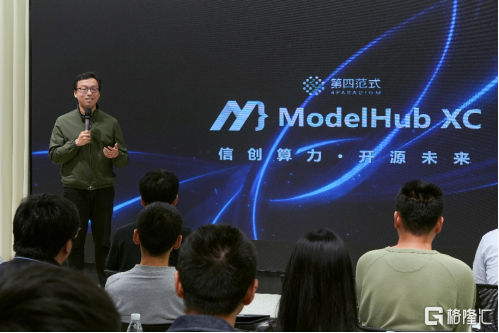
填补空白!第四范式发布「信创模盒」ModelHub XC,连接国产GPU和国产大模型
Ge Long Hui· 2025-09-22 11:12
Core Viewpoint - The emergence of compatibility issues between deployed AI models and chip architectures is becoming a hidden ceiling that restricts the practical application of AI, which Fourth Paradigm aims to address with its new solutions [1][7]. Group 1: Product Launch - Fourth Paradigm officially launched the "ModelHub XC" platform, the "Xinchang Community," and the "Xinchang Model Adaptation Value-Added Service" to tackle industry pain points and bridge gaps between customers, computing power, and developers [3]. - The "ModelHub XC" features an innovative AI engine system, EngineX, specifically designed to adapt to domestic computing power, fundamentally addressing the long-standing compatibility and support issues of domestic AI models [7]. Group 2: Market Context - Many existing ModelHubs primarily optimize foreign models and software for their hardware (e.g., NVIDIA GPUs), leading to compatibility issues with domestic hardware (e.g., Cambricon), resulting in time-consuming and repetitive adaptation processes [8]. - The platform has already certified and adapted over a hundred models upon launch, with plans to increase this number to thousands within six months and to reach tens of thousands within a year [10]. Group 3: Services and Support - Fourth Paradigm introduced a value-added service for model adaptation, providing tailored adjustments for users unfamiliar with which models are compatible with domestic computing power, ensuring a "safety net" for model compatibility [12]. - The platform also offers clear labeling of compatible domestic chip brands for each model, simplifying the process for users to determine which chips to purchase based on the models they wish to download [10].