大水漫灌

Search documents
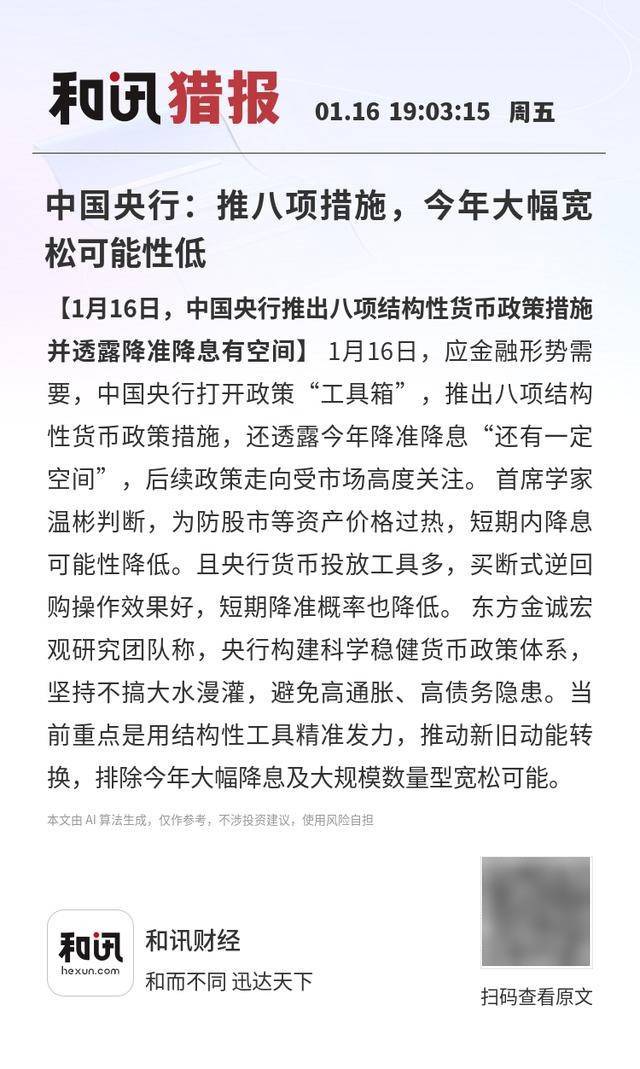
中国央行:推八项措施,今年大幅宽松可能性低
Sou Hu Cai Jing· 2026-01-17 18:28
【1月16日,中国央行推出八项结构性货币政策措施并透露降准降息有空间】1月16日,应金融形势需 要,中国央行打开政策"工具箱",推出八项结构性货币政策措施,还透露今年降准降息"还有一定空 间",后续政策走向受市场高度关注。首席学家温彬判断,为防股市等资产价格过热,短期内降息可能 性降低。且央行货币投放工具多,买断式逆回购操作效果好,短期降准概率也降低。东方金诚宏观研究 团队称,央行构建科学稳健货币政策体系,坚持不搞大水漫灌,避免高通胀、高债务隐患。当前重点是 用结构性工具精准发力,推动新旧动能转换,排除今年大幅降息及大规模数量型宽松可能。 For hexun.com 本文由 AI算法生成,仅作参考,不涉投资建议,使用风险自担 和讯财经 和而不同 迅达天下 扫码查看原文 ...

卢锋:可适时降准降息,“大水漫灌”刺激经济不可取
和讯· 2025-05-06 10:59
Core Viewpoint - The article discusses the impact of the US-China trade war on China's economy, emphasizing the need for effective policy responses to external shocks and the importance of domestic demand stimulation in the current economic context [2][4][18]. Group 1: Economic Context and Historical Comparison - The article highlights the differences in China's economic development stages compared to previous crises, noting that per capita GDP has significantly increased, reaching approximately $13,451 in 2024, nearing high-income status [7]. - It compares the external demand shocks from the 1998 Asian Financial Crisis and the 2008 Global Financial Crisis, indicating that the average negative GDP impact was 0.63 percentage points from 1999-2001 and 1.87 percentage points from 2009-2011, totaling a cumulative impact of 5.6 percentage points [3]. - The current economic environment is characterized by a "strong supply, weak demand" scenario, with average GDP growth from 2022-2024 projected at 4.4%, significantly below potential growth rates [8][9]. Group 2: External Economic Environment - China's trade surplus reached a record high in 2024, with total exports amounting to $3.6 trillion and a surplus close to $1 trillion, accounting for approximately 36%-37% of global trade surplus [9][10]. - The article notes that the US has shifted from monetary to fiscal stimulus policies, leading to challenges in maintaining export growth and trade surpluses due to rising inflation and fiscal discipline concerns [10]. - The structure of China's trade surplus has diversified, with significant growth in high-tech product surpluses, indicating competitive advantages in both high and low-end products [11]. Group 3: Policy Responses and Recommendations - The article suggests that China should adopt direct measures to counteract the US's trade pressures while maintaining an open dialogue for resolution [18]. - It emphasizes the need for a balanced approach to stimulate domestic demand, particularly through targeted fiscal transfers to low-income populations, to enhance consumption and economic rebalancing [18]. - The article advocates for structural reforms to improve social security systems, which have historically supported consumption growth and reduced trade surplus levels [17].