
天算

Search documents
马斯克申请100万卫星新进展!中国错过了星链,万不可再错过天算
Sou Hu Cai Jing· 2026-02-14 07:04
Group 1 - Musk's SpaceX has applied to the FCC for a plan to launch 1 million satellites, which is seen as a move to compete with China's satellite spectrum application [1][2] - The FCC has begun processing SpaceX's application, with public comments due by March 6, indicating regulatory support for Musk's ambitious project [2] - The plan aims to advance humanity towards a "Type II Kardashev civilization," which involves harnessing energy from entire star systems [4] Group 2 - The satellites are not ordinary communication satellites but are designed as powerful space servers, providing significant computational capabilities for AI models [6] - Once operational, the satellite network could deliver computational power equivalent to over 80 million top-tier servers, far exceeding current terrestrial capabilities [6] - Musk's vision transcends national competition, aiming to elevate human civilization as a whole, positioning SpaceX as a leader in this technological frontier [6] Group 3 - China has lost the lead in developing a satellite network, with Musk's plans dominating low Earth orbit spectrum, while China's recent application for 200,000 satellites is seen as a response to this disadvantage [8] - Despite missing the initial opportunity, China is rapidly advancing its own space computing capabilities, having launched its first batch of 12 computing satellites in May 2025 [9] - China's satellite system has demonstrated significant computational power, achieving capabilities equivalent to at least 5 million high-performance servers [9][10]

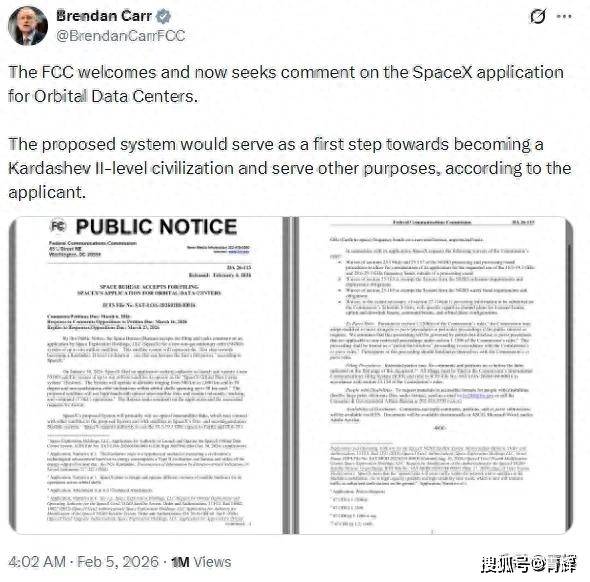
中国已错过“星链”,不可再错过太空算力
虎嗅APP· 2026-02-11 13:59
Core Viewpoint - The article discusses the emerging competition in space computing, particularly focusing on the integration of AI and satellite technology, highlighting the strategic importance of energy supply and system architecture in the development of space-based computing capabilities [4][10][12]. Group 1: Space Computing and AI Integration - Elon Musk's push for SpaceX to acquire xAI and the application for deploying 1 million low-Earth orbit satellites indicates a significant shift towards establishing a new framework for space computing [4][5]. - The concept of "space computing" is not merely about chip performance but fundamentally revolves around energy supply, system structure, and long-term cost considerations [10][12]. Group 2: Energy Supply and Structural Advantages - China is projected to have its electricity consumption exceed 10 trillion kilowatt-hours by 2025, establishing a robust energy supply system that supports high-intensity computing loads [11]. - The energy structure in China is diversifying, with solar power expected to surpass coal power by 2026, indicating a shift towards a more flexible and multi-source energy system [11]. Group 3: Challenges in Space Computing - The primary challenges in space computing include heat dissipation and data throughput, which cannot be solved solely by improving chip performance [16][18]. - In space, heat must be dissipated through radiation, which imposes significant engineering constraints on the design of computing systems [17]. Group 4: Demand for Space Computing - The rapid expansion of satellite constellations necessitates on-orbit computing capabilities to manage complex systems autonomously, as traditional ground-based processing may not suffice [28]. - The increasing volume of raw data from space missions requires on-orbit processing to alleviate communication bottlenecks, making space computing essential for efficient data management [29]. Group 5: Strategic Importance of "Sky Computing" - The urgency for "sky computing" arises from the need for autonomous systems that can operate with minimal human intervention, particularly in remote environments like space [30]. - Major companies like NVIDIA and Amazon are entering the "sky computing" arena, indicating a significant shift in the industry towards leveraging space for advanced computing capabilities [32]. Conclusion - The year 2026 is poised to be pivotal for China's space endeavors, as it seeks to catch up with established frameworks like SpaceX's Starlink while also exploring its own "sky computing" initiatives [34][35].
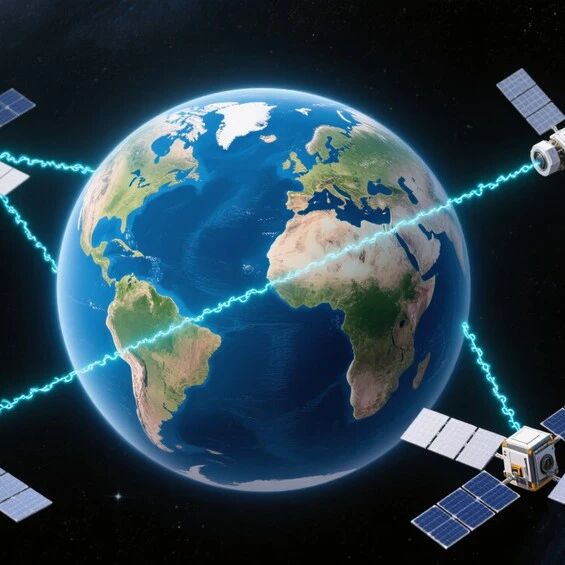
中国已错过“星链”,不可再错过太空算力
Guan Cha Zhe Wang· 2026-02-11 00:25
Core Viewpoint - The new space race has begun, driven by Elon Musk's push for SpaceX to acquire xAI and the application for deploying a low-Earth orbit satellite network of up to 1 million satellites, indicating a strategic positioning for future computational needs in space [1][2]. Group 1: Space Computing and Energy - The core issue of space computing is energy supply, as any computational facility ultimately relies on a stable power source [6]. - China is projected to have its electricity consumption exceed 10 trillion kilowatt-hours by 2025, establishing a robust energy supply system that supports high-intensity power loads [6][7]. - In contrast, the U.S. faces tighter constraints on energy supply, with its aging power grid struggling to meet the increasing demands of AI training and inference [8][10]. Group 2: Challenges of Space Computing - The challenges of space computing include heat dissipation and data throughput, which cannot be solved solely by improving chip performance [11][12]. - In space, heat must be released through radiation, creating engineering constraints that require larger heat dissipation systems [11][12]. - The need for a robust communication system is critical, as traditional satellite architectures may not support the high-frequency interactive tasks required for space computing [13][14]. Group 3: The Need for "Sky Computing" - The urgency for "sky computing" arises from the rapid explosion of computational demands that are beginning to exceed terrestrial capabilities [18][19]. - Complex systems in large satellite constellations require rapid decision-making capabilities that terrestrial systems cannot provide, necessitating computational power in orbit [19][20]. - The evolution of autonomous systems in space, such as space mining and robotic labor, further emphasizes the need for embedded computational capabilities in space [21][22]. Group 4: Strategic Implications - The development of "sky computing" is not merely a response to immediate needs but represents a strategic opportunity for countries to define the future of space computing [2][26]. - The year 2026 is poised to be significant for China's space ambitions, as it seeks to catch up while also positioning itself for future advancements in space technology [25][26]. - Major companies like NVIDIA, Amazon, and Blue Origin are entering the "sky computing" arena, indicating a competitive landscape that could redefine space capabilities [24][26].
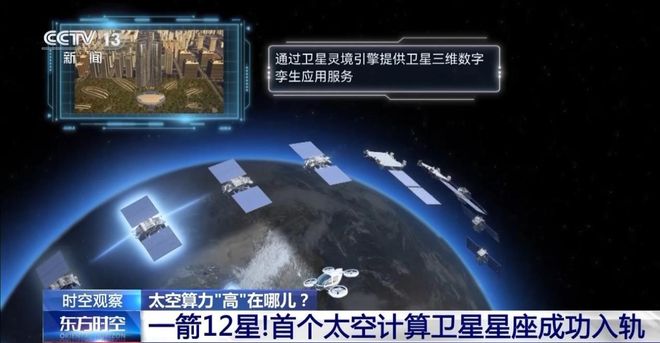
安徽实现“五算合一”体系全面贯通
Xin Lang Cai Jing· 2025-12-19 16:22
Core Insights - The integration of satellite data and computing infrastructure in Anhui marks a significant milestone, establishing the "fifth computing power" for various intelligent applications [1] Group 1: Platform Development - The Anhui Provincial Computing Coordination and Dispatch Platform has successfully integrated a four-in-one scheduling system since its launch in May 2024, encompassing general computing, intelligent computing, supercomputing, and quantum computing [2] - The platform has aggregated computing resources amounting to 639.2P for general computing, 41493.6P for intelligent computing, 33.3P for supercomputing, 2070 bits for quantum computing, and 1.1P for space-based computing, with over 400 million yuan involved in computing dispatch [2] Group 2: Application and Impact - The platform's integration with space-based computing allows for various satellite remote sensing services, including archived imaging and programmed shooting, and has launched two AIRSAT satellite computing products [2] - The collaboration enables applications in diverse fields such as agricultural monitoring, environmental protection, emergency command, and land planning, facilitating rapid transformation from data to information and from information to decision-making [2] Group 3: Technological Leadership - The Chinese Academy of Sciences' Aerospace Information Innovation Research Institute is a leader in spaceborne synthetic aperture radar (SAR) technology, with Zhongke Satellite serving as the industrialization platform for this technology [2] - Zhongke Satellite is a key player in the development of space computing in China, with plans to establish the AIRSAT constellation, aiming for 21 satellites in orbit by 2026 to create a comprehensive and efficient space-based infrastructure [3]