太空资源竞争

Search documents
航天资源竞赛加速、全球国防开支提升,产业多重利好推动航空航天ETF(563380)持续“吸金”
Xin Lang Cai Jing· 2026-02-03 04:21
Core Insights - The A-share market is experiencing increased volatility, but the aerospace sector is seeing active trading and capital inflow, indicating a trend towards high-growth sectors through ETFs [1][5][6] Group 1: ETF Performance - The Aerospace ETF (563380) has seen a net inflow of 155 million yuan and an average daily trading volume of 148 million yuan over the past week, with its total assets and shares reaching new highs of 900 million yuan and 742 million shares since its inception on October 29, 2015 [1][6] - The ETF is the only one tracking the CSI Aerospace Index, making it a key tool for investors looking to capitalize on opportunities in the aerospace industry [2][7] Group 2: Industry Fundamentals - Strong fundamentals support the popularity of the Aerospace ETF, driven by increasing competition in space resources, exemplified by SpaceX's application to deploy a satellite constellation of up to 1 million satellites [2][7] - Major economies like the U.S. and Germany are planning to increase defense spending by 2026, which is expected to elevate global security priorities and potentially unlock significant growth in the military trade sector [2][7] Group 3: Index Composition - The CSI Aerospace Index focuses on the aerospace sector, with significant allocations in aerospace equipment (62.8%), space equipment (18.0%), and military electronics (16.0%), covering key areas such as aircraft, satellites, and aerospace engines [2][7][8] - The ETF includes leading companies across various segments of the aerospace supply chain, providing broad exposure to emerging fields like commercial space and low-altitude economy [2][7]
【科创之声】我国为何一口气申报20万颗卫星
Jing Ji Ri Bao· 2026-01-19 00:59
Core Viewpoint - China's application for 203,000 satellite frequency orbits is a strategic reserve to secure its space development rights and transition from experimental to industrial capabilities in aerospace [2][3]. Group 1: International Competition and Strategic Importance - The application for 200,000 satellites is a reasonable action to defend China's space development rights amid global competition, where low Earth orbit and frequency resources are scarce and non-renewable [3]. - The current technological limit for safely deploying low Earth satellites is approximately 100,000, with an optimistic estimate of 175,000, while the total global applications have already surpassed this threshold [3]. - The "first come, first served" allocation rule by the ITU necessitates early applications to secure development opportunities, making China's application a necessary measure to lock in reasonable space for future aerospace development [3]. Group 2: Opportunities and Challenges in Commercial Space Development - The ambitious goal of 200,000 satellites will drive a comprehensive upgrade of a trillion-yuan industry chain, including rocket launches, satellite production, ground equipment, and operational services [4]. - Achieving this goal requires solid industrial capabilities, as the ITU mandates that the first satellite must be launched within seven years of application, and the entire constellation must be deployed within 14 years [4]. - There are significant challenges, including insufficient launch capacity, with only 92 launches planned in 2025 and fewer than 500 low Earth commercial satellites deployed, highlighting a substantial gap from the required annual launch rate of over 10,000 satellites [4]. Group 3: Strategies for Implementation - To realize the goal of 200,000 satellites, a three-pronged approach involving technological breakthroughs, policy support, and ecosystem collaboration is essential [5]. - Technologically, the focus should be on developing high-capacity reusable rockets and optimizing satellite mass production capabilities to ensure an annual supply of over 10,000 satellites [5]. - On the policy and resource front, it is crucial to enhance the regulatory framework, establish industry-specific funds, and optimize commercial launch site layouts to support the growth of the aerospace sector [6].


全球太空资源竞争加速,我国新增20万颗卫星申请,通用航空ETF基金(561660)涨超6%
Xin Lang Cai Jing· 2026-01-12 02:57
Group 1 - The core viewpoint of the news highlights the significant growth in the general aviation sector, with the Zhongzheng General Aviation Theme Index rising by 6.83% and several component stocks experiencing substantial gains, indicating a bullish market trend [1] - The general aviation ETF fund closely tracks the Zhongzheng General Aviation Theme Index, which includes 50 listed companies involved in various aspects of the aviation industry, reflecting the overall performance of the sector [2] - The International Telecommunication Union (ITU) reports that China has submitted multiple satellite constellation plans, with a total scale exceeding 200,000 satellites, indicating a competitive landscape in global space resources [1] Group 2 - The commercial space industry is expected to see multiple catalysts by 2026, particularly with the launch of several reusable and high-capacity commercial rockets, which will enhance satellite communication capabilities [2] - The top ten weighted stocks in the Zhongzheng General Aviation Theme Index account for 43.4% of the index, with key players including Aerospace Electronics, Haige Communication, and China Satellite Communications [2] - The recent authorization granted to SpaceX by the FCC to deploy an additional 7,500 second-generation Starlink satellites will increase the total number of satellites globally to 15,000, further intensifying competition in the satellite market [1]
我国新兴商业航天行业快速发展,推进太空基础设施建设
Huan Qiu Wang· 2026-01-12 01:05
Group 1 - The core viewpoint of the articles highlights China's rapid development in the commercial space industry, with a reported market size exceeding 2.5 trillion RMB [1][5] - China has submitted multiple satellite constellation plans to the International Telecommunication Union (ITU), with a total scale exceeding 200,000 satellites, including the largest constellations CTC-1 and CTC-2, each comprising 96,714 satellites [1] - The collaboration between government and private sectors is driving technological advancements, with new generation commercial rockets like Zhuque-3, Tianlong-3, and Gravity-2 alleviating satellite launch pressures and increasing launch frequency [1] Group 2 - The visibility and vitality of China's aerospace industry on a global scale are increasing, with significant progress in space infrastructure, particularly in the deployment of low Earth orbit satellite internet networks entering a large-scale constellation phase [5] - Due to the scarcity of satellite frequency and orbital resources, competition for global space resources is intensifying, governed by a "first come, first served" principle [5] - The satellite industry chain has shown strong performance in the capital market, with several satellite ETFs experiencing over 60% growth in the past month, and the total scale of satellite-related ETFs and linked products reaching 23.76 billion RMB, nearly doubling since the end of 2025 [5]
商业航天行业点评报告:商业航天:我国新增超20万颗卫星申请,全球太空资源竞争加速
ZHESHANG SECURITIES· 2026-01-11 10:23
Investment Rating - The industry investment rating is "Positive" (maintained) [6] Core Insights - China has submitted applications for over 203,000 satellites, indicating a significant expansion of satellite operation entities [1] - The global competition for space resources is accelerating, with China's new satellite applications aimed at securing frequency and orbital resources [3] - SpaceX has been approved to deploy an additional 7,500 second-generation Starlink satellites, bringing the total approved satellites to 15,000, enhancing network coverage both domestically and internationally [2] Summary by Sections Satellite Applications - In the last week of 2025, China reported multiple satellite constellation plans to the International Telecommunication Union (ITU), totaling 203,000 satellites [1] - The applications cover 14 satellite constellations and involve various operators, including traditional telecom companies and commercial space enterprises [1] Global Competition - The limited capacity for low Earth orbit satellites and the requirement for prior frequency resource applications are intensifying global competition in the space sector [3] - The core objective of China's new satellite applications is to secure frequency and orbital resources, further solidifying the domestic commercial space industry [3] Investment Recommendations - Focus on leading companies in the rocket and satellite sectors, including: - Rocket sector: Hangyang Co., Srey New Materials, Aerospace Power, and others [4] - Satellite sector: China Satellite, Maiwei Co., Zhenyou Technology, and others [4]
全球太空资源竞争趋于白热化
Xin Lang Cai Jing· 2026-01-11 02:34
Core Viewpoint - The global competition for space resources is accelerating, with China submitting multiple satellite constellation plans to the International Telecommunication Union (ITU) in late December 2025, totaling over 200,000 satellites [1][8]. Group 1: Satellite Constellation Plans - China has announced several satellite constellation plans, with the largest being CTC-1 and CTC-2, each consisting of 96,714 satellites, operated by the Radio Innovation Institute [2][3][9]. - Other notable plans include CHINAMOBILE-L1 with 2,520 satellites, SAILSPACE-1 with 1,296 satellites, and TIANQI-3G with 1,132 satellites, among others [2][9]. Group 2: Radio Innovation Institute - The Radio Innovation Institute was registered on December 30, 2025, in Xiong'an New Area, aiming to focus on technological innovation and the transformation of results in the field of radio management [4][10]. - The institute is a collaborative effort involving seven entities, including the National Radio Monitoring Center and several universities, with a vision to enhance the satellite internet industry and explore the value of spectrum resources [4][10]. Group 3: Global Space Resource Competition - The allocation of satellite frequency and orbital resources follows a "first-come, first-served" principle, intensifying global competition as countries rush to secure low Earth orbit resources [6][13]. - As of May 12, 2025, there are approximately 10,824 satellites in low Earth orbit, with a utilization rate of about 18% of the theoretical capacity of 60,000 satellites [6][13]. Group 4: Future Outlook - The commercial space industry is expected to experience significant growth in 2026, driven by the launch of multiple reusable and high-capacity rockets, which will facilitate satellite communication development [7][14]. - China's low Earth orbit satellite internet is entering a phase of mass launch construction in the second half of 2025, with expectations for accelerated industry development in 2026 [7][14].
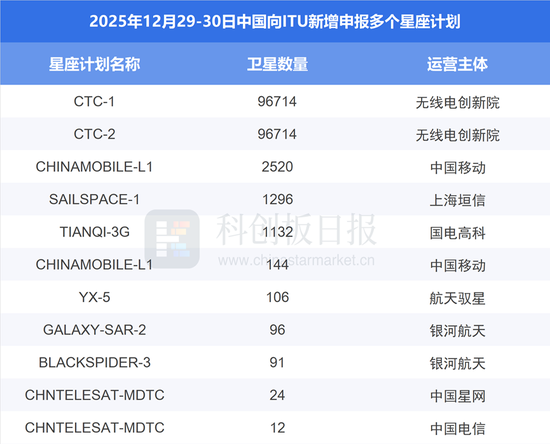
全球太空资源竞争趋于白热化
财联社· 2026-01-11 02:32
Core Viewpoint - The global competition for space resources is accelerating, with China planning to deploy over 200,000 satellites by the end of 2025 through various satellite constellation projects [2][3]. Group 1: Satellite Constellation Plans - China has submitted multiple satellite constellation plans to the International Telecommunication Union (ITU), with a total scale exceeding 200,000 satellites [3]. - The largest constellations are CTC-1 and CTC-2, each consisting of 96,714 satellites, operated by the Radio Innovation Institute [4][8]. - Other notable constellations include CHINAMOBILE-L1 with 2,520 satellites, SAILSPACE-1 with 1,296 satellites, and TIANQI-3G with 1,132 satellites [4]. Group 2: Regulatory and Competitive Landscape - The ITU is responsible for managing global radio frequency and satellite orbital resources, enforcing deployment timelines for satellite operators [9]. - The "first come, first served" principle for satellite frequency and orbital resources is intensifying global competition, as countries rush to secure limited orbital slots [11]. - As of May 2025, approximately 10,824 satellites are in low Earth orbit, with a utilization rate of about 18% of the theoretical capacity of 60,000 satellites [12]. Group 3: Market Outlook and Investment Opportunities - The U.S. leads in the number of operational spacecraft, holding 75.94% of the global share, while China accounts for approximately 9.43% [13]. - China is advancing national-level constellation projects like "GW Constellation" and "Qianfan Constellation," aiming to deploy over 10,000 satellites in the next decade [14]. - The commercial space industry is expected to experience significant growth in 2026, driven by the launch of multiple reusable and high-capacity rockets, facilitating satellite communication development [14]. - Companies to watch include Xinke Mobile, Haige Communication, Tongyu Communication, Guobo Electronics, Shaanxi Huada, Zhenyou Technology, Zhenlei Technology, Chengchang Technology, and Sanwei Communication [14].