
商业航天产业

Search documents
朱雀三号即将再次回收试验,我国火箭重复使用技术有望突破
Changjiang Securities· 2026-03-03 00:49
Investment Rating - The industry investment rating is "Positive" and maintained [6] Core Viewpoints - On February 25, Blue Arrow Aerospace announced that its Zhuque-3 reusable launch vehicle plans to conduct another recovery test in the second quarter of this year, aiming for its first recovery flight in the fourth quarter [3][4] - The successful recovery of reusable rockets is expected to significantly reduce launch costs, accelerating the development of China's commercial aerospace industry [4][9] - The Zhuque-3's first recovery test, although unsuccessful, provided valuable real-world data that can be used to improve technology through a cycle of testing and refinement [4][9] - Multiple Chinese commercial aerospace companies are expected to conduct their first flights or recovery tests within the year, indicating a shift from technological breakthroughs to large-scale development in the industry [4][9] Summary by Sections Event Description - Blue Arrow Aerospace plans to conduct a recovery test for the Zhuque-3 in the second quarter and aims for its first recovery flight in the fourth quarter [3] Event Commentary - The Zhuque-3's first recovery test provided critical data despite its failure, which will aid in refining technology for future tests [4] - The timeline for Zhuque-3's recovery flight could be significantly shorter than that of SpaceX, showcasing China's rapid advancements in commercial aerospace [4] - Other companies like CAS Space and Tianbing Technology are also set to conduct significant tests this year, reflecting a broader trend in the industry towards frequent and cost-effective operations [4]
商业航天“起飞”在即 绵阳如何登上这趟火箭
Xin Lang Cai Jing· 2026-02-26 22:50
Core Viewpoint - The article discusses the rapid development of the commercial aerospace industry in Mianyang, Sichuan, highlighting the establishment of a comprehensive "arrow-star-device-number" industrial ecosystem, with a current scale exceeding 3 billion yuan and a target of over 20 billion yuan by 2030 [3][4]. Group 1: Industry Development - Mianyang has gathered nearly 30 key enterprises in the commercial aerospace industry chain, including Jiuzhou Beidou and Interstellar Glory, with an industrial scale exceeding 3 billion yuan, showing a year-on-year growth of over 50% [3][4]. - By 2026, Mianyang aims to have a complete industrial chain for commercial aerospace, focusing on key areas such as rocket engines, manned spacecraft, general aviation, satellite applications, and aviation electronic components [3]. - The first "Mianyang-made" rocket engine, a 100-ton thrust liquid oxygen-methane engine, is set to undergo flight tests in the second half of 2026, marking a significant milestone for the local aerospace industry [3]. Group 2: Strategic Initiatives - Mianyang plans to integrate the commercial aerospace industry into the "587+" industrial system, with city-level leaders overseeing the industry chain to ensure clear direction and focus on development [3]. - The city is establishing a commercial aerospace sub-fund under the "587+" industrial mother fund to attract quality projects through collaboration with private funds [3]. - Aiming to enhance resource integration, Mianyang is developing an integrated satellite application center to facilitate data sharing among various satellite functions, thus unlocking a significant market potential [3]. Group 3: Innovation and Collaboration - Mianyang is focusing on creating innovative application scenarios in the satellite industry, targeting a market demand of over 1 billion yuan annually in areas such as forest fire prevention and urban disaster monitoring [3]. - The establishment of a low-altitude equipment inspection and certification center aims to attract more low-altitude companies to Mianyang, enhancing the region's appeal for aerospace testing and certification [3]. - A commercial aerospace supply-demand matching event was held, where 27 upstream and downstream enterprises participated, indicating a proactive approach to fostering collaboration within the industry [4].

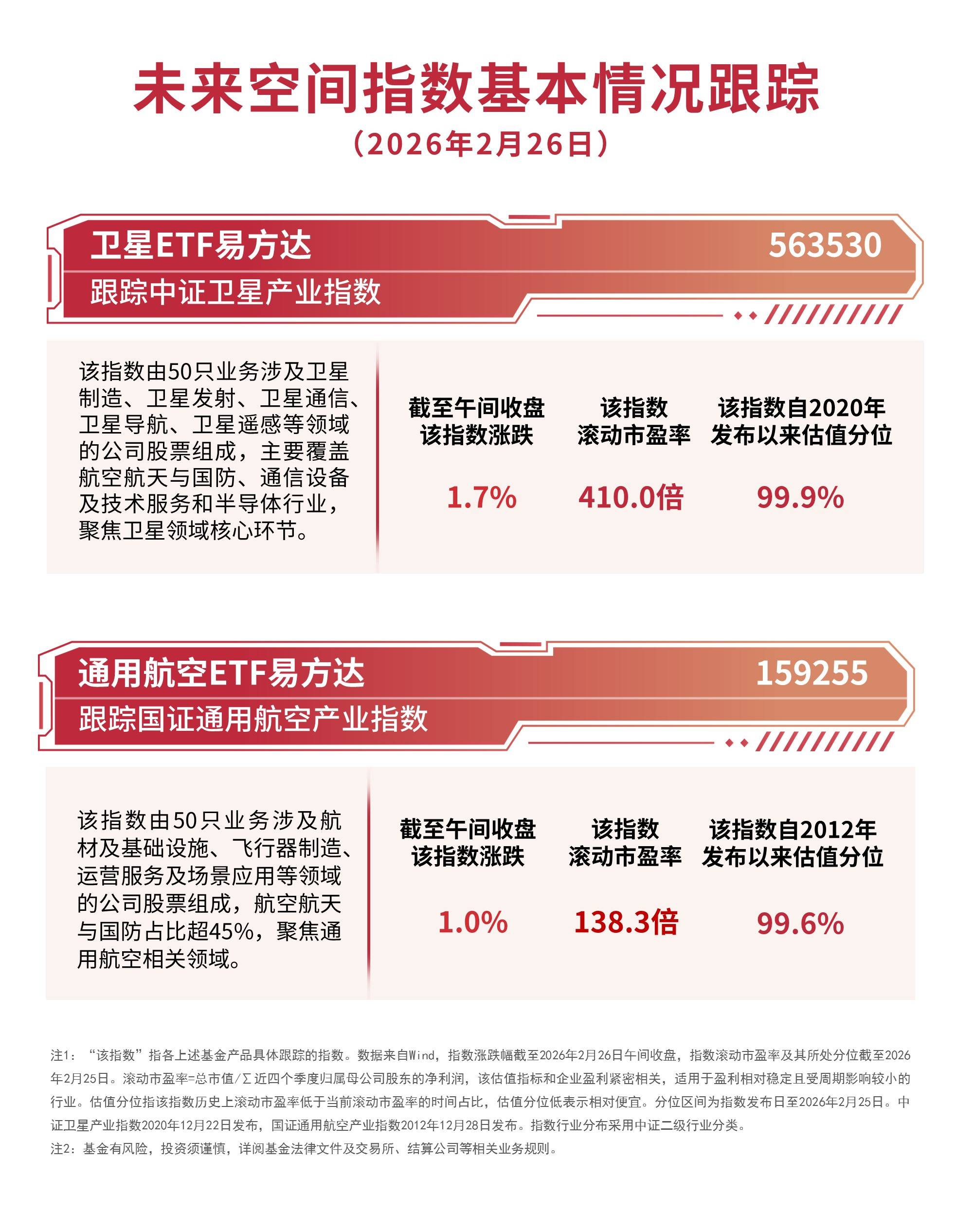
商业航天板块低开高走,卫星ETF易方达(563530)标的指数逆势涨超1%
Sou Hu Cai Jing· 2026-02-26 05:25
Group 1 - The core viewpoint of the articles indicates that the commercial aerospace industry is expected to enter a period of explosive growth over the next two years, driven by rapid technological iteration and engineering advancements [1] - The China Securities Index for the satellite industry rose by 1.7%, while the National General Aviation Industry Index increased by 1.0%, reflecting positive market sentiment towards the aerospace sector [1] - Demand for various aerospace tasks, including launch services, satellite networking, space computing, and space photovoltaics, is anticipated to further increase, supporting a long-term upward trend in the commercial aerospace industry [1]
昊志机电:公司持续关注商业航天产业的发展动态,积极推进产品体系的完善与市场布局的拓展
Zheng Quan Ri Bao Wang· 2026-02-25 09:44
Group 1 - The company is actively monitoring the developments in the commercial aerospace industry and is working on enhancing its product system and expanding market layout [1] - Currently, the revenue from the aerospace sector constitutes a small proportion of the company's main business income [1]

未知机构:hcdx电科蓝天卫星电源龙头长期看千亿市值2月10日-20260210
未知机构· 2026-02-10 01:55
Company Overview: HCDX Electric Science and Technology Blue Sky Industry and Company - HCDX Electric Science and Technology Blue Sky is a leading supplier of aerospace power systems in China, originating from the 18th Research Institute of the national team [1][2] - The company is set to debut on the Sci-Tech Innovation Board on February 10, with an initial offering price of 9.47 CNY per share, corresponding to a market capitalization of 16.1 billion CNY [1] Financial Performance - For 2024, the company achieved a revenue of 3.12 billion CNY and a net profit of 340 million CNY [1] - For 2025, the company expects revenue to be between 3.14 billion and 3.23 billion CNY, with a projected net profit of 330 million to 360 million CNY [1] - In the first half of 2024 and 2025, the company's aerospace power revenue is expected to be 1.9 billion CNY and 730 million CNY, respectively, accounting for 63.4% and 74.1% of total revenue [1] - The gross profit margin for aerospace power is reported at 31.8% for 2024 and 25.3% for 2025 [1] Market Position and Technology - The company has a strong technological foundation, having supported over 700 spacecraft, and is expected to cover over 50% of the domestic aerospace power market by 2024 [2] - The coverage rates for the National Grid Constellation and Qianfan Constellation are reported at 80% and 100%, respectively [2] - The company is positioned in the core segment of aerospace power, which is referred to as the "heart" of aerospace technology [2] Future Growth Potential - The estimated value per spacecraft supplied in 2024 is over 10 million CNY, with the value per satellite in low Earth orbit estimated between 5 million and 8 million CNY, potentially rising to 10 million CNY for future computing constellations [2] - The listing is expected to provide funding for capacity expansion, supporting the company's long-term growth logic [2] Investment Recommendations - HCDX Electric Science and Technology Blue Sky possesses a robust technological background and market entry barriers, closely tied to China's strategy of becoming a space power and the explosion of the commercial aerospace industry [2] - The long-term profit outlook for satellite power is projected at 3 billion CNY, with additional aerospace and special power sources expected to contribute 1.5 billion to 2 billion CNY [2] - The long-term valuation of the company is anticipated to reach 100 billion CNY [2]
未知机构:2月10日电科蓝天将在科创板首发上市发行价947元股对应市值161亿-20260210
未知机构· 2026-02-10 01:55
Summary of Key Points from the Conference Call Company Overview - The company, 电科蓝天, is a leading supplier of aerospace power systems in China, originating from the 18th Research Institute of the national team [1][2]. Financial Performance - The company plans to go public on the Sci-Tech Innovation Board on February 10, with an issue price of 9.47 CNY per share, corresponding to a market capitalization of 16.1 billion CNY [1]. - For 2024, the company achieved revenue of 3.12 billion CNY and a net profit of 340 million CNY [1]. - For 2025, the company expects revenue between 3.14 billion CNY and 3.23 billion CNY, with a projected net profit between 330 million CNY and 360 million CNY [1]. - In the first half of 2024 and 2025, the company's aerospace power revenue is expected to be 1.9 billion CNY and 730 million CNY, respectively, accounting for 63.4% and 74.1% of total revenue, with gross margins of 31.8% and 25.3% [1]. Market Position and Technology - The company has a strong technological foundation, covering all major national projects such as Shenzhou, Tiangong, Beidou, Chang'e, and Tianwen [2]. - The products have supported over 700 spacecraft, with a domestic aerospace power market coverage exceeding 50% in 2024 [2]. - The company has an 80% coverage rate for the State Grid Constellation and 100% for the Qianfan Constellation [2]. - The aerospace power systems are described as the "heart" of aerospace, with an estimated value of over 10 million CNY per spacecraft based on the supply of 144 spacecraft in 2024 [2]. Industry Dynamics - The emergence of large low-orbit satellites is expected to increase inflation expectations, with the value per satellite system estimated between 5 million CNY and 8 million CNY, potentially rising to 10 million CNY for future computing constellations [2]. Growth Potential - The listing is anticipated to provide funding for capacity expansion, with a clear long-term growth logic [3]. - The company is expected to achieve a long-term profit of 3 billion CNY from satellite power systems and an additional 1.5 billion to 2 billion CNY from other aerospace and special power systems, with a long-term valuation target of 100 billion CNY [4]. Investment Recommendation - The company possesses a deep "national team" technological foundation and market entry barriers, closely tied to China's aerospace strategy and the explosion of the commercial aerospace industry [4].
银行新基建,上天!
Zheng Quan Ri Bao Zhi Sheng· 2026-02-09 16:11
Core Viewpoint - The recent launch of satellites by banks like China Merchants Bank and Shanghai Pudong Development Bank signifies a strategic move to integrate banking services with satellite technology, enhancing digital financial infrastructure and supporting the commercial space industry [1][2]. Group 1: Satellite Launch and Collaboration - The "Zhaoyin Jinkui" and "Puyin Shuzhi" satellites were launched as part of the "Tianqi Constellation" to enhance banking capabilities [1][2]. - This is not the first instance of banks collaborating with commercial satellite companies; previous launches include "Zhaoyin 1" and "Zhaoyin 2" by China Merchants Bank and "Ping An 1" and "Ping An 2" by Ping An Bank [2]. - Banks are adopting different paths in satellite technology, with some investing in satellite hardware while others opt for data procurement and processing [2][3]. Group 2: Applications and Benefits of Satellite Technology - The integration of low-orbit satellites is expected to enhance financial asset management, risk control, and emergency communication for banks [2][5]. - Banks like Industrial and Agricultural Bank of China are utilizing satellite remote sensing technology in supply chain finance and agricultural monitoring [4]. - The shift from purchasing satellite images to participating in satellite launches reflects banks' evolving strategies to address financial pain points and enhance long-term planning [5][6]. Group 3: Financial and Industrial Synergy - The collaboration between banks and satellite companies represents a deeper integration of finance and the aerospace industry, facilitating the development of innovative financial products [9][10]. - The commercial space industry in China has seen rapid growth, with significant satellite launches and a focus on integrating financial services to support this sector [8][10]. - Financial institutions are exploring various applications of satellite data, including green finance and agricultural insurance, to convert space data into tangible ground value [11]. Group 4: Cost and Future Outlook - The costs associated with launching commercial satellites are expected to decrease due to technological advancements and economies of scale, making satellite applications more accessible [7]. - Current costs for launching a satellite range from tens of millions to over a billion yuan, with expectations that by 2030, costs could drop significantly [7]. - The financial sector is increasingly involved in the commercial space industry, providing funding and establishing industry-specific funds to support satellite manufacturing and data applications [10][11].


第三代星舰6周后发射 机构称商业航天产业拐点已现
Xin Lang Cai Jing· 2026-01-28 00:16
Core Viewpoint - SpaceX's CEO Elon Musk announced that the first flight test of the Starship V3 will take place in six weeks at the Starbase launch site in Boca Chica, Texas, aiming to send the next-generation Starlink V3 satellites into orbit and validate several key technological capabilities of the Starship V3 [1] Industry Summary - According to Dongwu Securities, the scale of China's commercial space market is projected to grow from 1.2 trillion yuan in 2024 to 4.8 trillion yuan by 2027, and is expected to exceed 7.8 trillion yuan by 2030 [1] - Zhongtai Securities believes that the commercial space industry is entering a new phase of rapid development, with the number of commercial space enterprises in China exceeding 600 and a total of 25 commercial space launch sites (18 operational and 7 under construction) [1] - The launch speed of the GW satellite constellation is significantly accelerating, and reusable rocket technology is approaching critical validation stages, driven by the demand for space computing capabilities [1] - A turning point in the commercial space industry has been observed, with the sector likely to experience concentrated catalysts in the near future, suggesting investment opportunities in the commercial space direction [1] Company Summary - Aerospace Technology has deeply entered the commercial space industry chain, collaborating with leading rocket manufacturers such as Jiuzhou Yunjian, Xinghe Power, Blue Arrow Aerospace, Tianbing Technology, Dongfang Space, and CAS Space, providing various supporting products including turbine discs, pumps, shells, flanges, and other forged components [1] - Xizi Clean Energy's subsidiary, Hangzhou Zhongneng Optoelectronics, has overcome challenges in large-area low-temperature preparation, high-precision laser scribing, and high-barrier packaging, providing reliable supply for high-power solar wings in space [1]


北京火箭大街六大共性平台正式启动 进一步完善产业引领支撑功能
Ren Min Ri Bao· 2026-01-27 22:25
Core Insights - Beijing Economic and Technological Development Zone has launched six common service platforms to enhance the commercial aerospace industry, including a measurement and control center, a common testing platform, and a public service platform [1] Group 1: Service Platforms - The commercial aerospace measurement and control center will provide satellite operation control services and a communication platform for enterprises [1] - The common testing platform will establish over 10 large testing facilities to offer testing services [1] - The one-stop service platform for aerospace components will integrate a component database and digital model library, creating a comprehensive "quality barrier" covering the entire lifecycle of components [1] Group 2: Data and Resource Integration - The spatiotemporal information service platform will consolidate remote sensing data resources from dozens of satellites, forming a resource closed loop between data supply and industry demand [1] - The space situational awareness service cooperation platform will offer space situational awareness and traffic management services to commercial aerospace companies [1] Group 3: Infrastructure Development - Multiple key projects in the Beijing Economic and Technological Development Zone are accelerating construction, centered around the Beijing Rocket Street [1]
四川凉山:设立不低于40亿元的商业航天产业专项基金,支持火箭、卫星研制及应用、航天大数据等相关企业落地
Xin Lang Cai Jing· 2026-01-23 06:33
Core Viewpoint - Sichuan Liangshan Prefecture has introduced a special policy to support the development of the commercial aerospace industry, establishing a special fund of no less than 4 billion yuan to promote the entire industry chain from research and development to application [1] Group 1: Policy Initiatives - The policy aims to support the establishment of companies involved in rocket and satellite development, as well as aerospace big data applications [1] - A "green channel" policy will be provided for commercial aerospace enterprises to address land use needs in accordance with laws and regulations [1] - Key commercial aerospace enterprises will be included in the provincial and state major project database, ensuring legal and regulatory support for new construction land annual plan indicators [1] Group 2: Financial Support - A special fund of at least 4 billion yuan will be set up to support the commercial aerospace industry [1] - The minimum price for land transfer can be executed at 70% of the corresponding minimum price standard for industrial land in Liangshan Prefecture [1] - The policy encourages a combination of leasing and transfer methods for land supply [1]