太空超算

Search documents
国际产业新闻早知道:元首外交引领中法合作新机遇,特朗普允许英伟达对华出口H200
Chan Ye Xin Xi Wang· 2025-12-09 05:49
Group 1 - The state visit of French President Macron to China from December 3 to 5, 2023, marks a significant opportunity for Sino-French cooperation, being Macron's fourth state visit to China and a reciprocal visit following Xi Jinping's historic visit to France last year [1][2] - Experts believe that this summit will enhance political mutual trust, expand practical cooperation across multiple fields, promote cultural exchanges, and improve global governance, playing a crucial role in stabilizing Sino-French and Sino-European relations under the new circumstances [2] Group 2 - China's trade surplus has surpassed $1 trillion for the first time in history, with total import and export value reaching 41.21 trillion yuan, a year-on-year increase of 3.6% [3][4] - In the first 11 months of the year, exports amounted to 24.46 trillion yuan, growing by 6.2%, while imports were 16.75 trillion yuan, increasing by 0.2% [3] - In November alone, China's foreign trade showed a recovery, with imports and exports totaling 3.9 trillion yuan, a year-on-year growth of 4.1% [4] Group 3 - China's exports to the U.S. have decreased by 29% year-on-year in the first 11 months, while exports to the EU, Australia, and Southeast Asia have surged, with EU exports increasing by 14.8% and Australian exports skyrocketing by 35.8% [5] - This shift indicates China's efforts to diversify its export markets and strengthen trade relations with Southeast Asia and the EU, particularly in light of ongoing U.S.-China trade tensions [5] Group 4 - China's soybean imports reached a four-year high in November, with 8.11 million tons imported, a 13.4% increase from the previous year [10] - The U.S. Trade Representative revealed that China has fulfilled about one-third of its soybean purchase commitments under the U.S.-China trade agreement [7][14] - Despite a slower purchasing pace after initial bulk purchases, China is expected to continue adhering to its import commitments [13][14] Group 5 - Mexico's Congress is set to vote on a proposal to impose tariffs on imports from China, which is part of a broader plan to protect local producers and ease trade tensions with the U.S. [15][16] - The proposed tariffs could reach up to 50% on certain goods, reflecting a significant shift in Mexico's trade policy towards Asia [16][18] Group 6 - OpenAI's recent survey indicates that its AI tools have enabled employees to save 40-60 minutes of professional work time daily, with 75% of respondents noting improved work speed or output quality [20][22] - Despite ongoing skepticism about AI's productivity benefits, OpenAI reports a rapid increase in enterprise adoption of its products, with over 1 million companies currently using its services [22] Group 7 - IBM announced its acquisition of Confluent for $11 billion to enhance its cloud computing offerings, reflecting a strategic move to capitalize on AI-driven demand [23][26] - The acquisition price of $31 per share represents a 34% premium over Confluent's last closing price, indicating strong market interest [26] Group 8 - The global semiconductor sales reached $72.7 billion in October, marking a 4.7% increase from September and a 27.2% increase from the previous year [31] - The growth in semiconductor sales is primarily driven by the Americas and Asia-Pacific regions, with China showing an 18.5% increase [31] Group 9 - The U.S. is supporting a Moroccan company to produce high-purity silicon for semiconductors and solar panels, aiming to reduce reliance on Chinese supplies [34][36] - The planned factory in Morocco is expected to produce 30,000 tons of polysilicon annually by the end of 2029, contributing to the diversification of critical technology materials [38] Group 10 - Tesla's Shanghai Gigafactory has achieved a milestone by producing its 4 millionth vehicle, contributing significantly to Tesla's global delivery volume [58][59] - The factory has a localization rate of 95% and serves as a key export hub for Tesla, with over 30,000 vehicles exported in October alone [59] Group 11 - Volkswagen Group plans to invest €160 billion (approximately $186 billion) by 2030, focusing on product development, technological innovation, and infrastructure in response to challenges in key markets [61][64] - The investment strategy reflects the company's efforts to adapt to cost pressures and competition in the U.S. and Chinese markets [63][64]


万卡集群要上天?中国硬核企业打造太空超算!
量子位· 2025-11-29 01:00
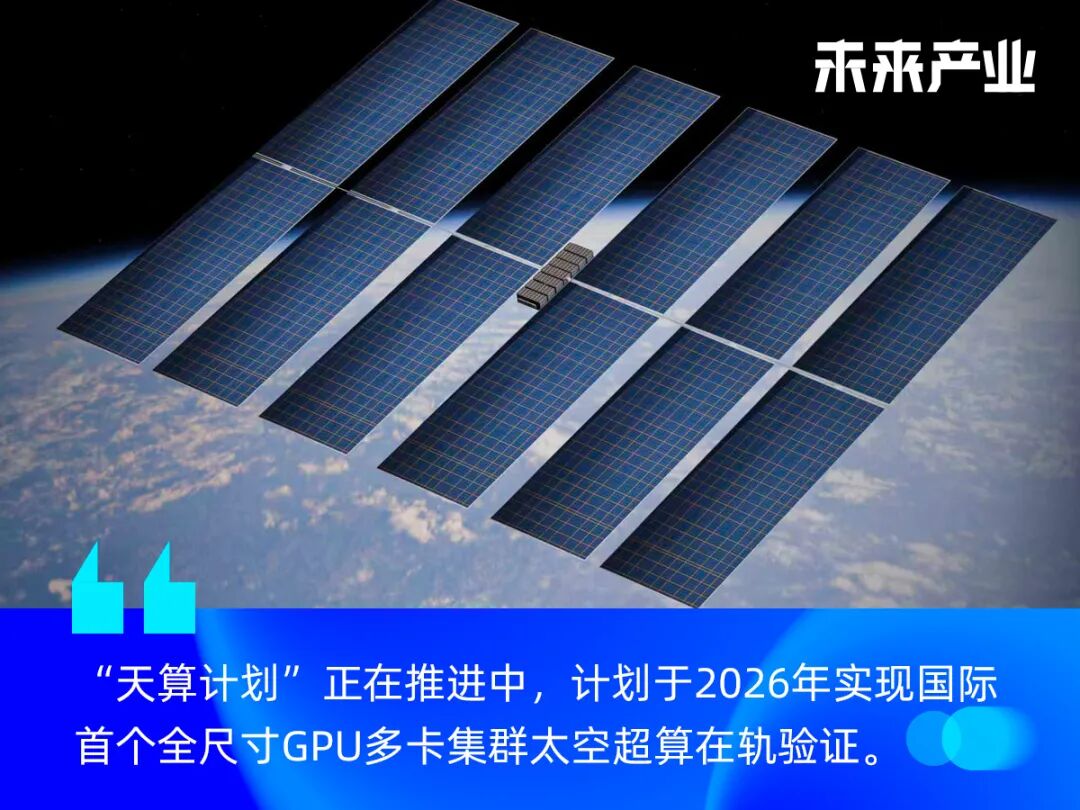
Core Viewpoint - The concept of "space supercomputing" is transitioning from a science fiction idea to an engineering reality, with significant advancements in computational infrastructure occurring in space [5]. Group 1: Developments in Space Computing - The successful launch of the Starcloud-1 satellite equipped with NVIDIA H100 by SpaceX marks a critical step in building "space supercomputing" [2]. - Google has announced its "Project Suncatcher," which involves deploying a satellite cluster equipped with TPU [3]. - Chinese research institutions have been exploring space intelligent computing since 2019, with significant projects like the "Three-Body Constellation" satellite launched by Zhijiang Laboratory [7]. Group 2: Chinese Initiatives in Space Computing - The Chinese Academy of Sciences has been a pioneer in space-based computing, developing advanced satellite computing payloads and intelligent models [9]. - Zhongke Tiansuan, a commercial space enterprise, is also actively involved in this field, aiming to establish a robust space computing ecosystem [8][11]. - The "Tiansuan Plan" aims to create a true "space supercomputer" in low Earth orbit, establishing a "second brain" for humanity in extreme conditions [13]. Group 3: New Paradigms in Space Computing - The traditional "ground computing" model is facing physical limitations, necessitating a shift to "space computing" where processing occurs closer to data sources [14]. - The development of a space internet application ecosystem is anticipated, similar to the evolution of terrestrial internet from 1G to 4G [16][18]. - The application of space computing can significantly enhance decision-making processes in various sectors, such as fisheries, by providing real-time data and insights [20]. Group 4: Technical Challenges and Solutions - The transition of supercomputing capabilities to space involves overcoming significant physical challenges, including radiation protection and thermal management [25][26]. - Zhongke Tiansuan is addressing these challenges by developing advanced cooling systems and utilizing semiconductor physics to enhance chip resilience in space [30][38]. - The proposed hybrid active-passive cooling architecture aims to efficiently dissipate heat generated by high-performance chips in the vacuum of space [39]. Group 5: Future Implications of Space Supercomputing - The establishment of space supercomputing infrastructure is crucial for humanity's future endeavors in space exploration and utilization [41]. - Space computing centers can provide robust support for remote areas and critical applications, enhancing capabilities in autonomous driving and low-altitude economies [42]. - As space computing networks develop, they are expected to become the primary battleground for computational and networking capabilities, surpassing terrestrial systems [43].
把AI送上天,打造全国产太空超算,「中科天算」完成数千万元天使轮融资|36氪首发
3 6 Ke· 2025-11-25 03:32
Core Insights - Beijing Zhongke Tiansuan Technology Co., Ltd. has completed several million yuan in angel round financing, led by Ge Wu Zhi Zhi Private Equity Fund and Shanghai Future Industry Fund, with funds allocated for core technology research and engineering preparation for its first satellite [2] - The company focuses on breakthroughs in "supercomputing in space" and "AI for Space" technologies, developing space-based intelligent computing hardware and software systems [2][4] - The founder, a leading figure in space computing at the Chinese Academy of Sciences, has extensive experience in satellite internet system design and development [2] Product Development - Zhongke Tiansuan's product lineup includes the Aurora series of satellite intelligent machines, with the Aurora 1000 series already validated in orbit for over 1000 days [3] - The Aurora 5000 series, which will feature a domestic full-size GPU comparable to NVIDIA's H100, is set for in-orbit validation next year [3][6] Technological Advancements - The company claims to be over two years ahead of the industry in developing key technologies for space supercomputing [7] - The Aurora 1000 series has successfully demonstrated high-performance AI computing systems in space, paving the way for collaborative computing architectures [4][7] Business Strategy - Zhongke Tiansuan aims to generate short-term revenue through hardware and algorithm sales, targeting leading satellite and rocket companies [7] - The long-term vision includes the "Tiansuan Plan," which aims to establish a space-based supercomputing system by 2030, featuring a centralized high-efficiency supercomputing architecture [8][9] Future Outlook - The "Tiansuan Plan" is expected to lead to significant revenue growth as satellite constellations and the supercomputing system are developed, potentially ushering in a new era of space applications [9]