
存量房盘活

Search documents
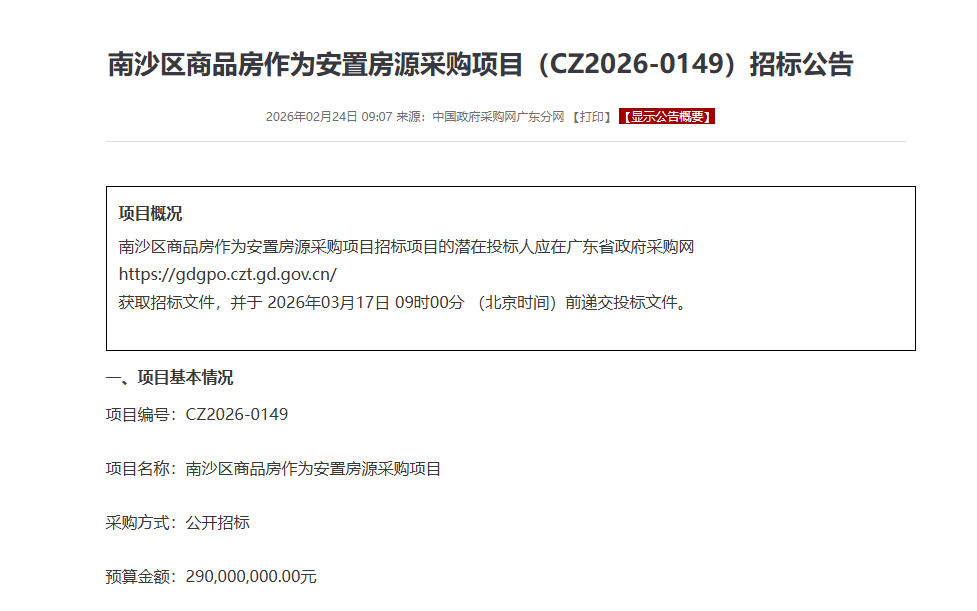
2.9亿元!广州南沙下场“收房”
Shang Hai Zheng Quan Bao· 2026-02-26 15:23
Group 1 - The core announcement is that Guangzhou's Nansha District plans to invest 290 million yuan to purchase 20,000 square meters of commercial housing to be used as resettlement housing [1] - The procurement requires that the commercial housing must be newly built, fully decorated, and completed but unsold, with a price not exceeding 14,500 yuan per square meter [4][3] - The housing must have clear ownership, no disputes, and be suitable for residential or mixed-use purposes, with specific requirements for unit types and sizes [4] Group 2 - Last year, Nansha District initiated a large-scale pilot program for "stock commercial housing resettlement," successfully providing around 2,100 units as resettlement housing [4] - The Guangzhou Anju Group has announced the first batch of 785 units of affordable housing for sale this year, with the "Wanglu Garden" project offering units at a base price of 22,800 yuan per square meter [5] - The city is also focusing on converting idle commercial office properties into affordable rental housing, with 664 units already transformed [7] Group 3 - The Guangzhou Housing and Urban-Rural Development Bureau aims to broaden channels for constructing affordable housing, emphasizing the conversion of existing stock [8] - Other cities like Shenzhen, Shanghai, and Jinan are also engaging in similar initiatives to revitalize stock housing resources [8] - Industry experts suggest that these initiatives can alleviate inventory pressure and enhance the housing security system, with state-owned enterprises expected to renovate acquired properties for rental purposes [9]

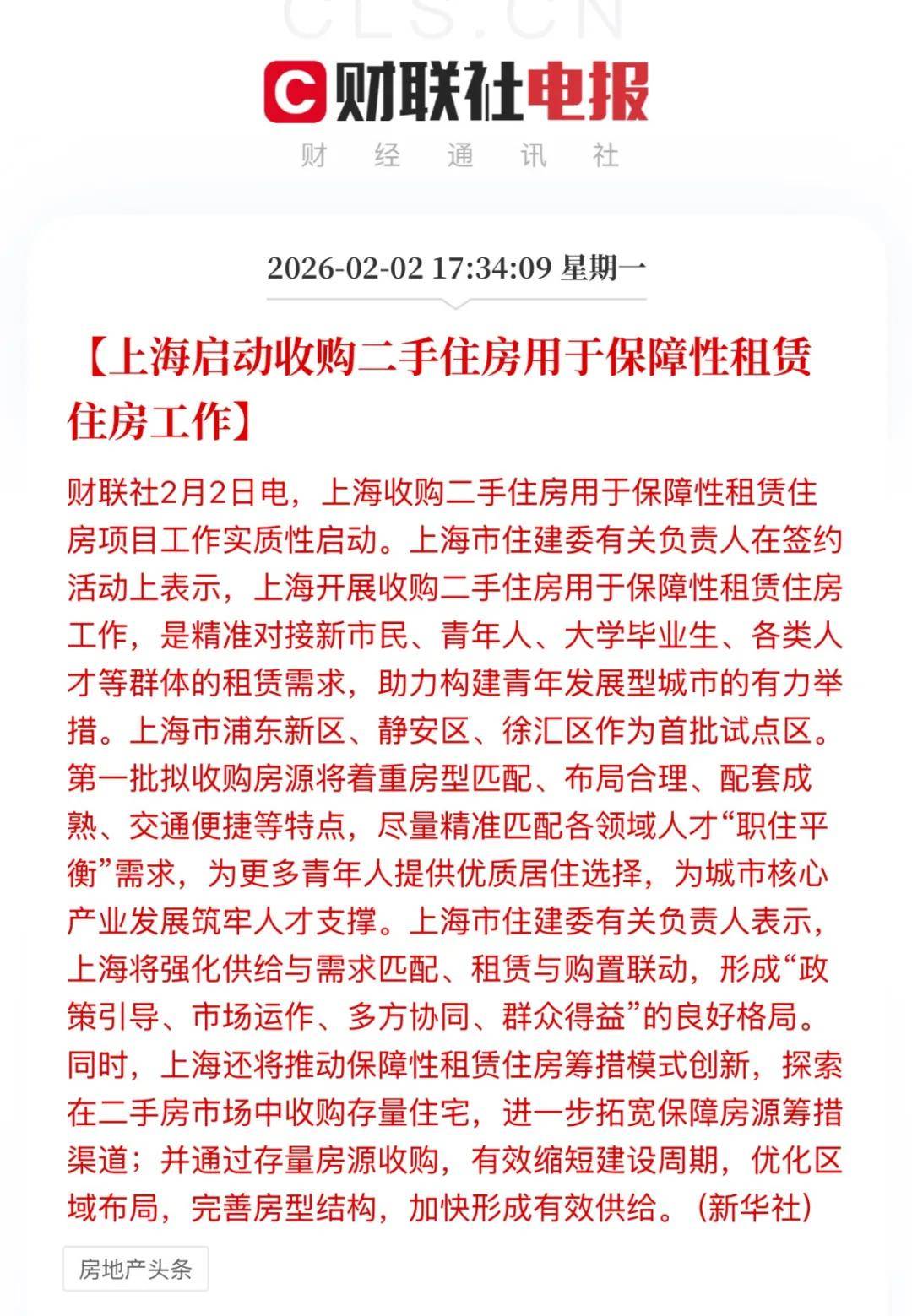
2026第一波大招落地,多地官方下场收二手房。重庆……
Sou Hu Cai Jing· 2026-02-15 12:47
Core Viewpoint - The article discusses a significant shift in the housing market, where government-led initiatives to purchase second-hand homes are emerging as a crucial trend for 2026, indicating a deep restructuring of the housing system rather than a temporary market rescue [2][25]. Group 1: Government Initiatives - Multiple cities, including Shanghai, Nanjing, Hangzhou, and Haikou, are initiating a "stock housing acquisition wave" led by the government [2]. - In Shanghai, pilot programs are being launched in key districts such as Pudong, Jing'an, and Xuhui, with specific requirements for the properties being acquired [3][5]. - The acquisition conditions include properties built before 2000, with a maximum area of 70 square meters and a total price cap of 4 million yuan, with financial support from China Construction Bank [5]. Group 2: Housing Supply and Demand Dynamics - The acquired properties will be converted into affordable rental housing to support new citizens and young people [5][10]. - The acquisition model aims to address liquidity issues in the stock housing market while simultaneously creating affordable housing options [10][11]. - The policy is designed to stimulate the new housing market by releasing funds and housing vouchers, thereby facilitating a smoother transition for homeowners [9][15]. Group 3: Broader Implications - The current initiatives are seen as a way to build confidence in the housing market and provide a predictable exit mechanism during times of slow market liquidity [13][14]. - The approach benefits multiple stakeholders, including homeowners looking to upgrade and renters seeking affordable housing, ultimately improving overall market liquidity [16]. - The article highlights that while the scope may be limited initially, the signal sent by these policies is clear: the government is actively working to revitalize the housing market [15][26]. Group 4: Case Study - Chongqing - Chongqing has not officially announced the purchase of individual second-hand homes but is exploring beneficial strategies within the broader framework of stock revitalization [18]. - In early 2024, state-owned enterprises in Chongqing acquired seven stock housing projects, totaling 4,207 units, demonstrating a proactive approach to housing supply [20]. - The city has implemented various measures to stabilize the real estate market, including a recent announcement of 22 policies aimed at revitalizing stock housing [23][24].
以买代建,存量房“爆改”大学宿舍
2 1 Shi Ji Jing Ji Bao Dao· 2025-12-01 13:34
Core Viewpoint - Several universities in China are purchasing or renting existing properties to address student dormitory shortages, which also helps to revitalize the surrounding real estate market [2][3][8] Group 1: University Initiatives - China University of Mining and Technology plans to invest 293 million yuan to purchase existing real estate for student dormitories [2] - Hubei University was the first to acquire existing properties for student housing, purchasing 352 units for nearly 200 million yuan, adding 2800 new beds [4][5] - Other universities, including Central South University and Hefei University of Technology, have also announced similar procurement plans [2][6] Group 2: Benefits of Property Acquisition - Acquiring or renting existing properties is seen as a dual benefit, improving student living conditions while helping to reduce excess inventory in the real estate market [3][8] - The average acquisition price for Hubei University's project was approximately 4653 yuan per square meter, significantly lower than previous market rates [6] Group 3: Challenges and Considerations - Universities face challenges such as limited available land for new construction and the need for properties to meet specific safety and management standards [9][10] - The success of these initiatives depends on understanding student needs and ensuring that the acquired properties are suitable for dormitory use [10][11] Group 4: Broader Implications - The trend of universities acquiring or renting existing properties may lead to further development of off-campus housing solutions [10] - Government support and streamlined processes are essential for facilitating the conversion of existing properties for educational use [11][12]