
实际房贷利率

Search documents
2025年地产债市场回顾与2026年展望:风险出清格局重塑 政策聚焦长效发展
Xin Lang Cai Jing· 2026-02-26 10:27
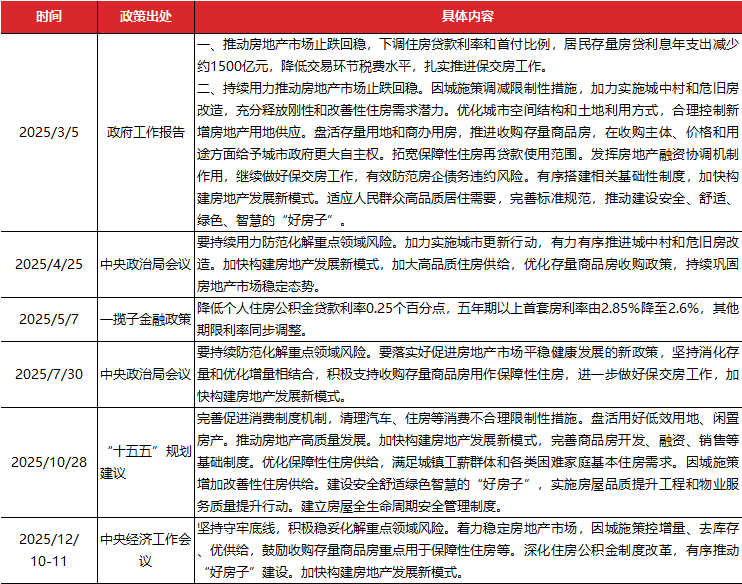
Group 1 - The real estate market in 2025 continued its adjustment, with significant declines in both second-hand and new housing prices, down 6.1% and 3.1% year-on-year respectively in December [1] - The total sales area of commercial housing decreased by 8.7% year-on-year, while the total development investment fell by 17.2% [1] - Despite the ongoing market adjustments, there was notable progress in debt restructuring among real estate companies, positively impacting their balance sheets [1] Group 2 - In 2026, the real estate policy is expected to maintain a marginally loose tone, focusing on guiding actual mortgage rates down and optimizing supply-demand structures [2] - The likelihood of significant increases in real estate support policies is low, suggesting continued market adjustments but with a potential narrowing of the adjustment range [2] - Core cities are expected to see a release of housing demand, while lower-tier cities will still face high inventory and prolonged de-stocking cycles [2] Group 3 - The credit risk outlook for real estate companies in 2026 indicates a decrease in repayment pressure for state-owned enterprises, while private companies will experience lower overall repayment pressure due to reduced bond issuance [3] - The trend of debt restructuring through significant debt reduction and diversified debt instruments is expected to continue [3] Group 4 - In 2025, the central government emphasized "promoting high-quality development of real estate" and included the construction of a new development model in the 14th Five-Year Plan [4] - Key policy directions included accelerating inventory clearance, enhancing financing support for project completion, and continuing to promote demand-side policy easing [4] Group 5 - The real estate market in 2025 did not show clear signs of stabilization, remaining in a deep adjustment phase towards a new development model [14] - Second-hand housing prices showed a trend of initial small contraction followed by significant widening of declines, with a year-on-year drop of 6.1% in December [15] - New housing prices also followed a downward trend, with a year-on-year decrease of 3.0% in December [17] Group 6 - The total sales area of commercial housing in 2025 was 88.101 million square meters, down 8.7% year-on-year, with sales revenue decreasing by 12.6% [20] - The real estate development investment completed in 2025 was 827.88 billion yuan, a year-on-year decline of 17.2% [28] - The funding sources for real estate development decreased by 13.4% year-on-year, indicating a significant contraction in capital availability [29] Group 7 - The real estate bond market in 2025 showed overall stability with structural differentiation, as debt restructuring efforts progressed significantly [40] - The total issuance of real estate bonds reached 796.9 billion yuan, a year-on-year increase of 93.3%, although the overall financing situation remained challenging [41] - The credit risk landscape is evolving, with a decrease in the number of new defaults and extensions, although the Vanke extension incident had a notable impact on market confidence [57]


东方金诚:2026年货币化安置和保障房收储政策有望持续扩容
Jin Rong Jie· 2026-02-10 09:04
Core Viewpoint - The article discusses the key economic themes for 2026, emphasizing the importance of domestic demand and the stabilization of the real estate market as crucial for economic recovery and growth [2]. Group 1: Domestic Demand and Real Estate Market - The central economic task for 2026 is to "insist on domestic demand as the main driver and build a strong domestic market," highlighting the critical role of expanding domestic demand in stabilizing the economy [2]. - The real estate market is expected to see continued marginal easing of policies in 2026, with a shift from short-term support to the establishment of long-term mechanisms [2]. - The core of the demand-side policy for 2026 will focus on guiding actual mortgage loan interest rates downward, especially as various purchasing restrictions have been largely lifted [2][4]. Group 2: Mortgage Rates and Economic Indicators - Since 2022, mortgage rates have been cumulatively reduced by approximately 250 basis points, yet the real estate market continues to decline, indicating a lack of sensitivity to these rate cuts [3]. - The GDP deflator index has shown negative year-on-year growth for 11 consecutive quarters as of the end of 2025, leading to an increase in the real mortgage rate from 1.2% at the end of 2021 to 4.2% in Q3 2025, near historical highs [3]. - To stabilize the real estate market, it is essential to lower actual mortgage rates through measures such as targeted interest rate cuts and fiscal subsidies [4]. Group 3: Supply-Side Policies and Land Market - The core policy for 2026 will focus on controlling new supply and reducing existing inventory to achieve a balance in the real estate market [5]. - The challenge lies in balancing the control of land supply with the declining land transfer revenue for local governments, particularly in lower-tier cities that rely heavily on land finance [5]. - Effective utilization of idle land is crucial, especially in lower-tier cities facing downward pressure in the real estate market, where the focus should be on matching idle land with effective demand [5]. Group 4: Inventory Reduction and Affordable Housing - The policies for inventory reduction in 2026 are expected to expand, particularly in terms of monetary compensation and the collection of affordable housing [6]. - Current challenges in affordable housing include high entry barriers for migrant workers and mismatches between housing supply and demand [6]. - Future adjustments should focus on breaking down barriers to access, optimizing housing layouts, and improving pricing and management mechanisms to better serve the needs of migrant workers [6].