
容错免责机制

Search documents
取消返投要求,深圳这家母基金打响全国第一枪
母基金研究中心· 2026-03-27 06:58
Core Viewpoint - The newly released "Shenzhen Angel Investment Guidance Fund Application Guidelines and Selection Method (2026 Edition)" marks a significant shift in China's government guidance fund industry by eliminating the mandatory local registration requirement for fund managers and removing the return investment constraints, which is expected to stimulate the venture capital sector and attract high-quality general partners (GPs) [2][3]. Group 1: Policy Changes - The new guidelines abolish the return investment requirement, allowing for a more flexible investment environment that encourages rapid fundraising and operational deployment by sub-funds [3]. - The average return investment multiplier requirement has decreased by over 40% in the past six years, with many funds now having requirements below 1.0, enhancing the appeal to top venture capital institutions [5]. - Shenzhen's proactive measures in venture capital, including the introduction of the "Shenzhen Technology Innovation Field Tolerance for Failure Work Guidelines," reflect a commitment to fostering innovation while balancing risk [6]. Group 2: Strategic Initiatives - The "Shenzhen Action Plan for Promoting High-Quality Development of Venture Capital (2025-2026)" aims to cultivate "patient capital" and "bold capital" to support strategic emerging industries, with a goal of forming a "double ten thousand" structure by the end of 2026 [7][8]. - Shenzhen plans to establish three new mother funds focusing on cross-border early-stage investments, scientific innovation, and specialized corporate venture capital, which will complement the existing fund ecosystem [8]. - The action plan addresses practical issues in the fundraising process, including exploring the cancellation of return investment requirements for early-stage funds and promoting long-term capital sources such as insurance funds and pension funds [8][9]. Group 3: Industry Impact - Shenzhen has become a leading city for private equity funds, with its mother fund development significantly contributing to the overall growth of the venture capital landscape in China [10][11]. - The city's initiatives are expected to create a favorable investment environment, enhancing the attractiveness of Shenzhen as a hub for private equity and venture capital [11].


以“中试+基金”深度融合引领产业科技创新
Jin Rong Shi Bao· 2026-01-26 02:10
Core Viewpoint - The 20th National Congress of the Communist Party of China emphasizes the construction of a modern industrial system and accelerating high-level technological self-reliance, marking a strategic shift from focusing on technological breakthroughs to promoting the development of future and emerging industries through industrial development [1] Group 1: "Mid-test + Fund" Concept - "Mid-test + Fund" represents a dual approach combining mid-test platforms and equity fund development, aligning investment risks and returns [2] - Mid-test platforms are crucial for validating research results before large-scale production, but they require significant upfront investment and have low short-term returns [2] - Equity financing is preferred over debt financing for mid-test projects due to the absence of repayment pressure and the potential for higher returns upon successful validation [2] Group 2: Local Government Involvement - Local governments utilize "Mid-test + Fund" as a key tool to integrate technology and industry, aiming to attract high-quality resources and avoid homogeneous competition [3] - The government plays a role in bridging the gap between technological innovation and industrial application, enhancing the ecosystem for mid-test funds [3] Group 3: State-Owned Capital's Role - The new round of state-owned enterprise reform emphasizes balancing public welfare and commercial functions, with state capital using commercial means to internalize public goals into sustainable profit models [4] - State-owned capital can enhance the market value of mid-test platforms and attract more social capital, thereby amplifying the effectiveness of fiscal funds [4] Group 4: Current Development Status - The Ministry of Industry and Information Technology and the National Development and Reform Commission aim for comprehensive coverage of mid-test capabilities in key industrial chains by 2025 [6] - Local governments are actively promoting the establishment of mid-test platforms, with specific plans and implementations already in place in various provinces [6] Group 5: Challenges Facing Mid-test Platforms - Many mid-test platforms are not fully aligned with policy expectations and fail to effectively transition research outcomes to industrial production [7] - The profitability model of mid-test platforms is often limited to service fees, leading to a lack of financial independence and diverse revenue streams [8] - Financing remains a significant challenge, as mid-test platforms struggle to attract sufficient investment due to high risks and low success probabilities [9] Group 6: Recommendations for Improvement - State-owned capital should act as patient capital, focusing on long-term value investments and enhancing market operational capabilities [10] - Accelerating the establishment of mid-test funds and platforms is essential, with a focus on understanding core challenges and developing supportive financial measures [11] - Exploring innovative profit models and integrating risks and benefits among mid-test platforms, funds, and projects can enhance investment returns [12] - Optimizing the investment direction of mid-test funds to focus on key technologies and specialized mid-test platforms can improve the overall ecosystem [14]
山东省重点研发计划管理办法修订印发 营造奖惩分明、宽容失败的创新生态
news flash· 2025-07-14 05:22
Core Viewpoint - Shandong Province has revised the "Shandong Provincial Key Research and Development Plan Management Measures," establishing a comprehensive embedded supervision and evaluation mechanism for the provincial key R&D plan [1] Group 1: Supervision and Evaluation Mechanism - The supervision and evaluation results will serve as a crucial basis for project adjustments, cancellations, terminations, financial fund disbursements, performance evaluations, and subsequent project support [1] - An innovation incentive mechanism will be established, where units and individuals with outstanding performance in project implementation may receive rolling support and preferential selection for future projects [1] Group 2: Accountability and Responsibility Mechanisms - A fault-tolerance and exemption mechanism will be created, which will not hold accountable those who have acted diligently but failed to meet project goals due to technical route choices, market risks, or other unforeseen reasons [1] - A responsibility accountability mechanism will be implemented, where projects executed poorly will be investigated by the Provincial Science and Technology Department, with serious consequences for those responsible, and results will be publicly disclosed and included in scientific integrity records [1]
干部获容错免责并晋升,宽严相济鼓励担当作为|新京报快评
Xin Jing Bao· 2025-07-02 10:35
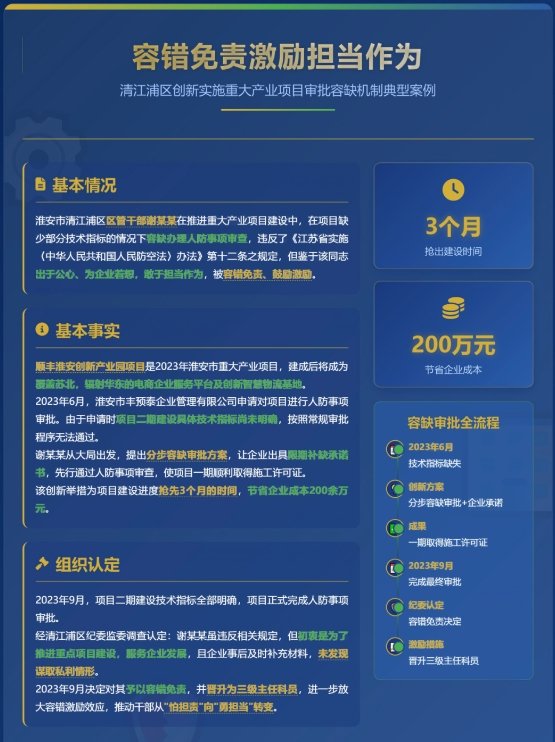
Core Viewpoint - The case of a local official in Huai'an, Jiangsu Province, being granted immunity for violating regulations while expediting a major project highlights the balance between accountability and encouraging proactive governance [4][5][6]. Group 1: Case Summary - The official, identified as Xie, facilitated the construction of the SF Express Huai'an Innovation Industrial Park by approving a project lacking certain technical indicators, saving the company over 2 million yuan and gaining three months of time [4][5]. - The local disciplinary committee recognized Xie's actions as being in the public interest, leading to his promotion to a higher position despite the regulatory breach [4][6]. - This incident reflects a broader initiative to encourage officials to take responsibility and act decisively in the face of challenges, moving from a culture of fear of accountability to one of proactive engagement [6][7]. Group 2: Policy Context - The case aligns with the guidelines set forth in the "Regulations on Accountability of the Communist Party of China," which allows for non-accountability in cases of unintentional mistakes made during reform efforts [5][6]. - The Huai'an district has implemented a "white list" system to protect innovative and reform-oriented officials, particularly in areas like optimizing the business environment and managing major projects [5][6]. - The emphasis on a scientific approach to error correction and the differentiation between unintentional mistakes and deliberate misconduct is crucial for maintaining a balance between discipline and encouragement [7].
正本清源 发挥国资创投主渠道作用
Shang Hai Zheng Quan Bao· 2025-06-22 17:20
Group 1 - The core viewpoint is that state-owned capital venture investment (国资创投) is becoming a dominant force in China's equity investment market, injecting stable funding and targeting new productive forces, thus playing a crucial role in the development of strategic emerging industries [1][2] - In 2023, over 50% of newly raised funds in various scales had state-owned capital backgrounds, with 100 billion yuan and above funds exclusively managed by state-owned capital [2][3] - The trend of state-owned capital and government-guided funds accounted for 77.43% of total fund subscriptions in 2023, increasing to 81.58% in 2024 [3] Group 2 - Challenges faced by state-owned venture capital include the need for clarity on the legal status of state-owned fund managers, as current regulations restrict state-owned entities from being general partners [2][12] - There is a prominent issue of homogenized competition among local governments, leading to overlapping investment strategies in popular sectors like AI and renewable energy, which increases the risk of bubbles and overcapacity [3][4] - The operational model of state-owned venture capital deviates from market-oriented practices, with weakened incentive mechanisms and bureaucratic decision-making processes [4][5] Group 3 - The recruitment process for talent in state-owned venture capital lacks autonomy and competitiveness, making it difficult to attract skilled professionals [5][6] - The assessment mechanisms for state-owned venture capital do not align with the unique characteristics of the venture capital industry, focusing instead on immediate financial metrics like revenue and profit [6][16] - The exit procedures for investments are complex and face rigid constraints, complicating the liquidation of funds and the recovery of investments [7][8] Group 4 - Recommendations include revising the partnership law to grant legal status to state-owned venture capital as general partners, reflecting the industry's evolution over the past two decades [12][18] - Local governments should develop industries based on their unique resource endowments, avoiding blind investments in trending sectors without local advantages [13][14] - Establishing market-oriented incentive mechanisms and independent decision-making processes is essential for the healthy development of state-owned venture capital [14][15]