
宽基ETF资金流出

Search documents
近万亿资金流出宽基ETF,降温进度条已至60%
Sou Hu Cai Jing· 2026-02-03 23:50
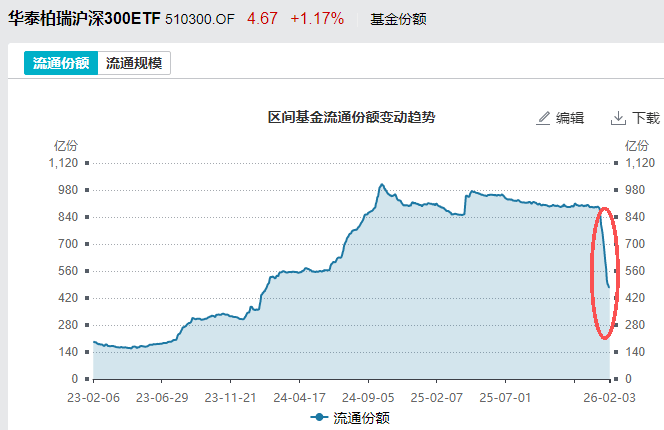
Core Viewpoint - The article discusses a significant decline in the shares of major broad-based ETFs, attributed to a mysterious institution holding large portions of these ETFs, leading to a substantial outflow of funds from the market [3][8]. ETF Share Decline - Several leading broad-based ETFs have experienced a drastic reduction in shares, with many seeing their latest shares cut in half compared to the previous year-end totals [3]. - The mysterious institution holds significant shares in 22 ETFs, with the total shares at year-end being 14,964 billion, and an estimated outflow of approximately 9,426 billion this year, representing about 63% of the institution's holdings [8][9]. Specific ETF Data - The following ETFs have shown notable declines in shares: - HuShen 300 ETF (华泰柏瑞): Last shares 475 million, down from 888 million [4]. - HuShen 300 ETF (易方达): Last shares 325 million, down from 1,115 million [4]. - Shanghai 50 ETF: Last shares 252 million, down from 567 million [4]. - ChiNext ETF (创业板): Last shares 191 million, down from 315 million [4]. - The estimated outflow amounts for specific ETFs include: - HuShen 300 ETF (华泰柏瑞): 1,965 million [9]. - HuShen 300 ETF (易方达): 1,538 million [9]. - Shanghai 50 ETF: 991 million [9]. Market Trends - Since January 14, there has been a rapid outflow from major broad-based ETFs, with a cumulative net outflow of approximately 9,426 billion, nearing the 10 trillion mark [8][6]. - The pace of outflows has slowed recently, with some ETFs experiencing small inflows in the last few trading days [6][11]. Institutional Behavior - The mysterious institution appears to have ceased significant selling in the HuShen 300 ETFs while continuing to exert pressure on the mid-cap stocks represented by the ChiNext and other mid-cap ETFs [14][11]. - The market is currently characterized by a strong performance in large-cap and small-cap stocks, while mid-cap stocks are under pressure [14]. Investor Sentiment - There is a prevailing sense of helplessness in the market, as traditional analysis methods are failing to predict movements due to the influence of the mysterious institution [17]. - The article suggests that the current market dynamics are heavily influenced by the actions of this institution, which is perceived as controlling the market's direction [20][19].

1165亿元!宽基ETF成交再放量 资金持续流出
Shang Hai Zheng Quan Bao· 2026-01-28 09:58
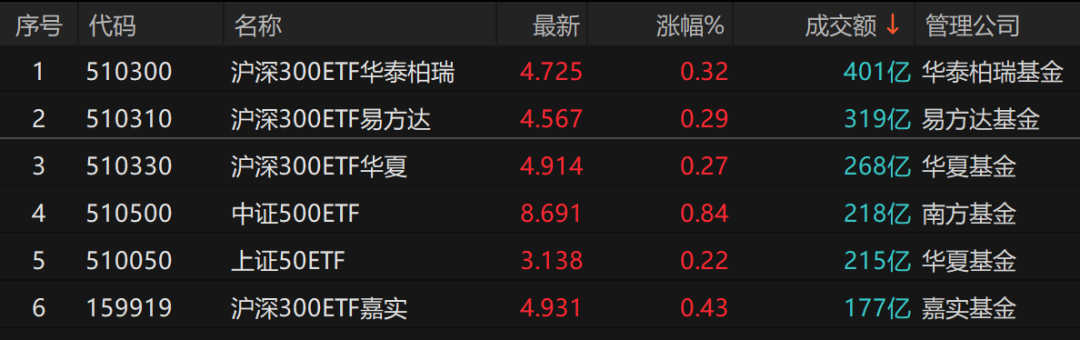
Core Viewpoint - On January 28, trading volume for major ETFs surged, with four "giant" CSI 300 ETFs reaching record transaction amounts, indicating strong market interest and activity in these investment vehicles [1][2]. Group 1: Trading Volume Highlights - The Huatai-PineBridge CSI 300 ETF achieved a transaction volume of 401 billion yuan, marking its highest since its launch in May 2012 [2][3]. - The E Fund CSI 300 ETF recorded a transaction volume of 319 billion yuan, while the Huaxia CSI 300 ETF and the Jiashi CSI 300 ETF reached 268 billion yuan and 177 billion yuan, respectively, all setting new records since their inception [2][3]. - The total transaction volume for these four leading CSI 300 ETFs amounted to 1,165 billion yuan [2]. Group 2: Market Performance - Despite the record trading volumes, the market showed resilience, with the CSI 300 Index rising by 0.22% and the Shanghai Composite Index increasing by 0.27%, while the ChiNext Index fell by 0.57% [7]. - The trading activity was concentrated in two time slots: 10:31-11:00 and 14:31-15:00, indicating specific periods of heightened investor interest [3]. Group 3: Fund Flows - On January 27, stock ETFs (excluding cross-border ETFs) experienced a net outflow of 474.82 billion yuan, with major broad-based ETFs facing significant withdrawals [8]. - The Huatai-PineBridge, Huaxia, E Fund, and Jiashi CSI 300 ETFs collectively saw a net outflow of 436.53 billion yuan [8]. - From January 14 to 27, broad-based ETFs had a total net outflow of 7,663.19 billion yuan, with the leading ETFs losing over 4,400 billion yuan in total [8]. Group 4: Sector Performance - In contrast to the outflows in broad-based ETFs, several thematic industry ETFs attracted significant inflows, particularly in the metals sector, with the Huaxia Nonferrous Metals ETF seeing a net inflow of 16.57 billion yuan [8][9]. - The performance of gold-related ETFs was notably strong, with several reaching their upper price limits and exhibiting premium rates above 2% [9][10]. - The total scale of domestic gold-related ETFs reached 3,141.41 billion yuan as of January 27, a significant increase from 704.42 billion yuan at the beginning of 2025 [10][11].
策略张文宇:宽基ETF资金大幅流出:规模,节奏与影响
ZHONGTAI SECURITIES· 2026-01-26 10:09
Group 1: Key Insights on the Tool Industry - The report suggests that the tool industry is entering a clear upward cycle driven by the supply-side reform, with tungsten carbide price fluctuations being a critical factor influencing the industry's performance [3][4]. - The demand for tools is positively correlated with industrial value-added, indicating a long-term increase in tool demand [3]. - The supply of tungsten is tightening due to a decrease in domestic mining quotas and export controls, leading to a projected global supply gap that will expand significantly by 2027 [4]. Group 2: Competitive Landscape and Market Dynamics - The tool industry is experiencing a shift towards consolidation, with a decline in foreign imports and an increase in domestic production, as evidenced by the drop in import market share from 37.26% in 2016 to 27.16% in 2022 [5]. - Private enterprises are gaining market share due to their innovation capabilities, while state-owned enterprises face challenges in management and innovation [5]. - The financial health of the tool industry is improving, with revenue and net profit growth rates for the first three quarters of 2025 showing significant increases compared to previous years [6]. Group 3: Investment Recommendations - The report recommends focusing on companies with strong R&D capabilities or those that can collaborate effectively with upstream raw material suppliers, as the industry transitions to a technology-driven competitive landscape [6][7]. - The tool industry is expected to see a value reassessment as it exits a deflationary phase and enters an upward cycle, making it an attractive investment opportunity [6].