
宽容失败

Search documents
广州宣布接受单项目100%亏损,把给科创企业的补贴变为投资
第一财经· 2026-01-15 11:45
Core Viewpoint - Guangzhou is fostering a more tolerant environment for failure in technology innovation, aiming to create a "Guangzhou model" for the transformation of scientific and technological achievements through the implementation of the "补改投" pilot program [2][4]. Group 1: Policy Framework - The "补改投" pilot program aims to address the challenges in the initial stages of technology achievement transformation, focusing on the most difficult and high-risk "first kilometer" [2]. - The program establishes a long-term governance system characterized by "incentives + tolerance for losses," allowing for a 100% loss on individual projects without accountability for responsible parties, as long as overall losses remain within 80% [2][6]. - The program encourages a principle of "tolerance for failure," ensuring that financial losses from the "补改投" funds do not serve as a basis for evaluating the performance of relevant departments and personnel [2][6]. Group 2: Investment Strategy - The "补改投" program will channel funds into sectors such as artificial intelligence, biomedicine, and low-altitude economy, transitioning from merely providing financial support to enabling companies to become self-sustaining [3]. - Investment methods include direct financial investment, government investment funds, and a "first invest, then take equity" approach, with the program's funds generally not exceeding 30% equity stake in projects [3][4]. - The program aims to leverage public funds to attract social capital, with a target of achieving a leverage effect of over three times the initial investment [3]. Group 3: Implementation and Impact - The Guangzhou Science and Technology Bureau plans to allocate at least 15% of the municipal science and technology innovation development fund annually for "补改投" initiatives over the next three years [4]. - The program is expected to stimulate innovation and attract high-quality resources and capital to Guangzhou, with a goal of creating a 20 billion yuan technology innovation fund to support early-stage technology companies [4][5]. - The "补改投" reform will convert 100 million yuan of previous competition subsidies into equity investments, facilitating initial financing for startups and enhancing the overall entrepreneurial environment [5].


广州宣布接受单项目100%亏损,把给科创企业的补贴变为投资
Di Yi Cai Jing· 2026-01-15 08:13
Core Viewpoint - Guangzhou is actively developing a "Guangzhou model" for the transformation of scientific and technological achievements, emphasizing a "tolerant of failure" approach to foster innovation and support for startups [1][2]. Group 1: Policy Framework - The "Work Method" released on January 15 aims to address the challenges in the initial stages of technology transfer, particularly the high risks involved [1]. - The framework establishes a long-term governance system that encourages a "tolerant of failure" principle, ensuring that financial losses do not impact the assessment of responsible departments and personnel [1][6]. - It allows for a 100% loss on individual projects without accountability, and overall investment losses of up to 80% are tolerated without repercussions for involved parties [1]. Group 2: Investment Strategy - The "补改投" initiative focuses on sectors such as artificial intelligence, biomedicine, and low-altitude economy, aiming to shift fiscal support from "blood transfusion" to enabling companies to "self-generate" [2]. - Investment methods include direct fiscal investment, government investment funds, and a "first invest, then equity" model, with the government holding no more than 30% equity in projects [2]. - The initiative is designed to leverage fiscal funds to attract social capital, with a goal of achieving a multiplier effect of over three times [2]. Group 3: Implementation and Impact - The Guangzhou Science and Technology Bureau plans to allocate at least 15% of its annual special funds for technology innovation to support the "补改投" initiative over the next three years [3]. - The 2025 Guangzhou Science and Technology Innovation and Entrepreneurship Competition will feature a total prize pool of 200 million yuan, with a focus on supporting startups that have not previously received equity financing [3][4]. - The "first invest, then equity" model is expected to enhance the entrepreneurial environment within universities, encouraging alumni to return and contribute to startup projects [4].
王安宇×林晓杰:《垂直人生》里的演技,藏着普通人的真情
Xin Lang Cai Jing· 2026-01-06 15:27
Core Viewpoint - The short drama series "Miracle" features a heartwarming story in the "Vertical Life" segment, highlighting the friendship between a young graduate and a cleaning lady in Shenzhen, showcasing themes of mutual support and resilience in the face of life's challenges [1][12]. Summary by Sections Story Development - The narrative follows Li Lei, a fresh graduate who starts his career in Shenzhen, and his interactions with Li Fen, a cleaning lady. Their relationship evolves from a minor misunderstanding to a deep friendship as they support each other through various life challenges [1][5][6]. - Over time, Li Lei progresses from an intern on the 8th floor to a manager and eventually starts his own company on the 28th floor, while Li Fen faces her own life changes, including returning home to care for family and later re-entering the workforce [5][6]. Themes and Messages - The story encapsulates the ups and downs of life, emphasizing the importance of resilience and the courage to face one's destiny. It reflects the broader narrative of Shenzhen's development over 45 years, integrating the city's values of innovation and tolerance for failure into the storyline [4][13]. - The performances of the actors, particularly the natural and relatable portrayal of their characters, enhance the emotional depth of the story, making the themes resonate more authentically with the audience [8][11][13].

深圳:允许100%亏损!
FOFWEEKLY· 2025-07-30 06:28
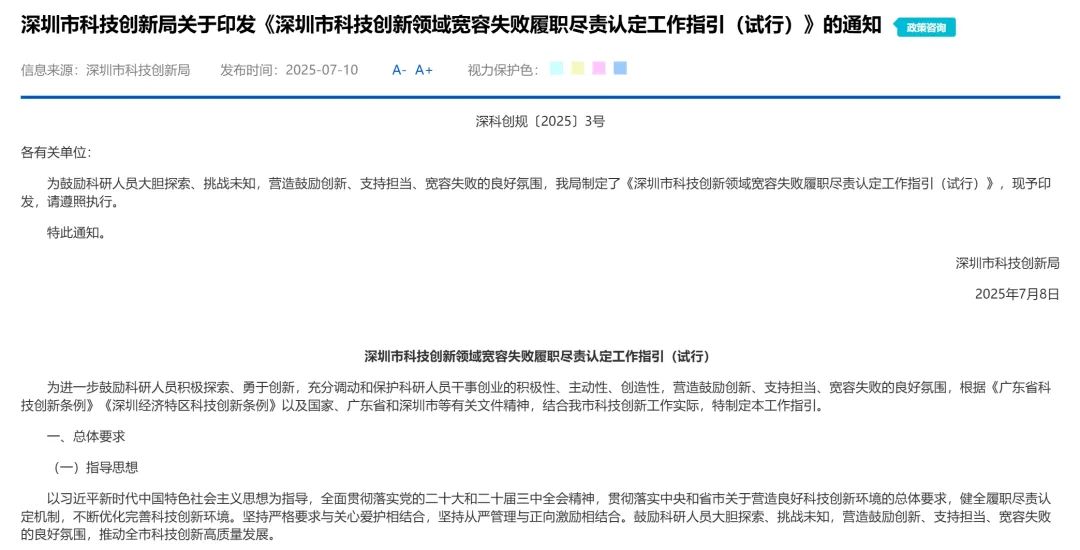
Core Viewpoint - Shenzhen has introduced a new regulation to encourage innovation and tolerate failure in the technology sector, providing a clear framework for accountability and support for researchers [1][2]. Group 1: Principles and Objectives - The regulation outlines three basic principles: respect for the laws while encouraging innovation, objective and fair assessment based on facts, and a dual approach of legal compliance and error correction [2]. - It emphasizes the importance of recognizing the exploratory nature of scientific research and aims to alleviate concerns regarding innovation risks [2]. Group 2: Conditions and Exemptions - Five conditions for diligent responsibility are specified: alignment with strategic decisions, adherence to democratic decision-making processes, avoidance of personal gain from authority, proactive engagement, and willingness to correct mistakes [3]. - Nine circumstances under which researchers may be exempt from liability are detailed, including failure to meet project goals despite diligent efforts, challenges faced in high-risk projects, and unforeseen factors affecting project outcomes [3]. Group 3: Implementation Procedures - The regulation establishes a structured process for initiating and recognizing accountability, which includes four main steps: initiation, acceptance of investigation, organizational decision-making, and feedback on results [4]. - Entities and individuals recognized for fulfilling their responsibilities will not face penalties, and their evaluations will remain unaffected [4].
深圳科研人员容错免责来了
投资界· 2025-07-29 08:05
Core Viewpoint - The article discusses the newly issued "Guidelines for Tolerance of Failure in the Field of Technological Innovation in Shenzhen," which aims to create a supportive environment for innovation by allowing for the forgiveness of failures in scientific research and technology projects [2][4]. Summary by Sections Introduction - Shenzhen's government has officially released guidelines to promote tolerance for failure in scientific research, emphasizing that failure is a common occurrence in the innovation process [2][3]. Guidelines Overview - The guidelines consist of five parts, detailing three basic principles, five conditions for diligent responsibility, nine scenarios for exemption, and the procedures for investigation and recognition [4]. Conditions for Diligent Responsibility - The guidelines specify five preconditions for diligent responsibility: alignment with strategic direction, adherence to democratic decision-making processes, absence of personal gain from authority, proactive engagement, and willingness to correct mistakes [4]. Exemption Scenarios - Nine specific scenarios are outlined for exemption from responsibility, including: 1. Failure to complete projects despite diligent efforts [5]. 2. Non-passing of milestone assessments for significant projects [5]. 3. Funding for high-risk innovative projects that do not meet expected outcomes [5]. 4. Inability to continue projects due to uncontrollable factors [5]. 5. Challenges due to inappropriate technical routes [5]. 6. Key technologies becoming public unexpectedly [5]. 7. Market changes rendering developed products irrelevant [5]. 8. Research difficulties due to new mechanisms or methods [5]. 9. Other scenarios as defined by relevant regulations [5]. Applicability and Procedures - The guidelines apply broadly to all technology innovation activities funded by municipal financial resources, covering various entities including public institutions and enterprises [7]. The procedures for recognition include initiation, acceptance of investigation, organization of decisions, and feedback on results [7]. Importance of the Guidelines - The guidelines provide a systematic and operational framework that respects the exploratory nature of scientific research, aiming to alleviate the pressure on researchers and encourage innovation by reducing the fear of failure [6][9]. Broader Context - The article highlights a growing trend in the investment community towards embracing a culture of tolerance for failure, which is essential for fostering innovation and creativity in high-risk sectors like artificial intelligence and biotechnology [9][12].

深圳发布“宽容失败”指引 科技创新领域9种情形可免责
Nan Fang Ri Bao Wang Luo Ban· 2025-07-25 07:41
Group 1 - The Shenzhen Municipal Science and Technology Innovation Bureau has issued the "Guidelines for Recognizing Accountability in the Field of Technological Innovation" to provide systematic and operational institutional support for the principle of "encouraging innovation and tolerating failure" [1] - The guidelines define clear "tolerance" boundaries for researchers, outlining three basic principles, five diligence and responsibility conditions, nine exemption scenarios, and investigation and recognition procedures [1] - Units and individuals recognized for fulfilling their responsibilities will not face accountability, and this will not affect their evaluations, assessments, or future applications for financial support for technology projects [1] Group 2 - The belief in "encouraging innovation and tolerating failure" has been a core value of Shenzhen for 45 years, emphasizing the importance of a supportive environment for innovation [2] - Experts argue that a good system should encourage individuals to innovate and create wealth for society, highlighting that the level of societal tolerance directly impacts creativity [2] - The need for institutionalization and standardization of the accountability recognition mechanism in the field of technological innovation has become increasingly urgent as Shenzhen deepens its innovation-driven development strategy [2]
不予追责,不影响考评!深圳官方出台“容错”新规
Nan Fang Du Shi Bao· 2025-07-12 14:55
Core Viewpoint - Shenzhen has introduced new regulations to encourage innovation and tolerate failure in the technology sector, aiming to provide a systematic and operational institutional guarantee for scientific research and innovation activities [5][17]. Summary by Sections Overall Requirements - The guidelines emphasize three fundamental principles: respect for scientific laws and encouragement of innovation, objective and fair assessment, and adherence to laws and regulations while allowing for corrections [5][19]. Applicable Situations - The guidelines apply to all technology innovation activities funded by municipal financial resources, covering various entities including public institutions, enterprises, and individuals engaged in scientific research [6][18]. Diligence and Responsibility Conditions - Five conditions must be met for entities or individuals to be considered diligent and responsible, including alignment with strategic decisions, adherence to democratic decision-making processes, avoidance of personal gain, proactive engagement, and timely correction of mistakes [7]. Exemption Situations - Nine specific situations are outlined where entities may be exempt from liability, such as failure to complete projects despite diligent efforts, non-passing of milestone assessments, and unforeseen factors affecting project outcomes [9][10][11][12][13][14][15]. Implementation Procedures - The guidelines establish a clear process for initiating and recognizing diligence and responsibility, ensuring that recognized entities will not face penalties or negative evaluations in future assessments [15][17]. Highlights of the New Regulations - The new regulations provide a systematic framework for "encouraging innovation and tolerating failure," clearly defining the boundaries for exemptions and ensuring broad applicability across various sectors [17][18].
新华网视评丨我们需要怎样的创新,新华网连发三评
Xin Hua She· 2025-06-13 10:03
Core Viewpoint - The article emphasizes the importance of innovation for companies to thrive in a competitive landscape, highlighting that waiting and observing can hinder progress and success [2][4]. Group 1: Innovation and Competition - Chinese technology companies have gained global attention through significant innovations, such as DeepSeek and DJI, showcasing the potential of autonomous innovation [2]. - Founders of leading companies express a sense of urgency and the necessity for continuous innovation to maintain competitiveness, indicating that past strategies may not be applicable in the future [3]. - The article warns against complacency, using Nokia as an example of a company that failed to adapt and innovate, leading to its decline in the smartphone era [3]. Group 2: Embracing Failure - The article discusses the need for a culture that tolerates failure in the innovation process, suggesting that many successful innovations are built on lessons learned from previous failures [4][5]. - It highlights the importance of allowing innovators the space to experiment and learn from mistakes, as exemplified by Huawei's approach to innovation [5]. Group 3: Managing Expectations - There is a caution against setting unrealistic expectations for innovation outcomes, as some innovators may face setbacks when high expectations are not met [6]. - The article stresses that innovation is a gradual process that requires patience and realistic goal-setting, advocating for a balanced approach to innovation that respects the time needed for development [6]. Group 4: Technological Advancements - Recent technological breakthroughs in China, such as advancements in robotics and aerospace, demonstrate the long-term commitment and perseverance of research teams [6]. - The transformation of Beijing's Zhongguancun from a market to a tech hub illustrates the importance of sustained institutional support for innovation [6].
