
小多边主义

Search documents
共话全球经济破局之道,热议AI发展趋势,重磅嘉宾齐聚腾讯财经达沃斯愿景晚宴
Di Yi Cai Jing· 2026-01-23 11:33
Group 1: AI Development Trends - The World Economic Forum highlighted AI as a key topic, emphasizing its profound impact on work, life, and research, indicating that AI is evolving into a core infrastructure and productivity driver across industries [3][9] - Discussions at the event included the need for vertical AI models in education, which focus on deep data accumulation rather than merely applying general language models [9][10] - The integration of AI with cryptocurrency was noted as a significant trend, with AI agents potentially controlling assets and facilitating continuous trading once assets are tokenized [12] Group 2: Global Economic Insights - Michael Spence, a Nobel laureate, expressed optimism about globalization, stating it is evolving rather than declining, with technology driving inclusive growth and entrepreneurial vitality [6][8] - The concept of "small multilateralism" was discussed as a necessary reality in a divided world, emphasizing the importance of alliances that promote cooperation for common interests [7] - The need for a systematic approach to building industrial ecosystems was highlighted, advocating for the retention of diverse industrial systems to avoid pitfalls of over-specialization [8] Group 3: ESG and Sustainable Development - The shift towards green development in China is moving from production-led to a dual-driven model of production and consumption, with green consumption becoming a vital area for sustainable development [13][14] - ESG principles are increasingly integrated into corporate operations, with companies like Moutai focusing on sustainable practices and stakeholder interests [14]


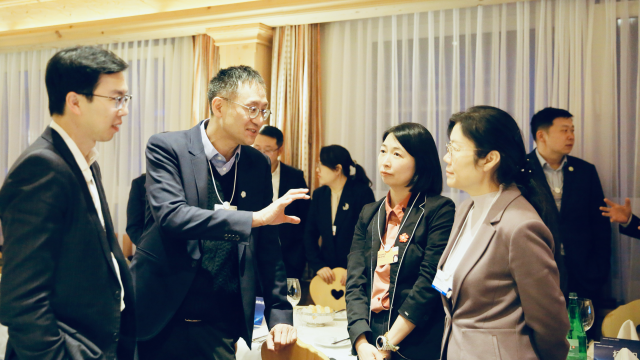
世界经济论坛梁锦慧 :警惕“窄播”风险,以“对话精神”拓宽世界的合作空间
Di Yi Cai Jing· 2026-01-22 13:29
Core Viewpoint - The collaboration discussed at the World Economic Forum aims to foster business opportunities, trade, and investment while addressing global issues such as environment, society, and health [1][5]. Group 1: Dialogue and Cooperation - Liang Jin-hui emphasized the importance of "dialogue spirit" to expand communication spaces and encourage diverse perspectives, countering the risks of "narrow casting" that limit information access [4]. - The concept of "small multilateralism" is emerging, where like-minded parties form smaller alliances for cooperation, differing from traditional multilateralism [4]. Group 2: Event Highlights - The 2026 Winter Davos Vision Dinner, hosted by Tencent News and Yicai Global, gathered over 30 scholars, business leaders, and politicians to discuss new trends in AI and seek new economic growth drivers [1][3]. - Liang Jin-hui suggested that participants, especially first-timers, should take time to connect with nature amidst the busy schedule of the forum to rejuvenate [4].

世界经济论坛:在动荡与变化的时代坚持对话和沟通
Xin Lang Cai Jing· 2026-01-18 20:33
Core Viewpoint - The World Economic Forum's 56th annual meeting highlights the complexities of the current geopolitical landscape, emphasizing the need for dialogue and cooperation amidst rising global risks [1] Group 1: Global Risks - A new era of competition is identified, with global risks becoming interwoven and escalating, as reflected in the 2026 Global Risk Report [2] - Only 1% of respondents believe that the global situation will remain stable in the short and long term, with 50% expecting instability in the next two years, a significant increase from 36% the previous year [2] - Geoeconomic confrontation is seen as the primary risk, with 18% of respondents indicating it could lead to a global crisis by 2026, influenced by U.S. tariff policies disrupting global trade [2][3] Group 2: Geopolitical Tensions - Geoeconomic confrontation has risen in risk ranking, now viewed as the most severe threat, reflecting the weakening of multilateral institutions [3] - Armed conflict between nations remains a high-ranking risk, with recent U.S. military actions underscoring the precarious global situation [3] - Environmental risks, while still significant, are perceived as less urgent in the short term due to ongoing geopolitical tensions [3] Group 3: Cooperation Trends - Despite challenges to multilateralism, cooperation persists in various forms, with climate and technology sectors showing strong collaboration [4] - "Small multilateralism" is emerging as a potential model for future cooperation, as global fragmentation and trade barriers increase [5] - The need for new cooperative frameworks is emphasized, as individual countries cannot address major challenges alone, necessitating proactive international engagement [5]