
环境风险

Search documents
世界经济论坛:在动荡与变化的时代坚持对话和沟通
Xin Lang Cai Jing· 2026-01-18 20:33
Core Viewpoint - The World Economic Forum's 56th annual meeting highlights the complexities of the current geopolitical landscape, emphasizing the need for dialogue and cooperation amidst rising global risks [1] Group 1: Global Risks - A new era of competition is identified, with global risks becoming interwoven and escalating, as reflected in the 2026 Global Risk Report [2] - Only 1% of respondents believe that the global situation will remain stable in the short and long term, with 50% expecting instability in the next two years, a significant increase from 36% the previous year [2] - Geoeconomic confrontation is seen as the primary risk, with 18% of respondents indicating it could lead to a global crisis by 2026, influenced by U.S. tariff policies disrupting global trade [2][3] Group 2: Geopolitical Tensions - Geoeconomic confrontation has risen in risk ranking, now viewed as the most severe threat, reflecting the weakening of multilateral institutions [3] - Armed conflict between nations remains a high-ranking risk, with recent U.S. military actions underscoring the precarious global situation [3] - Environmental risks, while still significant, are perceived as less urgent in the short term due to ongoing geopolitical tensions [3] Group 3: Cooperation Trends - Despite challenges to multilateralism, cooperation persists in various forms, with climate and technology sectors showing strong collaboration [4] - "Small multilateralism" is emerging as a potential model for future cooperation, as global fragmentation and trade barriers increase [5] - The need for new cooperative frameworks is emphasized, as individual countries cannot address major challenges alone, necessitating proactive international engagement [5]
2026年全球风险报告(英文版)-世界经济论坛
Sou Hu Cai Jing· 2026-01-16 18:11
Core Insights - The Global Risks Report 2026 highlights a turbulent global outlook, with 50% of respondents anticipating a turbulent or stormy situation in the next two years, increasing to 57% over the next decade, while only 1% expect a calm outlook [14][27][29] - Geoeconomic confrontation is identified as the most severe risk for the next two years, with 18% of respondents believing it could trigger a major global crisis, followed by state-based armed conflict at 14% [15][29][85] - Economic risks have seen significant increases in concern, particularly regarding economic downturns, inflation, and asset bubbles, driven by high debt levels and market volatility [15][34][98] - Technological risks, particularly misinformation and disinformation, are also rising, with adverse outcomes of AI technologies moving from 30th to 5th in long-term risk rankings [15][54][90] - Environmental risks are being deprioritized in the short term, with extreme weather events and pollution declining in perceived severity, although they remain significant concerns in the long term [62][67][96] Group 1: Global Risk Landscape - The report indicates a shift towards a multipolar or fragmented global order, with 68% of respondents expecting this trend to continue over the next decade [2][74] - Trust in multilateral systems is declining, with rising protectionism and national interests overshadowing collective action on global challenges [2][29][74] - The interconnectedness of risks is emphasized, with societal polarization and inequality identified as key factors exacerbating other global risks [60][67] Group 2: Economic Risks - Economic downturn and inflation have risen sharply in concern, with both risks moving up eight positions in the rankings, indicating a growing apprehension about economic stability [34][98] - The potential for asset bubbles is also highlighted, with concerns about debt sustainability contributing to fears of economic volatility [34][98] - The report suggests that the economic landscape is becoming increasingly precarious, with high debt levels and market fluctuations posing significant threats to stability [15][34] Group 3: Technological Risks - Misinformation and disinformation are ranked as the second most pressing short-term risk, reflecting the growing impact of technology on information integrity [54][90] - The adverse outcomes of AI technologies are now seen as a major long-term risk, indicating a shift in perception regarding the implications of technological advancements [54][90] - Cybersecurity threats are also highlighted, with increasing sophistication of cyberattacks targeting critical infrastructure [54][94] Group 4: Environmental Risks - Environmental concerns are experiencing a decline in immediate priority, with extreme weather events and pollution falling in perceived severity [62][67] - Despite this short-term deprioritization, environmental risks remain critical in the long-term outlook, with significant concerns about biodiversity loss and critical changes to Earth systems [62][67][96] - The report underscores the need for renewed attention to environmental issues, particularly in the context of aging infrastructure and climate change impacts [67]


地缘经济对抗预计将成为2026年首要威胁
Shang Wu Bu Wang Zhan· 2026-01-16 16:10
Core Insights - The World Economic Forum (WEF) identifies geopolitical economic confrontation as the largest risk for 2026, followed by inter-state conflict, extreme weather, social polarization, and the spread of misinformation [1] Economic Risks - Economic risks are expected to peak in 2026 and 2027, with concerns over economic slowdown, inflation, rising public debt, and asset bubbles under geopolitical tensions [1] Environmental Risks - The overall environmental risks remain severe, with extreme weather events, biodiversity loss, and significant changes in Earth's systems being the primary issues [1] - Approximately 75% of surveyed experts predict that environmental conditions will be extremely unstable in the coming years [1] Artificial Intelligence Risks - The risks associated with artificial intelligence are rapidly increasing, with concerns about its negative impacts on labor, safety, and social structures rising from 30th place in two-year forecasts to 5th place in ten-year outlooks [1]
9家上市公司暴露环境风险 中国交建控股公司违法采矿被罚
Mei Ri Jing Ji Xin Wen· 2025-12-07 13:24
Core Viewpoint - Environmental risks are increasingly becoming a significant operational risk for listed companies, impacting both their development and corporate image [2]. Group 1: Environmental Violations and Penalties - China Communications Construction Company (CCCC) was fined 1.384 million yuan for unauthorized mining activities and the utilization of illegally mined mineral products [1][2]. - The fine was imposed by the People's Government of Aotou Town, Guangzhou, and included the confiscation of illegal gains amounting to 3.46 million yuan, totaling 4.844 million yuan in penalties [3]. - Defu Technology's subsidiary, Jiujiang Defu New Energy Co., was fined 200,000 yuan for exceeding wastewater discharge standards, with copper concentration levels at 11.3 mg/L and a pH of 2.8 [5][6]. - Longjiang Machinery, a subsidiary of Haoneng Co., was fined 270,000 yuan for failing to reapply for a pollution discharge permit after adding new emission sources [6][7]. Group 2: Impact on Shareholders - The environmental risks associated with the nine listed companies involved affect approximately 433,100 shareholders, potentially exposing them to investment risks [2].


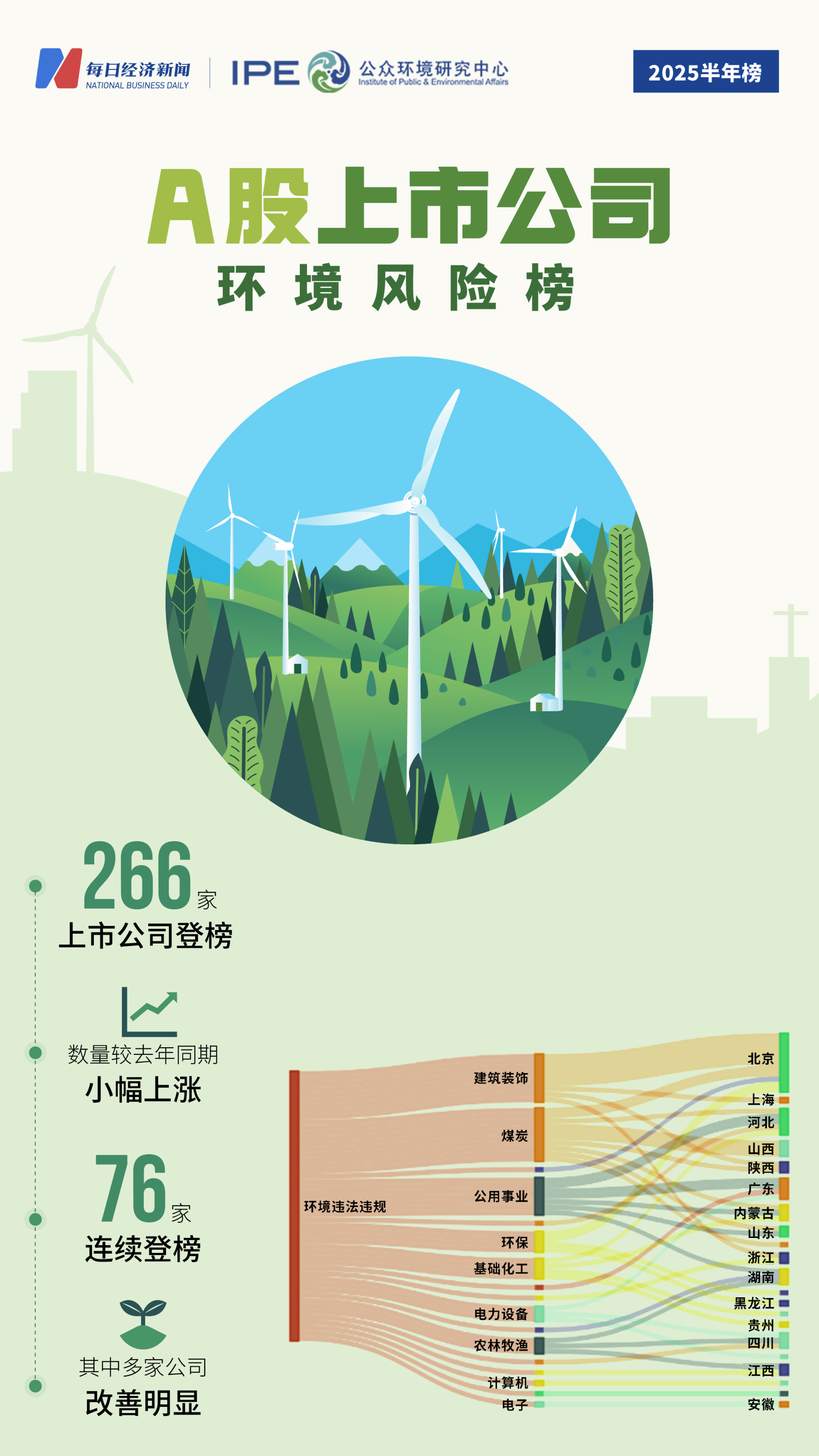
A股环境风险榜|2025年上半年266家上市公司暴露环境风险,一公司合计被罚没超7000万元
Mei Ri Jing Ji Xin Wen· 2025-10-31 09:39
Core Viewpoint - The 2025 first half A-share environmental risk list reveals that 266 listed companies are exposed to environmental risks, an increase of 10 companies compared to the same period last year, highlighting ongoing environmental compliance challenges in various industries [10][26]. Group 1: Environmental Risk Overview - A total of 504 regulatory data disclosures were made, involving 266 listed companies from January 1 to June 30, 2025 [10][8]. - Gansu Energy Chemical (SZ000552) ranked first on the environmental risk list, with its subsidiary receiving three administrative penalties totaling 1.508 million yuan [15][10]. - The coal and light manufacturing industries saw an increase of 7 companies each on the list, marking the highest growth among all sectors [10][26]. Group 2: Industry-Specific Insights - In the top 10 environmental risk companies, the coal industry had 4 companies, an increase of 1 from the previous year, while the construction and decoration industry maintained 2 companies [15]. - China Communications Construction (SH601800) ranked third, with its subsidiary facing significant penalties for illegal mining activities, totaling approximately 61.245 million yuan [17][18]. - The environmental violation types included water pollution (26.88%), air pollution (21.88%), and solid waste pollution (8.75%), with a noted decrease in these categories compared to the previous year [20]. Group 3: Company-Specific Cases - High Energy Environment (SH603588) faced penalties for exceeding arsenic discharge limits, resulting in direct economic losses of 9.8543 million yuan [19]. - Multiple companies, including Duolun Technology (SH603528) and Jiangxi Changyun (SH600561), were penalized for data falsification and issuing false reports, with fines totaling 0.408 million yuan and 0.11 million yuan respectively [25]. - 76 companies appeared on the environmental risk list for two consecutive periods, indicating persistent compliance issues [31]. Group 4: Regulatory Developments - The China Securities Regulatory Commission is revising the "Guidelines for the Preparation of Sustainable Development Reports" to enhance environmental reporting standards among listed companies [32].

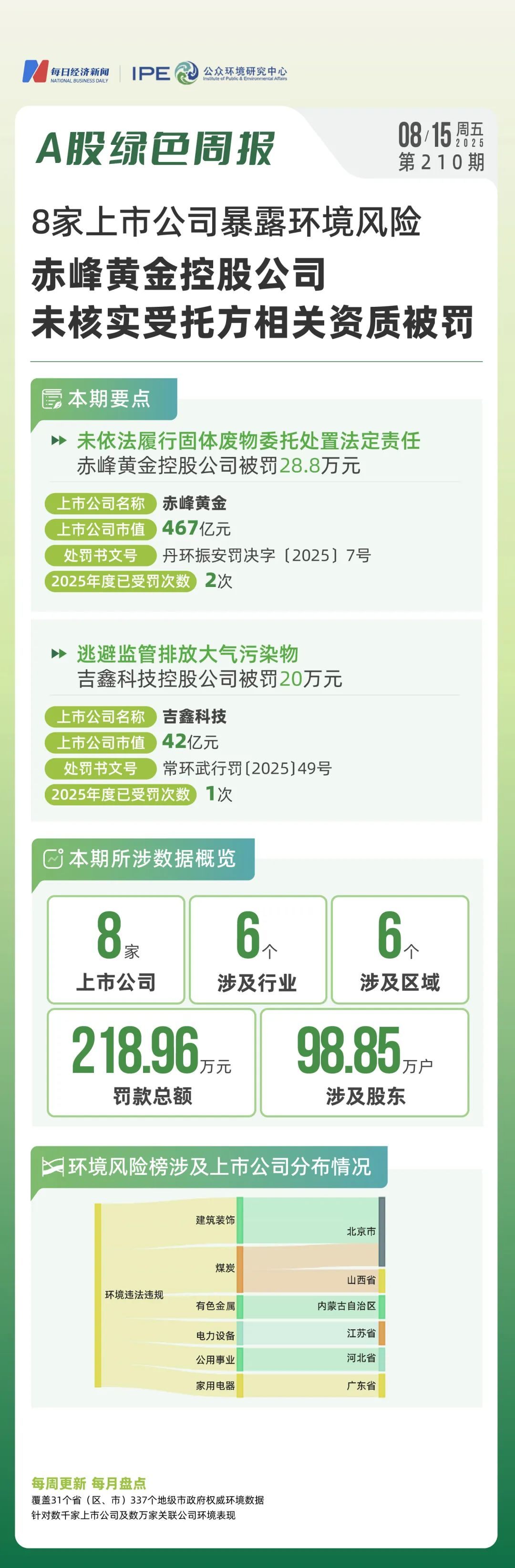
8家上市公司暴露环境风险,赤峰黄金控股公司未核实受托方相关资质被罚|A股绿色周报
Mei Ri Jing Ji Xin Wen· 2025-08-15 13:12
Core Viewpoint - The article highlights the increasing environmental risks faced by listed companies in China, emphasizing the importance of environmental compliance and transparency in corporate operations [4][5][9]. Group 1: Environmental Violations and Penalties - Eight listed companies were recently identified for environmental violations, with five of them being state-controlled enterprises [6][7]. - Chifeng Gold's subsidiary, Wulong Gold Mining, was fined 288,000 yuan for failing to properly manage solid waste disposal, as it did not verify the qualifications of the companies it entrusted with waste management [7][8]. - Sanxiong Aurora was fined 210,000 yuan for not completing necessary environmental protection facilities before commencing production [8]. Group 2: Regulatory Context and Investor Implications - The article discusses the growing emphasis on ESG (Environmental, Social, and Governance) principles among investors, indicating that environmental responsibilities of companies are increasingly scrutinized [9][10]. - The public's right to access environmental information and participate in environmental protection is reinforced by various laws and regulations, promoting transparency in corporate environmental practices [10].



10家上市公司现环境风险 华能国际旗下企业被罚
Mei Ri Jing Ji Xin Wen· 2025-08-10 12:40
Core Viewpoint - In the first week of August 2025, ten listed companies in the A-share market were identified as having environmental risks, raising concerns about their environmental protection and disclosure responsibilities [1]. Group 1: Companies with Environmental Violations - Huaneng International's subsidiary, Huaneng Linxiang New Energy Co., was fined 200,000 yuan for failing to legally approve environmental documents and for operating without the necessary environmental protection facilities [2][3]. - Huaneng International's other subsidiary, Huaneng Hunan Yueyang Power Co., was fined 150,000 yuan for improper wastewater management and failure to implement effective dust control measures [4]. - The total fines imposed on Huaneng International's subsidiaries amounted to 350,000 yuan [4]. Group 2: Other Companies Facing Penalties - Haineng Energy Technology Co. faced a fine of 246,400 yuan due to its subsidiary, Daqing Sanju Energy Purification Co., illegally discharging pollutants through unauthorized pipes [5]. - Guoxuan High-Tech's subsidiary, Yifeng Guoxuan Lithium Industry Co., was fined 300,000 yuan for unauthorized storage of industrial solid waste [5][6].

9家上市公司暴露环境风险 金达莱控股企业被罚28万元
Mei Ri Jing Ji Xin Wen· 2025-04-13 14:48
Core Viewpoint - Recent environmental violations by several listed companies have raised concerns about their operational risks and responsibilities in environmental protection [2][3]. Group 1: Environmental Violations and Penalties - Jindalai's subsidiary, Jincen Water Co., was fined 280,000 yuan for discharging wastewater into the external environment due to improper modifications to drainage systems [3][4]. - Northern Rare Earth's subsidiary, Baotou Green Source, was fined 109,092 yuan for exceeding air pollutant discharge limits, specifically carbon monoxide [4][5]. - Chifeng Gold's subsidiary, Wulong Mining, was fined 246,000 yuan for commencing production without the necessary environmental protection facility approvals [7]. - Huadong's subsidiary, Quzhou Minxin Food Co., was fined 296,000 yuan for exceeding pollutant discharge limits and evading regulatory oversight [8]. Group 2: Impact on Shareholders and Market Perception - The environmental risks associated with these companies could potentially affect 1.2548 million shareholders, raising concerns about investment risks [3]. - The report highlights that environmental risks are becoming a significant aspect of operational risks for listed companies, impacting their development and public image [3].


10家上市公司因环境违规被罚 国中水务、电投能源等企业环保处罚引关注
Jin Rong Jie· 2025-03-30 23:03
Group 1 - The A-share market has seen a resurgence of environmental issues, with 10 listed companies penalized for violations related to excessive emissions and unapproved environmental facilities [1][3] - Guozhong Water Holdings' Taiyuan Haofeng Wastewater Treatment Co., Ltd. was fined 400,000 yuan for exceeding water pollutant discharge standards, with total nitrogen and ammonia nitrogen levels surpassing national limits [1][3] - Electric Power Investment Energy was fined 350,000 yuan for using environmental protection facilities that had not been approved, highlighting deficiencies in project management and compliance [2][3] Group 2 - Environmental risks are becoming a significant operational risk for listed companies, with 6 out of 10 penalized companies being state-owned enterprises, potentially affecting 887,300 shareholders [3] - The increasing emphasis on ESG (Environmental, Social, and Governance) investment principles is leading investors to prioritize companies' sustainable development capabilities [3] - Companies must enhance their environmental management and compliance levels to protect their brand image and investor confidence [5] Group 3 - The level of public disclosure regarding environmental regulatory information has improved, supported by legal frameworks that ensure citizens' rights to access environmental information [4] - The revised Environmental Protection Law emphasizes the importance of information disclosure and public participation in environmental protection [4]
