
小核酸药物研发

Search documents
行业周报:GSK联手中国新锐,siRNA赛道布局再下一城
KAIYUAN SECURITIES· 2026-03-01 10:45
Investment Rating - The investment rating for the pharmaceutical and biotechnology industry is "Positive" (maintained) [2] Core Insights - The report highlights the ongoing collaboration between GSK and Chinese company Frontier Bio in the siRNA field, indicating that Chinese enterprises are gaining international recognition for their R&D capabilities [6][7] - The pharmaceutical sector saw a 0.5% increase, underperforming the CSI 300 index by 0.58 percentage points, ranking 25th among 31 sub-industries [8][22] - The report recommends focusing on innovative drugs and their supply chains, including CXO and research services, as well as emerging industries like AI and brain-machine interfaces [9] Summary by Sections GSK Collaboration and Market Trends - GSK has been actively engaging in partnerships related to small nucleic acids, with significant pipelines in ASO and siRNA. Notably, GSK's collaboration with Frontier Bio involves a total transaction value of up to $1.003 billion for two pipelines [6][7][18] - The report notes that GSK's recent partnerships reflect the growing technical strength and platform value of Chinese companies in the small nucleic acid drug development sector [7][17] Market Performance - In the week of February 4, 2026, the pharmaceutical sector increased by 0.5%, with the medical consumables sector showing the highest growth at 3.99%. Conversely, the medical R&D outsourcing sector experienced the largest decline at -2.2% [8][22][23] - Monthly data indicates that since the beginning of 2026, the overall market has been on an upward trend, with various sectors performing differently [22] Recommendations - The report continues to favor innovative drugs and their associated industries, recommending specific companies such as Heng Rui Medicine, WuXi AppTec, and others for investment [9][26] - Weekly recommendations include companies like Bai Li Tian Heng and Kanglong Huacheng, indicating a strategic focus on firms with strong growth potential in the pharmaceutical sector [9]

行业周报:GSK联手中国新锐,siRNA赛道布局再下一城-20260301
KAIYUAN SECURITIES· 2026-03-01 10:20
Investment Rating - The investment rating for the pharmaceutical and biotechnology industry is "Positive" (maintained) [2] Core Insights - The report highlights the ongoing collaboration between GSK and domestic companies in the siRNA field, indicating that Chinese enterprises are gaining international recognition for their R&D capabilities [6][7] - The pharmaceutical sector has shown a 0.5% increase, underperforming the CSI 300 index by 0.58 percentage points, ranking 25th among 31 sub-industries [8][22] - The report emphasizes the positive outlook for innovative drugs and their supply chain, recommending specific companies for investment [9] Summary by Sections GSK Collaboration and R&D - GSK has been actively collaborating in the small nucleic acid space, with multiple significant pipelines. Since 2009, GSK has engaged in numerous business development transactions focused on ASO and siRNA [6][16] - In 2026, GSK partnered with a Chinese siRNA company, Frontline Bio, for a deal worth up to $1.003 billion, showcasing the growing recognition of Chinese firms in the global market [7][18] Market Performance - The pharmaceutical sector's performance in February 2026 showed a 0.5% increase, with the medical consumables sector leading with a 3.99% rise, while the medical R&D outsourcing sector experienced the largest decline at 2.2% [22][23] - Monthly data indicates that the overall market has been on an upward trend since the beginning of 2026, with various sectors performing differently [22][26] Investment Recommendations - The report maintains a positive outlook on innovative drugs and their supply chain, including CXO and research services, as well as emerging industries like AI and bio-manufacturing [9] - Monthly and weekly investment recommendations include companies such as Heng Rui Medicine, WuXi AppTec, and Frontline Bio, among others [9]

迈威生物接待36家机构调研,包括淡水泉、天风证券、东吴证券、华福证券等
Jin Rong Jie· 2026-02-28 03:58
Core Insights - The company is advancing multiple clinical research programs, including Nectin-4 ADC (9MW2821) and B7-H3 ADC (7MW3711), targeting various cancers with promising clinical data and development strategies [1][2][5]. Group 1: Nectin-4 ADC (9MW2821) - Nectin-4 ADC (9MW2821) utilizes a next-generation conjugation technology, MMAE toxin, and DAR4 design, currently in clinical research for urothelial carcinoma, cervical cancer, triple-negative breast cancer, and esophageal cancer [1][4]. - Over 1,900 patients have been enrolled in clinical trials, with several indications progressing ahead of global competitors [1][4]. - Three pivotal Phase III trials are ongoing, with interim analyses planned for 2026, potentially leading to a new drug application meeting with CDE [1][4]. Group 2: B7-H3 ADC (7MW3711) - B7-H3 ADC (7MW3711) has completed Phase II trials, with data presented at the 2025 ESMO conference showing an objective response rate (ORR) of 42.9% for esophageal cancer and 50.0% for small cell lung cancer at a dose of 4.0 mg/kg [2][5]. - The drug demonstrates good tolerability and anti-tumor activity, with a disease control rate (DCR) of 100% for esophageal cancer and 90.0% for small cell lung cancer [2][5]. - The company is pursuing differentiated development strategies, including trials combining 7MW3711 with PD-1/VEGF dual antibodies and platinum-based chemotherapy [6]. Group 3: Small RNA and TCE Platforms - The company has established a small RNA platform focusing on chronic diseases, with the lead candidate 2MW7141 targeting lipid disorders and cardiovascular events, expected to submit IND applications in the US and China this year [3][7]. - The TCE platform features modified CD3 antibodies and secondary signal-activating antibodies, enhancing tumor targeting and reducing off-target effects [8][9]. - 6MW5311, a TCE targeting CD3 and LILRB4, is aimed at treating relapsed/refractory acute myeloid leukemia and is expected to submit IND applications in mid-2026 [9]. Group 4: IL-11 Monoclonal Antibody (9MW3811) - IL-11 monoclonal antibody (9MW3811) is in Phase II trials for pathological scars, with the first patient dosed in December 2025, marking it as the first IL-11 targeted drug for this indication [10]. Group 5: Hong Kong Stock Issuance - The company has submitted an application for H-share issuance on the Hong Kong Stock Exchange and has received a notice for overseas issuance, with the approval process progressing smoothly [11].


前沿生物药业(南京)股份有限公司2025年度业绩快报公告
Shang Hai Zheng Quan Bao· 2026-02-27 19:34
Core Viewpoint - The company reported a total revenue of 143.67 million yuan for 2025, marking a 10.96% increase from the previous year, primarily driven by sales of its innovative HIV drug and other products [3][4] Financial Performance and Status - The company experienced a net loss attributable to shareholders of 261.72 million yuan, an increase in loss of 60.33 million yuan compared to the previous year, mainly due to the absence of investment income from the disposal of subsidiary equity in 2024 [3] - The total assets at the end of the reporting period were 1.586 billion yuan, a decrease of 12.49% from the beginning of the year, while the equity attributable to the parent company decreased by 22.52% to 884 million yuan [3] Business Operations - The core product, the HIV drug, maintained its position as the preferred medication in the inpatient and severe cases, with outpatient market revenue continuing to grow after being included in the medical insurance directory [4] - The company successfully launched a new infrared therapy patch, establishing a distributor management team and actively expanding online marketing channels [4] Research and Development - The company increased its R&D investment, focusing on a multi-layered pipeline that includes antiviral business, small nucleic acid innovative drugs, and high-end generic drugs [5] - Significant progress was made in small nucleic acid drug development, with several candidates entering various stages of research and regulatory processes [5] - An exclusive licensing agreement was signed with GSK, providing the company with a $40 million upfront payment and potential milestone payments totaling up to $950 million, which will support core R&D and financial optimization [6]
前沿生物牵手GSK交易额超10亿美元 聚焦小核酸创新药扣非连续三年减亏
Chang Jiang Shang Bao· 2026-02-24 23:48
Core Viewpoint - Frontier Biotech has entered into a significant international collaboration with GlaxoSmithKline (GSK), granting GSK exclusive global rights to develop, manufacture, and commercialize two small RNA (siRNA) drug candidates, with a total transaction value potentially exceeding $1 billion [1][2]. Group 1: Collaboration Details - The agreement includes an upfront payment of $40 million and a milestone payment of $13 million, with potential additional milestone payments of up to $950 million based on development, regulatory, and commercialization achievements [2][3]. - The two siRNA products are in early development stages, with one candidate having entered the Investigational New Drug (IND) application phase and the other in preclinical development, both targeting inflammation-driven diseases such as kidney diseases [2][3]. Group 2: Financial Implications - The collaboration is expected to significantly improve Frontier Biotech's cash flow, providing funding for core pipeline development and technology platform upgrades, while allowing the company to focus its research resources and optimize its financial structure [3]. - For 2025, Frontier Biotech forecasts a revenue of approximately CNY 140 million to CNY 145 million, representing a year-on-year growth of 8.13% to 11.99%, while the net loss attributable to shareholders is projected to be between CNY 255 million and CNY 290 million [6]. Group 3: R&D Focus and Strategy - Frontier Biotech is undergoing its third transformation, shifting towards a dual-driven model of "innovative drugs + high-end generics," with a strong emphasis on small RNA drug development [6]. - The company has achieved a reduction in net profit losses for three consecutive years, with the expected loss for 2025 being between CNY 288 million and CNY 323 million, a decrease of CNY 4.31 million to CNY 39.31 million compared to the previous year [6].
60岁南京医药大佬 一把狂揽70亿
2 1 Shi Ji Jing Ji Bao Dao· 2026-02-24 16:08
Core Viewpoint - The company Frontline Bio has entered into a significant exclusive licensing agreement with GlaxoSmithKline (GSK) to co-develop two small nucleic acid drugs, with a total deal value exceeding $1 billion, which will help improve its cash flow and financial structure [2][5]. Group 1: Licensing Agreement Details - The agreement includes an upfront payment of $40 million and a milestone payment of $13 million, with potential future payments up to approximately RMB 6.55 billion based on successful development and commercialization [2]. - The collaboration will allow Frontline Bio to focus on early development of the drugs, while GSK will handle global clinical development and commercialization [5]. Group 2: Company Background and Financial Situation - Frontline Bio, founded by CEO Xie Dong in 2013, has faced financial difficulties, accumulating losses of over RMB 1.5 billion in the past five years, with cash reserves declining from RMB 527 million in 2023 to RMB 249 million in 2024 [6][11]. - The company’s flagship product, Aikening, has struggled with sales growth despite being the first long-acting HIV-1 fusion inhibitor approved in China [8][11]. Group 3: Focus on Small Nucleic Acid Drugs - Xie Dong has shifted the company’s strategy to focus on small nucleic acid drugs, which are seen as a promising area in the pharmaceutical industry, expanding from rare diseases to chronic conditions [3]. - The company is developing multiple products targeting various conditions, including IgA nephropathy and hyperuricemia, with most projects still in early stages [3][4]. Group 4: Market Context and Competition - The small nucleic acid drug market is becoming increasingly competitive, with nearly 20 approved products globally and several domestic companies also pursuing this area [14]. - Frontline Bio's pipeline is primarily in preclinical development, and the timeline for clinical trials could extend 7-8 years, creating uncertainty regarding future milestone payments [14].


开源证券晨会纪要-20260224
KAIYUAN SECURITIES· 2026-02-24 15:22
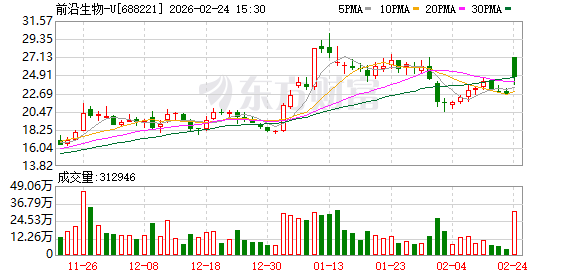
Group 1: Real Estate and Construction - The real estate market continues to show signs of bottoming out, with a weak performance in new home sales during the Spring Festival period, reflecting poor supply and demand dynamics [3][9][12] - The land market has seen a significant decline in both supply and demand, with total land area launched in January 2026 down 16% year-on-year, and total land transaction value down 39% [11][12] - Policy measures such as the reduction of the value-added tax on second-hand housing and the lowering of minimum down payments for commercial properties indicate a generally accommodative policy environment [3][12] Group 2: Agriculture, Forestry, Animal Husbandry, and Fishery - The pig price is under pressure post-holiday due to the end of stocking and limited weight reduction, with the average price of pigs at 11.66 yuan/kg as of February 13, 2026, down 0.40 yuan/kg week-on-week [4][13] - The supply side shows a slight decrease in the average weight of pigs being marketed, indicating ongoing pressure from large pigs and structural pricing risks [13][14] - The overall market sentiment remains weak, with expectations of a seasonal decline in demand in the weeks following the holiday [14] Group 3: Retail and Consumer Services - The retail sector is experiencing a steady recovery in consumption, with payment transactions on the eve of the Spring Festival increasing by 21.64% compared to the previous year [5][19] - Key retail and catering enterprises reported an average daily sales increase of 8.6% during the first four days of the holiday compared to the same period in 2025 [19][25] - Investment recommendations focus on high-quality companies in the consumer sector, particularly those in gold and jewelry, offline retail, cosmetics, and medical aesthetics [26] Group 4: Pharmaceuticals - The company has entered into an exclusive licensing agreement with GSK for two siRNA pipeline products, with potential total transaction value reaching up to $1 billion [6][28] - Revenue forecasts for the company are maintained at 143 million, 169 million, and 201 million yuan for 2025, 2026, and 2027, respectively, with a downward adjustment in net profit estimates [6][28] - The collaboration with GSK highlights the company's growing recognition in the small nucleic acid drug development field, paving the way for future global partnerships [28][29]
前沿生物:公司信息更新报告两款siRNA管线独家授权GSK,携手推进全球合作-20260224
KAIYUAN SECURITIES· 2026-02-24 07:25
Investment Rating - The investment rating for the company is "Buy" (maintained) [1] Core Views - The company has entered into an exclusive licensing agreement with GSK for two siRNA product pipelines, which will enhance its global collaboration efforts [4][5] - The revenue forecast for the company is maintained at 143 million, 169 million, and 201 million yuan for 2025, 2026, and 2027 respectively, while the net profit estimates have been revised downwards to -257 million, -208 million, and -199 million yuan for the same years [4][5] - The current stock price corresponds to a price-to-sales ratio (P/S) of 59.3, 50.2, and 42.1 for 2025, 2026, and 2027 respectively, indicating a long-term competitive outlook due to the company's focus on small nucleic acid pipeline development [4][5] Financial Summary - The company reported a revenue of 114 million yuan in 2023, with a year-on-year growth of 34.8%, and is projected to grow to 201 million yuan by 2027 [8] - The net profit for 2023 was -329 million yuan, with an expected improvement to -199 million yuan by 2027 [8] - The gross margin is expected to improve from 29.0% in 2023 to 34.2% in 2027, while the net margin is projected to improve from -287.9% to -99.2% over the same period [8]
前沿生物(688221):公司信息更新报告:两款siRNA管线独家授权GSK,携手推进全球合作
KAIYUAN SECURITIES· 2026-02-24 06:43
Investment Rating - The investment rating for the company is "Buy" (maintained) [1][4] Core Insights - The company has entered into an exclusive licensing agreement with GSK for two siRNA pipeline products, which will enhance its global collaboration efforts [4][5] - The revenue forecast for the company is maintained at 143 million, 169 million, and 201 million yuan for 2025, 2026, and 2027 respectively, while the net profit estimates have been revised downwards to -257 million, -208 million, and -199 million yuan for the same years [4][5] - The current stock price corresponds to a price-to-sales (P/S) ratio of 59.3, 50.2, and 42.1 for the years 2025, 2026, and 2027 respectively [4][5] Financial Summary - The company reported a revenue of 114 million yuan in 2023, with a year-over-year growth of 34.8%, and is projected to grow to 201 million yuan by 2027 [8] - The net profit for 2023 was -329 million yuan, with an expected improvement to -199 million yuan by 2027 [8] - The gross margin is expected to improve from 29.0% in 2023 to 34.2% in 2027 [8] - The company’s P/B ratio is projected to increase from 6.3 in 2023 to 17.8 in 2027 [8]
前沿生物与葛兰素史克达成小核酸药物全球授权许可合作 累计或将获得最高超10亿美元收益
Zheng Quan Ri Bao Wang· 2026-02-24 04:42
Core Insights - Frontline Bio has entered into an exclusive licensing agreement with GlaxoSmithKline (GSK) for two small nucleic acid (siRNA) pipeline products, enhancing its global development and commercialization capabilities [1][2] - The agreement includes an upfront payment of $40 million and potential milestone payments totaling up to $950 million based on successful development and commercialization [1][2] - The collaboration is expected to improve Frontline Bio's cash flow and financial structure, providing solid funding for core pipeline research and technology platform upgrades [2][3] Company Summary - Frontline Bio will be responsible for early development work on the two products, including advancing one product through Phase I clinical trials in China and supporting IND research for the other [1] - GSK will handle all global clinical development, regulatory submissions, and commercialization activities for the products [1] - The partnership reflects growing recognition of Frontline Bio's research capabilities in the small nucleic acid drug development field [2][3] Industry Context - Small nucleic acid drugs are a significant development direction in the global pharmaceutical industry, offering precise gene silencing and durable, highly specific efficacy [3] - The market for small nucleic acid therapies is expanding from rare diseases to chronic conditions such as cardiovascular and metabolic diseases, indicating a broad market potential [3]