居民存款活化

Search documents
信贷“开门红”成色几何?【国盛宏观熊园团队】
Xin Lang Cai Jing· 2026-02-14 03:05
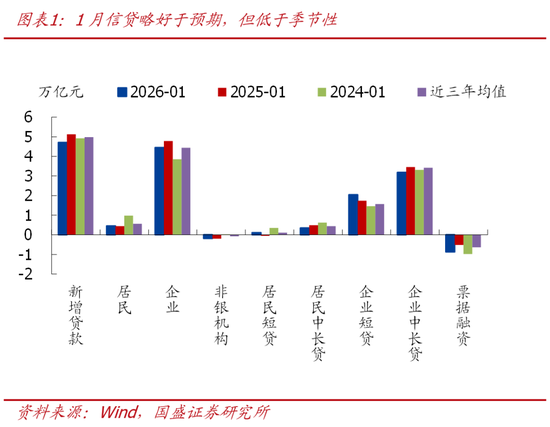
Core Viewpoint - Overall, the January credit "opening red" is insufficient, particularly reflected in the weak performance of long-term loans for residents and enterprises, while short-term loans for enterprises show signs of a surge [2][26] Group 1: Credit Data Summary - In January, new RMB loans amounted to 4.71 trillion, a year-on-year decrease of 420 billion, slightly better than market expectations of 4.5 trillion but below seasonal averages of 4.98 trillion [4][28] - New social financing reached 7.22 trillion, a year-on-year increase of 165.4 billion, exceeding market expectations of 6.51 trillion and seasonal averages [13][37] - The growth rate of outstanding social financing decreased to 8.2%, down 0.1 percentage points from the previous month [13][39] Group 2: Loan Structure Analysis - On the residential side, short-term loans increased by 1.097 trillion, indicating potential marginal improvement in consumer spending due to early issuance of consumption subsidies, while long-term loans decreased for four consecutive months [7][31] - For enterprises, short-term loans increased by 2.05 trillion, reflecting cash flow pressures, while long-term loans decreased by 2.8 trillion, indicating weak investment willingness [10][34][35] Group 3: Monetary Indicators - M1 increased by 4.9% year-on-year, up 1.1 percentage points from the previous month, attributed to a lower base and accelerated activation of resident deposits [17][41] - M2 rose by 9% year-on-year, up 0.5 percentage points, likely supported by increased fiscal spending [17][41] - Total deposits in January increased by 8.09 trillion, with a year-on-year increase of 3.77 trillion, indicating a shift in resident deposits [17][41]

银行周报(2026/1/12-2026/1/16):12月收支表:居民存款边际活化,中小银行配债意愿或有下降-20260118
GUOTAI HAITONG SECURITIES· 2026-01-18 07:44
Investment Rating - The report assigns an "Accumulate" rating for the banking sector [5] Core Insights - In December, there are signs of marginal activation in household savings deposits, while medium to long-term loans from small and medium-sized banks show significant growth. The bond market experienced fluctuations, leading to a potential decrease in the willingness of small and medium-sized banks to allocate bonds [2][3] Summary by Sections Liabilities - Personal deposits increased by CNY 428.7 billion year-on-year, with demand deposits and time deposits increasing by CNY 100 billion and decreasing by CNY 39.1 billion respectively. There is a trend of time deposits migrating from small and medium-sized banks to large banks, with large banks and small banks seeing increases of CNY 75.9 billion and decreases of CNY 115 billion respectively [3] - Corporate deposits decreased by CNY 134.3 billion year-on-year, with demand deposits and time deposits decreasing by CNY 191.2 billion and increasing by CNY 172.7 billion respectively. Small and medium-sized banks contributed significantly to the increase in time deposits, with a year-on-year increase of CNY 118.3 billion in December [3] - Non-bank deposits decreased by CNY 3.2 trillion year-on-year, with large banks and small banks seeing decreases of CNY 3.1 trillion and increases of CNY 63.8 billion respectively. The significant increase in non-bank deposits is attributed to a low base effect from the self-regulatory mechanism for interbank demand deposits in 2024 [3] - Financial bonds increased by CNY 44.9 billion year-on-year, with large banks and small banks seeing increases of CNY 14.2 billion and CNY 30.7 billion respectively [3] Assets - Loans decreased by CNY 50.9 billion year-on-year, primarily due to a decrease in non-bank loans. Short-term loans and medium to long-term loans increased by CNY 86.2 billion and CNY 33.9 billion respectively. Large banks saw significant increases in short-term loans, while small banks showed a contrasting trend [4] - Bond investments decreased by CNY 909.8 billion year-on-year, with large banks and small banks seeing decreases of CNY 35.2 billion and CNY 874.6 billion respectively. The fluctuations in the bond market have led to a potential decrease in the willingness of small and medium-sized banks to allocate bonds, while they have increased their holdings in repurchase agreements by CNY 778 billion year-on-year [4]
华创张瑜:2026年将是中国股市配置价值觉醒元年,中游制造是最确定方向 | Alpha峰会
Hua Er Jie Jian Wen· 2025-12-24 07:16
Core Viewpoint - The year 2026 is anticipated to be a pivotal year for the awakening of value in China's capital market, moving towards a low-volatility and high-Sharpe ratio investment phase [1][6][26]. Economic Outlook - China's economy is expected to emerge from its low point and enter a recovery phase, with exports remaining a key support for macroeconomic performance in 2026 [1][30]. - Despite overall external demand pressure, China's manufacturing competitiveness remains intact, particularly in the midstream sector, which is expected to show resilience in exports [1][30]. - CPI is likely to trend positively, with a high certainty of turning positive, reflecting the ongoing recovery in domestic demand [1][30][33]. - PPI is expected to show an upward trend, but its year-on-year positive growth needs to be verified in the second quarter [1][30][37]. Policy Perspective - Macro policies are shifting away from "extraordinary" measures, focusing instead on stabilizing expectations and supporting economic operations [2][26]. - The emphasis will be on sustainable policy adjustments rather than large-scale stimulus, with a focus on balancing short-term and long-term goals [2][27]. Asset Allocation Insights - In 2026, a "dual bull market" in stocks and bonds is unlikely; the focus will be on asymmetric volatility between the two asset classes [2][5]. - Investors are encouraged to consider undervalued, high-dividend sectors for allocation, while speculative funds should target industries with high capacity utilization and limited capital expenditure [2][5]. Sector-Specific Analysis - The midstream manufacturing sector is identified as the most certain area of prosperity for 2026, supported by enhanced export competitiveness and the implementation of anti-involution policies [5][30]. - The return on equity (ROE) in midstream manufacturing is expected to stabilize and improve, with PPI year-on-year growth anticipated to stop declining in the first half of the year [5][30]. Market Dynamics - The trend of residents moving their savings into financial assets is expected to continue, although risk appetite may not rise rapidly [2][5]. - The stock market's trading volume is projected to remain high but may not see significant increases compared to previous years [2][5]. Price Trends - The housing market's recovery is contingent on mortgage rates being lower than rental yields, which is a critical condition for stabilizing property prices [5][40]. - The relationship between mortgage rates and rental yields is highlighted as a key indicator for predicting housing price stabilization [5][40].