
市场换手率

Search documents
未知机构:股票性价比指标分析以相除与相减两种方法衡量股市性价比可直观展示当前数据情况-20260204
未知机构· 2026-02-04 02:05
Summary of Key Points from the Conference Call Industry Analysis - The analysis focuses on the equity market and bond market performance, particularly in relation to stock price performance and valuation metrics. Core Insights and Arguments - **Stock Valuation Metrics**: As of the end of January 2026, the stock price-to-earnings ratio (P/E) metrics show a ratio of 0.95 and a difference metric of -0.09, both reaching new lows since September 2024, with historical percentiles at 0.498 and -1.68 respectively [1] - **Market Performance Relative to Historical Averages**: The current market performance is above the historical median, indicating that the equity market still possesses some value [2] - **Bond Yield Analysis**: The yield difference between stocks and bonds is currently 16.48%, indicating that holding stocks has outperformed long-term government bonds by 6.48% over the past decade. This metric is at the 69.3 percentile historically, suggesting a lower valuation for the stock market compared to historical highs [3] - **Equity Risk Premium (ERP)**: The ERP as of January 2026 is 2.48, significantly lower than the levels seen in previous years, indicating potential for upward movement in the equity market. The historical percentile for ERP is at 60.1%, suggesting some room for improvement compared to the peaks in 2018 and 2021 [3] - **Valuation Levels of Broad Indices**: Most broad indices are currently above the 60th percentile in terms of valuation. The dynamic P/E ratio for the Wande All A index is 23.3, with a historical percentile of 82.6% [3] - **Valuation Disparity**: The historical percentiles for the ChiNext 50 and CSI 300 are 40% and 65.5% respectively, indicating that the Wande All A index is relatively overvalued compared to these indices [4] - **Market Turnover Rate**: The average turnover rate as of January 2026 is 2.42%, which is relatively high, with a historical percentile of 89.9%. This indicates increased trading activity compared to previous periods [4] - **Industry MACD Indicators**: The MACD indicators for 28 industries indicate a bullish market, with values exceeding 97%, suggesting a broad market rally [5] - **Stock Performance Above Annual Line**: As of January 2026, 74.92% of stocks are above their annual line, indicating a recovery from lower levels seen in previous months [5] - **Stock Buyback Trends**: The scale of stock buybacks has decreased to 6.6 billion, indicating a low level of buyback activity in the market [5] - **Net Reduction Trends**: There is a continuing trend of net reductions in stock holdings, with a peak net reduction of 569.7 billion in January 2020, marking the highest level of reductions since September 2020 [6] Other Important Insights - The analysis highlights the disparity in valuations across different indices and sectors, suggesting that while some areas may be overvalued, others may present investment opportunities. - The current market conditions reflect a complex interplay between stock performance, investor behavior, and macroeconomic indicators, warranting careful monitoring for potential investment strategies.
泓德基金:调整是市场运行的正常现象
Zheng Quan Shi Bao Wang· 2025-09-04 08:29
Core Viewpoint - The recent adjustments in the equity market are attributed to profit-taking after significant gains and a cooling of speculative behavior among investors, leading to increased selling pressure [1] Market Performance - Since April 8, the total A-share market has risen over 30%, while the Shanghai Composite Index has increased by more than 25% [1] - Historical data indicates that when major indices experience a rapid increase of over 30%, market corrections typically follow, making the current adjustment expected [1] Market Valuation - Current market valuations have risen but have not reached bubble levels [1] - The turnover rate in the A-share market has increased but has not surpassed the high point from October 8 of the previous year [1] Fund Flows - There is evidence of increased equity allocation through margin trading and "fixed income plus" products among residents [1] - Despite the market's rise, data from high-frequency ETFs and public fund monthly reports indicate that investors continue to redeem equity funds, suggesting that the funding environment is not overly exuberant [1] Investment Strategy - Given the structural market conditions and increased volatility, there is a need for stronger stock selection and directional judgment capabilities [1]
信达策略:当下或是牛市主升浪的前期
Sou Hu Cai Jing· 2025-08-17 23:57
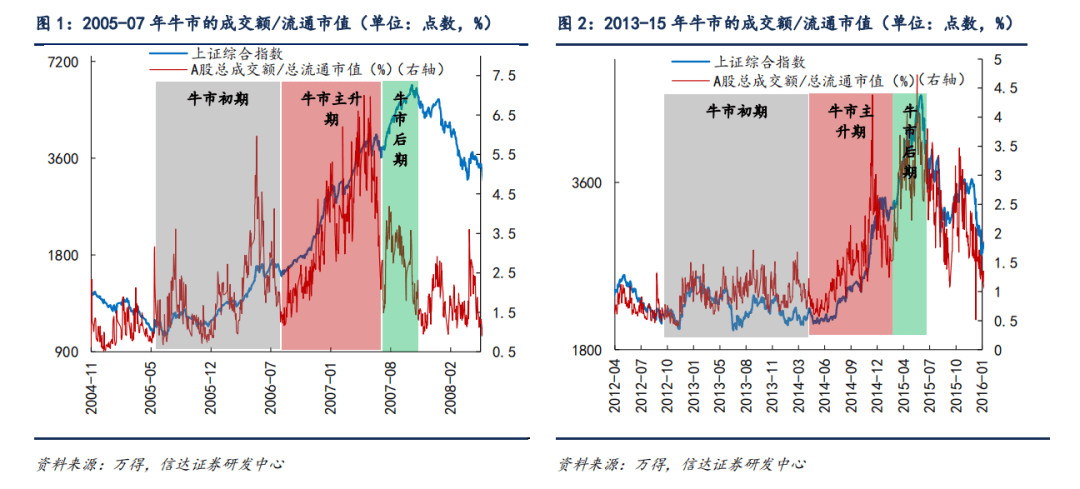
Group 1 - The current market may be in the early stage of a bull market's main upward wave, supported by three main reasons: the market turnover rate is still significantly lower than the peak observed at the beginning of the bull market, the prevailing small-cap style suggests it is likely the early stage of the main upward wave, and the equity financing scale has not yet reached historical highs [1][12][16] Group 2 - During previous bull market main upward waves, the market turnover rate typically increased significantly, with historical examples showing turnover rates rising from around 1.5% to over 6% and from below 1% to above 4% [2][4] - The style of leading stocks often changes between the early and late stages of a bull market, with small-cap stocks leading in the early stage and large-cap stocks taking over in the later stage [7][11] Group 3 - The scale of equity financing tends to increase rapidly during the main upward wave of a bull market, with historical bull markets showing significant recoveries in financing levels, while the current recovery remains slow [12][19] - The market is expected to experience a bull market main upward wave in the second half of the year, with structural opportunities arising from various themes and a gradual increase in resident capital inflows [16][18] Group 4 - Recent market performance shows significant gains in major indices, with the ChiNext 50 and ChiNext Index leading the increases, while certain sectors like telecommunications and electronics have outperformed [21]

策略周报:当下或是牛市主升浪的前期-20250817
Xinda Securities· 2025-08-17 13:05
Group 1 - The current market phase is likely the early stage of a bull market's main wave, supported by three main reasons: (1) Market turnover rate typically reaches the initial high point of the bull market during the main wave, but the current turnover rate remains significantly lower than the peak observed on October 8, 2024 [2][6][7] - (2) There are significant style changes between the early and late stages of a bull market. Since April 2025, small-cap stocks have been leading, indicating that if this is indeed the early stage of the main wave, a shift to large-cap stocks may occur in the later stage [2][6][16] - (3) During the main wave of a bull market, equity financing usually increases rapidly to historical highs, but current levels remain low. Historical bull markets from 2005-2007 and 2013-2015 saw significant increases in equity financing during their main waves, while current financing levels are still recovering slowly [2][23][29] Group 2 - The report indicates that the second half of 2025 may experience a sustained main wave of the bull market, with characteristics similar to previous bull markets in 2013-2014 and 2019. The market is expected to respond positively to policy changes and structural opportunities, with a gradual increase in resident capital inflows [25][26] - Recent market performance shows that major A-share indices have generally risen, with notable gains in sectors such as communication and electronics, while banks and steel have underperformed [31][32] - The report suggests a shift in investment strategy towards more flexible allocations, particularly increasing exposure to non-bank financials and sectors benefiting from AI applications, as well as cyclical stocks that may show resilience in the coming months [29][30]