平台补贴战

Search documents
千问宣布免单卡延期,9小时订单破1000万,奶茶店员:要疯了,根本做不完
2 1 Shi Ji Jing Ji Bao Dao· 2026-02-07 07:39
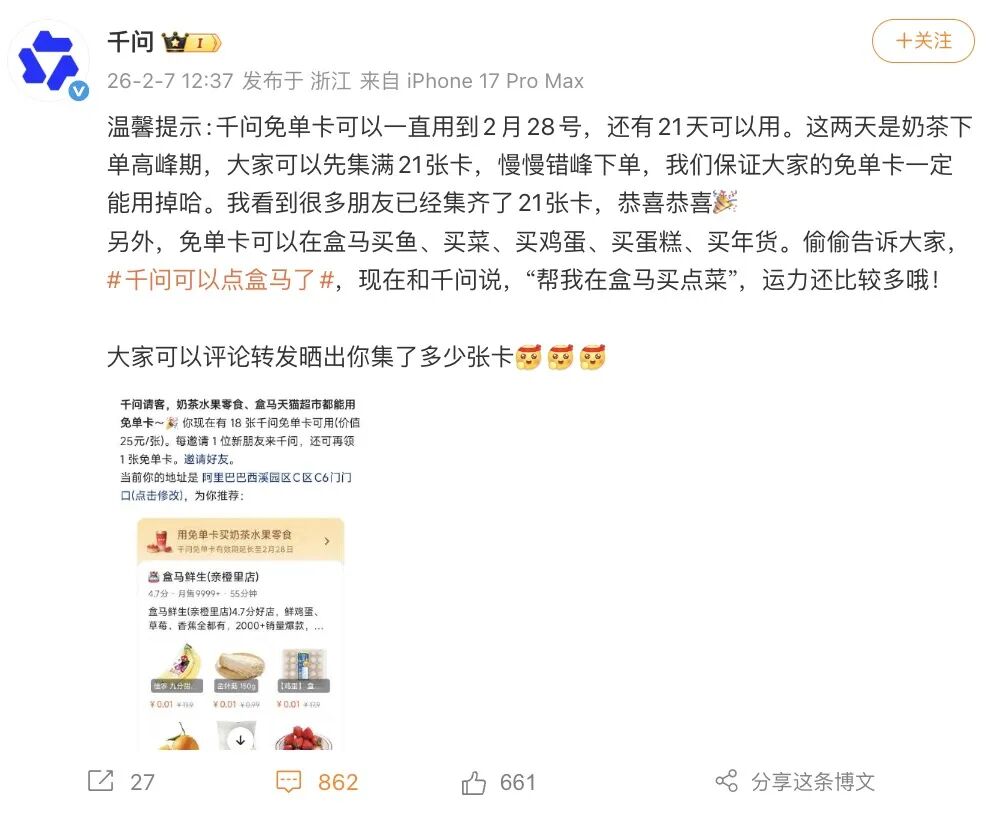
Group 1 - The core event is the launch of Alibaba's "Spring Festival 3 Billion Free Orders" campaign, which generated significant consumer interest and led to a surge in orders, reaching 10 million within 9 hours of launch [1] - The campaign's free order cards were initially set to expire on February 23 but were extended to February 28 to accommodate consumer demand, allowing purchases not only for milk tea but also for various food items [1] - The campaign caused operational chaos in many tea beverage stores across the country, with reports of overwhelmed staff and systems crashing due to the high volume of orders [1][2] Group 2 - The sudden spike in demand positively impacted the stock performance of tea beverage companies, with notable increases in share prices for brands like Cha Bai Dao (up 6.08%) and Gu Ming (up 3.58%) on February 6 [2] - The new tea beverage market has seen a slowdown in growth, with projections indicating a market size exceeding 300 billion yuan by 2025, but growth rates have dropped from over 20% to single digits [3] - External support from major platforms like Alibaba provides a significant boost to tea brands, enhancing brand visibility and customer acquisition at a low cost, which is seen as a profitable opportunity for these companies [4] Group 3 - The promotional activity is part of a broader trend of competition among internet giants for user acquisition, which has implications for the tea beverage industry as it benefits from increased consumer engagement [6][8] - The immediate impact of the subsidy campaign was evident, with over 1 million orders placed through the app within 3 hours of launch [7] - Despite the short-term stock price declines for Alibaba due to the costs associated with the subsidy, analysts suggest that such investments are crucial for long-term user retention and market positioning [9]


千问宣布免单卡延期,9小时订单破1000万,奶茶店员:要疯了,根本做不完
21世纪经济报道· 2026-02-07 07:37
Core Viewpoint - The article discusses the impact of Alibaba's promotional campaign "Spring Festival 3 Billion Free Orders" on the new tea beverage industry, highlighting the surge in consumer demand and the subsequent stock market reactions for tea companies [1][3][5]. Group 1: Promotional Campaign Impact - Alibaba's "Spring Festival 3 Billion Free Orders" campaign led to a significant increase in orders, reaching 10 million within 9 hours of launch [1]. - The campaign's success prompted an extension of the validity of the free order cards from February 23 to February 28, allowing consumers more time to utilize them [1]. - The promotion not only boosted sales for tea beverage stores but also provided substantial brand exposure and customer acquisition for participating brands [5]. Group 2: Market Reactions - The tea beverage sector saw a collective rise in stock prices, with notable increases such as Tea Baidao up 6.08% and Gu Ming reaching a historical high with a 3.58% increase [3]. - The sudden spike in demand led to operational chaos in many stores, with reports of overwhelmed staff and systems crashing due to the high volume of orders [2][3]. - Despite the positive short-term effects on tea stocks, there are concerns about the sustainability of this growth, as previous promotional campaigns have led to temporary spikes followed by declines [5][6]. Group 3: AI Competition and Long-term Implications - The article emphasizes that the competition among major platforms for AI user acquisition is driving unexpected benefits for the new tea beverage industry [5][9]. - Analysts suggest that the current competition for user engagement and data will shape the future landscape of the industry, with companies needing to invest heavily in AI to maintain relevance [10]. - While short-term financial pressures from promotional activities may affect profitability, the long-term potential for companies that secure user loyalty and data is significant [11].

二〇二五一通乱战,二〇二六期待改变
Qi Lu Wan Bao· 2026-01-01 16:07
Core Insights - The fierce competition in the food delivery industry in 2025 led to significant financial losses for major platforms, with a total loss exceeding 500 billion yuan across three companies [5][11] - Despite the intense competition benefiting riders with higher earnings, many merchants reported losses due to the low profitability of the increased order volume [3][4] - Regulatory interventions have prompted a shift from aggressive subsidy wars to a more rational and quality-focused competition in the industry [6][11] Group 1: Industry Competition - The food delivery battle in 2025 saw major platforms like JD, Alibaba, and Meituan collectively spend over 220 billion yuan in subsidies during the second and third quarters [2] - Riders experienced record earnings, with one rider achieving a daily income of 1,700 yuan and monthly earnings exceeding 20,000 yuan during peak competition [3] - Many merchants participated in subsidy activities despite low profits, as platforms offered incentives for meeting order volume targets [4] Group 2: Financial Impact - The financial reports of major platforms revealed substantial losses, with Meituan reporting a quarterly loss of 160.1 billion yuan and Alibaba's operating profit dropping by 85% year-on-year [5] - The intense competition led to a decline in order volume as platforms reduced subsidies, resulting in a seasonal downturn in the industry [6][7] Group 3: Regulatory Changes - The introduction of new regulations aimed at curbing predatory pricing and ensuring fair competition has led to a reduction in subsidy activities by platforms [6][11] - The National Market Supervision Administration's interventions have emphasized the need for platforms to adhere to legal standards and protect the rights of merchants and riders [6][11] Group 4: Rider Welfare - Improvements in rider welfare were noted, including reduced insurance costs and the introduction of insurance subsidies by platforms [8] - Platforms have begun to implement better algorithm governance to ensure rider safety and fair working conditions [8] - Despite some challenges, riders expressed gratitude for the job, which provides essential support for their families [10][11]