
并购潮

Search documents
2025年大型交易回归 华尔街为明年新一轮并购潮蓄势待发
Ge Long Hui A P P· 2025-12-31 03:08
Core Insights - The article highlights a record number of 68 transactions valued at $10 billion or more announced globally this year, leading to an average annual deal size reaching a new high of approximately $2.27 billion [1] Group 1: Market Trends - Large transactions are driving the market, indicating confidence among CEOs and boards [1] - The momentum is expected to continue into 2026 and beyond, spanning various industries [1] Group 2: Investment and Recruitment - Major banks and law firms, including Wells Fargo and Lazard, are continuously investing in recruitment, signaling optimism in the market [1] - Top law firms are focusing on trends such as more spin-offs, increased mergers in the cryptocurrency sector, and larger inflows of capital from sovereign wealth funds, particularly from the Middle East [1] Group 3: Regulatory Environment - The Trump administration's more lenient enforcement of merger regulations is also a contributing factor to the growth in transactions [1]
AI催化下,并购潮开启?
Xin Lang Cai Jing· 2025-12-29 13:39
Core Insights - The education technology sector is experiencing a significant wave of mergers and acquisitions driven by the explosive growth of AI technologies, with over 20 deals expected in 2025 [2][48] - Companies are focusing on integrating AI capabilities as a core competitive advantage, particularly in the fields of vocational education and educational content [3][48] - In China, mergers are diverse, influenced by policy changes and structural adjustments, with a focus on acquiring scarce resources such as AI technology teams and quality educational content [3][48] Group 1: Mergers and Acquisitions Overview - Notable acquisitions include Northstar Holdings acquiring Cool Academy for approximately 180 million yuan, and Cengage Group acquiring Visible Body for about 100 million USD [4][49] - The trend indicates a shift towards strategic acquisitions aimed at securing future market positions rather than mere financial investments [3][48] - The acquisition of NextBeat by Duolingo highlights the integration of music education into language learning platforms, showcasing a broader trend of combining different educational content areas [11][56] Group 2: AI-Driven Mergers - The breakthrough in large model technology is identified as the primary driver of the 2025 merger wave, enabling personalized and adaptive learning experiences [40][48] - High education companies like Gaotu are acquiring AI education teams to enhance their capabilities in adaptive learning algorithms and content understanding [10][55] - The merger between Coursera and Udemy, valued at approximately 2.5 billion USD, represents a strategic integration to address global skill transformation demands driven by AI [15][60] Group 3: Content Integration and Market Expansion - Cengage Group's acquisition of Visible Body emphasizes the trend towards deep digitalization of educational content, particularly in STEM fields [33][78] - Newsela's acquisition of Generation Genius aims to enhance K-8 educational resources, combining text and multimedia to improve student engagement in STEM [34][81] - The acquisition of LingoAce by Dragon Phoenix Online Chinese reflects a strategy to consolidate market position in the competitive online Chinese education sector [31][76] Group 4: Cross-Industry Collaborations - Chery's acquisition of a stake in Honghe Technology illustrates a cross-industry approach, aiming to create immersive learning environments within smart vehicles [21][66] - The failed acquisition attempt by Haitai Development of Zhixueyun highlights the challenges of cross-industry mergers, particularly in the education technology space [5][50] - The strategic shift of Happy Holdings from education to animation indicates a broader exploration of AI applications across different sectors [12][59]


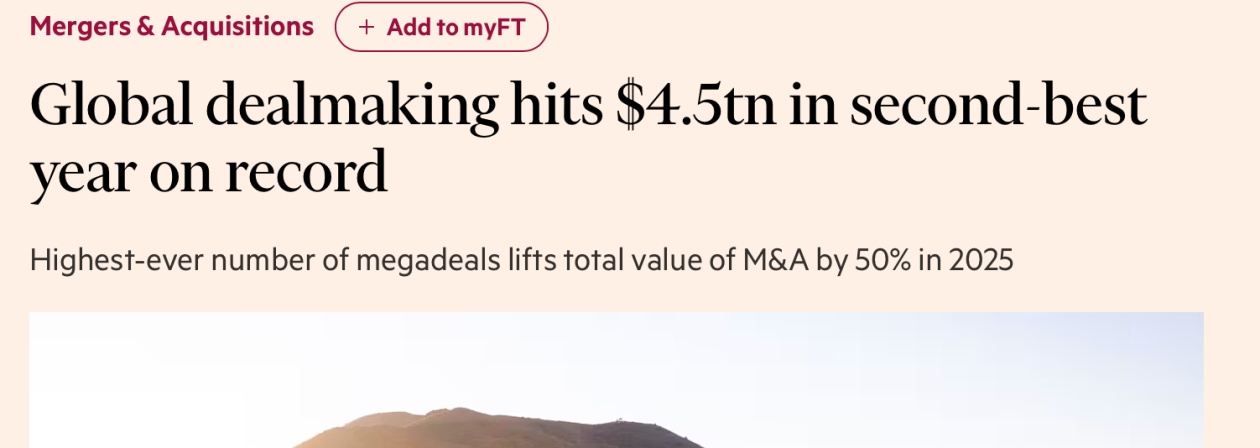
全球并购交易创历史次高 大型交易重塑行业格局
Huan Qiu Wang· 2025-12-27 01:13
Group 1 - The core viewpoint of the article indicates that global M&A activity is expected to reach $4.5 trillion in 2025, marking a nearly 50% increase from 2024 and the second-highest level on record since the 1970s, only behind the M&A boom of 2021 [1] - This year, there have been 68 large transactions, each valued at over $10 billion, significantly reshaping various industries from media to industrial sectors [3] - Key factors driving the current M&A wave include a favorable market environment, ample financing options, and a relatively relaxed regulatory landscape in the U.S., encouraging companies to pursue previously shelved M&A plans [3] Group 2 - The surge in transaction activity has directly contributed to an increase in investment banking revenues, which have risen to approximately $135 billion this year, a 9% year-on-year increase, with over half of the revenue coming from the U.S. market [4] - Despite the large-scale M&A activity, smaller transactions have seen a decline, with the total number of such deals dropping by 7% year-on-year to the lowest level since 2016 [4] - The private equity M&A market has also experienced a slow recovery, with total deal value increasing by about 25% to $889 billion, although challenges remain for acquisition groups in asset exits [4] Group 3 - Looking ahead, there is an expectation for further increases in M&A activity over the next couple of years, with financial sponsors beginning to gain momentum [5] - Despite stock markets reaching new highs, pricing imbalances persist in the market, with diverse financing sources supporting investment opportunities [5]
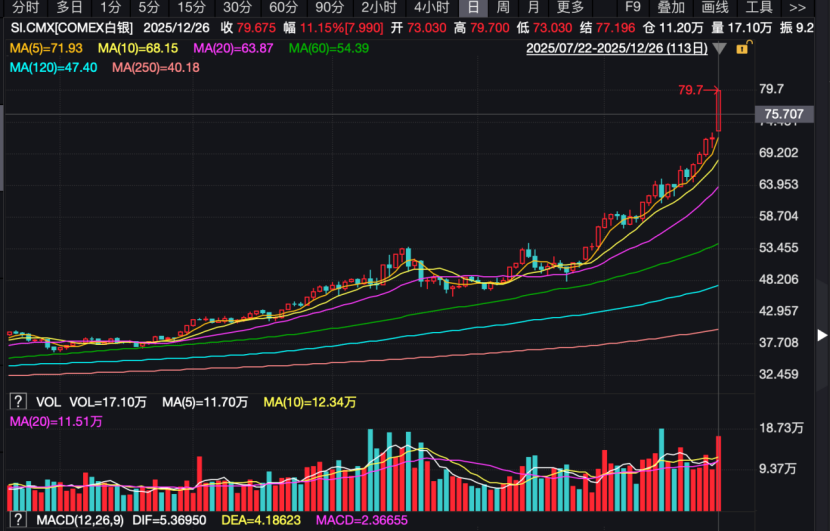
10%+!贵金属 史诗级暴涨!
Zheng Quan Shi Bao· 2025-12-27 00:34
Group 1: Precious Metals Performance - Silver, platinum, and palladium prices surged over 10% recently, with COMEX silver futures rising by 11.15% and spot silver increasing by 10.24%, reaching new historical highs [1][4] - NYMEX platinum rose by 11.84%, also achieving a historical high, while NYMEX palladium increased by 14.04% [1][8][6] - COMEX gold futures and spot gold prices rose by 1.31% and 1.12% respectively, marking new historical highs as well [1][4] Group 2: Market Trends and Influences - The recent surge in precious metals is attributed to escalating geopolitical tensions, a weakening dollar, and low market liquidity [10] - The U.S. has imposed sanctions affecting oil tankers in Venezuela, contributing to market instability [10] - The trend is further supported by a shift in investor behavior, with concerns over rising national debt leading to increased demand for gold as a hedge against currency devaluation [10] Group 3: M&A Activity - Global M&A activity reached $4.5 trillion in 2025, a nearly 50% increase from 2024, marking the second-highest level in over 40 years [2] - The year saw 68 transactions exceeding $10 billion, spanning various sectors, driven by favorable market conditions and a relatively lenient regulatory environment in the U.S. [2] - The largest transactions included competitive bids for Warner Bros. Discovery and a major merger between Union Pacific and Norfolk Southern, creating a $250 billion railroad giant [2]
申万宏源证券晨会报告-20250707
Shenwan Hongyuan Securities· 2025-07-07 00:44
Core Insights - The report emphasizes the distinction between "capital expenditure reduction," "capacity reduction," and "output reduction" in the context of anti-involution policies, drawing parallels to supply-side reforms from 2016-2017 [1][10] - The current anti-involution policies are expected to lead to a significant decline in capital expenditure growth in the midstream manufacturing sector, with the growth rate hitting a new low since 2012 [2][10] - The report predicts that by mid-2026, the fixed asset formation growth rate of listed midstream manufacturing companies will fall below the nominal GDP growth rate, indicating a visible turning point in supply-demand dynamics [3][10] Summary by Sections Section 1: Anti-Involution Policies - The report identifies three core elements of the supply-side reform experience from 2016-2017: "capacity reduction," "output reduction," and the significant impact of demand-side stimulation [1][10] - The current anti-involution policies are seen as a systematic correction of excessive investment in advanced manufacturing driven by local government subsidies from 2022-2024 [2][10] - The report suggests that the current environment is not conducive to strict "output reduction" policies due to the lack of mechanisms for implementation in privately-owned advanced manufacturing sectors [2][10] Section 2: Market Trends and Predictions - The report anticipates that the supply-demand dynamics in the midstream manufacturing sector will improve significantly by 2026, with a focus on sectors such as electric equipment, steel, and building materials [3][10] - The report maintains a bullish outlook for the Hong Kong stock market, despite concerns over liquidity fluctuations [3][10] Section 3: Outdoor Apparel Industry - The outdoor apparel market in China is projected to reach a scale of 102.7 billion yuan in 2024, with a year-on-year growth of 17%, driven by factors such as increased health awareness and a shift towards experiential consumption [15][16] - The brand "Berghaus" has shown remarkable growth, with a projected revenue of 1.77 billion yuan in 2024, reflecting a year-on-year increase of 94.5% [15][16] - The report highlights the competitive landscape of the outdoor apparel industry, noting that the top ten brands account for only 27.2% of the market, indicating significant room for growth [15][16]