强制去杠杆

Search documents
昨夜,币圈跳水了
Xin Lang Cai Jing· 2026-02-15 22:44
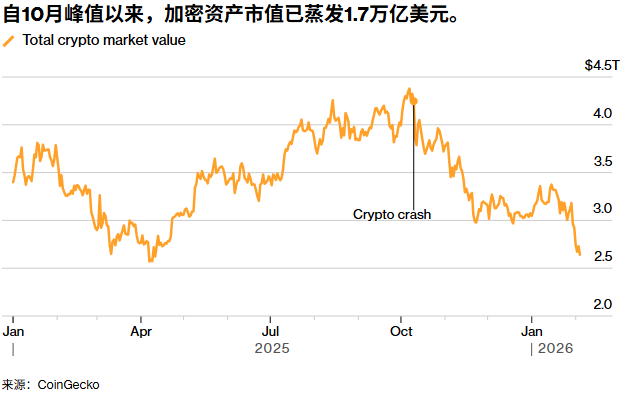
Core Viewpoint - The cryptocurrency market is experiencing significant downward pressure, particularly with Bitcoin and Ethereum showing notable declines, raising concerns about potential further volatility and market instability [3][9]. Market Dynamics - On February 15, the cryptocurrency market saw Bitcoin drop over 1% and Ethereum nearly 4% [3][9]. - Bitcoin is currently fluctuating around $69,000, having retreated approximately 40% from its peak in October of the previous year [11]. - The decline began at the end of last year when over $19 billion in long positions were liquidated during a severe deleveraging process [11]. Key Price Levels - Analysts indicate that if Bitcoin falls below the critical $60,000 mark, it could trigger a new wave of extreme volatility [4][10]. - The largest cluster of put options in the Bitcoin options market is positioned below $60,000, with significant support at the 200-week moving average, currently just above $58,000 [5][10]. - A breach of these levels could lead to forced liquidations, further depressing prices and potentially causing a cascade effect in the market [5][10]. Sentiment and Predictions - Current market sentiment is overwhelmingly bearish, with notable figures like Michael Burry warning of a potential "death spiral" for Bitcoin [6][11]. - Analysts from Standard Chartered suggest that Bitcoin could drop to $50,000 before stabilizing, which is also a significant level for put options open interest [6][11]. - The total open interest for put options linked to the $60,000 strike price is reported to be $1.24 billion [12]. Potential Downside - If Bitcoin continues to trade below the $60,000/$58,000 critical zone, it may open the door for further declines, potentially testing support levels above $40,000 [12].


比特币失守7万美元关口:较峰值跌45%,恐慌抛售触发“强制去杠杆”
智通财经网· 2026-02-05 13:21
Core Viewpoint - Bitcoin price has fallen below the critical psychological level of $70,000, reaching a low of $69,271, marking the lowest point since November 2024, driven by a combination of factors including a significant drop in marginal demand, volatility in the tech stock market, and turbulence in the precious metals market [1][3] Group 1: Market Dynamics - Bitcoin has experienced a nearly 20% decline since the beginning of the year, triggering a large-scale "forced deleveraging" process in the market [1] - Compared to the peak in October last year, Bitcoin's price has dropped approximately 45%, leading to a withdrawal of institutional investors from the market, including ETFs and digital asset bonds [1] Group 2: Investor Sentiment - The cryptocurrency market is currently facing heavy price movements, with Bitcoin being a major factor affecting overall market sentiment [3] - Signs of panic selling are evident, with daily technical indicators showing severe overselling and the Fear and Greed Index reaching extreme lows [3] - Ongoing low trading volumes and a "forced deleveraging phase" in the futures market have created a demand vacuum, resulting in persistent selling pressure that is forcing investors to exit at a loss [3]
CME与上金所纷纷出手 沪银行情“罕见”跌停
Jin Tou Wang· 2026-02-02 06:53
Core Viewpoint - The silver futures market is experiencing significant volatility, with a recent drop in prices and increased margin requirements from exchanges, indicating potential market instability and a bearish trend for silver investors [2][3]. Group 1: Market Movements - As of February 2, silver futures are trading below 26,103, having opened at 25,960 and currently reported at 24,832, marking a 17% decline. The highest price reached was 26,780, while the lowest was 24,832, suggesting a short-term sideways movement in the market [1]. - The Shanghai Gold Exchange has adjusted the margin levels and price limits for silver contracts due to significant price fluctuations, aiming to mitigate market risks [3]. Group 2: Margin Requirements - The Chicago Mercantile Exchange (CME) has raised the trading margin requirements for Comex silver futures, increasing the margin for non-high-risk accounts from 11% to 15% and for high-risk accounts from 12.1% to 16.5%. This adjustment is seen as detrimental to long positions, potentially leading to forced liquidations and further price declines [2]. - Historical data indicates that such increases in margin requirements often occur at the peak of market exuberance, suggesting that the current market conditions may signal the end of a bullish trend or the beginning of a significant correction [2].
Cathie Wood links Binance with October flash crash
Yahoo Finance· 2026-01-28 21:52
Core Insights - On October 10, 2025, a significant market event occurred when Donald Trump threatened to impose 100% tariffs on Chinese imports, leading to a violent reaction in the markets, particularly in the crypto sector [1] - The crypto market experienced its largest single-day liquidation event, with over $19 billion in leveraged positions wiped out, primarily affecting Bitcoin [2] - ARK Invest CEO Cathie Wood estimated that the forced deleveraging event resulted in approximately $28 billion being lost across the crypto ecosystem [3] Market Impact - Bitcoin, being the most liquid asset, was significantly impacted, serving as a pressure valve for forced selling, which led to a collapse in prices [2][8] - The market has struggled to regain stability in the months following the event, indicating long-term repercussions from the crash [2] Technical Issues - Wood linked the chaos to a software glitch at Binance, which contributed to the market's forced deleveraging [4] - Binance stated that the sell-off was driven by broader market conditions rather than failures on its platform, maintaining that its core systems remained operational [5][6] - The exchange compensated users approximately $283 million for issues related to de-pegging and other problems, with plans for additional payouts for verified losses [6] Trading Dynamics - Binance explained that the sharp price drops in certain trading pairs were due to legacy limit orders, thin liquidity, and interface display issues, rather than assets trading at zero values [7]
全网疯传,国际大行白银爆仓?
凤凰网财经· 2025-12-30 12:43
Core Viewpoint - A viral rumor about a "systemically important" bank facing a silver margin call and potential bankruptcy has circulated widely, but the claims lack credible evidence and are likely exaggerated [2][3][7]. Group 1: Rumor Details - The rumor originated on social media, claiming that a major bank failed to meet a margin call for silver futures and was forcibly liquidated by the exchange [2]. - It was reported that the Federal Reserve injected $34 billion into the banking system overnight, following a previous injection of $17 billion [3]. - The bank in question is described as a major player in the precious metals derivatives market, having breached all risk limits and exhausted credit lines [4]. Group 2: Verification of Claims - The rumor contains elements of truth, such as the Federal Reserve's operation of a repo mechanism, which indeed saw an injection of $17.25 billion on the previous Friday [5]. - However, the alleged $34 billion injection remains unverified, with the New York Fed not issuing any statements to support this claim [7]. - The repo operations of $17.25 billion and $25.9 billion are within reasonable limits, especially considering seasonal liquidity pressures at year-end [9]. Group 3: Margin Call Context - The Chicago Mercantile Exchange (CME) did raise margin requirements for silver trading, effective December 29, but there is no evidence of a major clearing member failing to meet these requirements [10]. - The CME's clearinghouse is a systemically important entity, and any significant default would trigger a series of compliance and reporting procedures [11]. - If a well-known bank were to face a margin call failure, it would not simply manifest as a viral social media post [12]. Group 4: Market Dynamics - There is no evidence supporting the claims of a bank's bankruptcy, with no notifications of defaults or regulatory statements available [13]. - Initial rumors pointed to JPMorgan Chase as the "bank in trouble," but data shows that U.S. banks, including JPMorgan, are net long in the silver futures market [14][15]. - The actual burden of margin calls and potential losses from short positions in silver futures is manageable for large banks, suggesting that the market dynamics do not necessitate a bank failure narrative [19].

崩盘前奏?CME两周内二次上调保证金,白银多空对决一触即发
Jin Shi Shu Ju· 2025-12-29 04:21
Core Viewpoint - The Chicago Mercantile Exchange (CME) has raised the initial margin requirement for silver futures, indicating potential market volatility and raising concerns about whether the silver price surge is sustainable or overheated [2][3]. Group 1: Margin Requirement Changes - CME has increased the initial margin requirement for silver futures contracts expiring in March 2026 from $20,000 to approximately $25,000, effective December 29 [2]. - This adjustment adds pressure on leveraged traders as silver prices hover near historical highs [2]. Group 2: Historical Context and Market Reactions - The margin increase has sparked debates about the current silver market dynamics, drawing parallels to significant peaks in 1980 and 2011 when similar margin hikes occurred [3]. - In 2011, aggressive margin increases led to a nearly 30% drop in silver prices within weeks after reaching a peak of $50 per ounce [3]. - The 1980 incident involved the Hunt brothers, whose leveraged positions contributed to a price spike that was curtailed by CME's "Silver Rule 7" and subsequent Federal Reserve interest rate hikes [3]. Group 3: Supply and Demand Dynamics - Current silver price increases are supported by tightening physical supply rather than speculative trading, with China planning to implement a silver export licensing system starting January 1, 2026 [5]. - COMEX silver inventories have decreased by approximately 70% over the past five years, while domestic silver stocks in China are nearing a ten-year low [5]. Group 4: Market Imbalances - The disparity between paper silver and physical silver prices has widened, with negative swap rates indicating strong demand for physical delivery [6]. - A recent phenomenon saw a Chinese silver fund halt new retail inflows due to price surges exceeding the value of its underlying assets, highlighting excessive speculative sentiment in the market [6]. Group 5: Industrial Demand and Price Sensitivity - Silver's applications in electric vehicles, AI chips, and solar panels are driving demand growth, with the solar manufacturing sector accounting for a significant portion of annual silver consumption [8]. - Analysts warn that if silver prices approach $134 per ounce, it could eliminate operational profits for the solar industry, potentially slowing solar installation growth [8]. Group 6: Market Volatility and Future Outlook - The upcoming margin increase will pressure hedge funds to rebalance their positions as year-end approaches, contributing to rising market volatility [9]. - The outcome of leveraged sell-offs versus physical buying will determine the next major trend in silver prices, placing the market at a critical juncture of historical, leverage, and real scarcity factors [10].
高盛交易员:最痛苦但有可能的场景是“美股三年熊市”,重演“2001-2003”剧本
华尔街见闻· 2025-03-08 09:53
Core Viewpoint - The current market is fragile, and stock returns are likely to face ongoing challenges, with a potential for a prolonged bear market rather than a sharp financial crisis [1][2]. Group 1: Market Dynamics - The absence of a clear financial crisis means the market will not experience a rapid sell-off, leading to a slow and painful decline that could last for years, reminiscent of the post-dot-com bubble period [2][3]. - Consumer pressure is increasing as the "American exceptionalism" narrative fades, contributing to market volatility [2][4]. - Credit tightening, estimated at around 20%, typically signals an economic recession, but without a crisis, there is no forced deleveraging to create a sustainable market bottom [3][4]. Group 2: Economic Indicators - Consumer confidence is declining, and discretionary spending is decreasing due to persistent inflation in essentials like food, energy, and housing, complicating the Federal Reserve's policy decisions [4][5]. - Global capital is withdrawing from the U.S., tightening domestic liquidity and increasing volatility [4][5]. Group 3: Geopolitical and Policy Risks - Geopolitical risks, such as the Russia-Ukraine conflict, and changes in fiscal policy, including increased defense spending in Europe, are adding to market uncertainty [5][6]. - Market expectations regarding Federal Reserve rate cuts may be misaligned, with potential cuts needing to be deeper than currently anticipated, by 20-50 basis points [5][6]. Group 4: Trading Dynamics - Hedge funds are experiencing the highest level of deleveraging since 2008, exacerbating liquidity-driven volatility [7][8]. - Key technical levels are collapsing, turning previous support into resistance, which increases the risk of further declines [9][10]. Group 5: Investment Strategies - In this market environment, patience and tactical positioning are essential, as it is not a time for bottom-fishing but rather for cautious navigation [15][17]. - Suggested strategies include going long on MDAX stocks, shorting bond substitutes, and investing in gold while shorting the U.S. dollar [18].