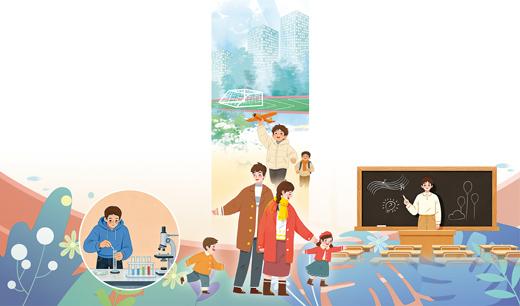
思政课堂与社会课堂融合

Search documents
如何促进思政课堂和社会课堂有效融合(政策问答·回应关切)
Ren Min Ri Bao· 2026-01-22 23:16
Core Viewpoint - The integration of ideological and political education (思政课) with real-life social contexts is emphasized, aiming to enhance the effectiveness and relevance of the curriculum [1][2]. Group 1: Integration of Ideological Education - The "14th Five-Year Plan" suggests promoting effective integration between ideological education in classrooms and social contexts [1]. - The Ministry of Education and ten other departments have issued a plan to fully mobilize social resources for practical teaching in ideological education [2]. - Over 600 universities have implemented practical credit requirements for ideological courses, with pilot reform areas expanding to ten regions [2]. Group 2: Practical Teaching Innovations - The Ministry of Education has organized nationwide "Ideological Big Classes" to create benchmark courses that combine theory and practice [3]. - A significant outreach effort has been made, with over 1.5 billion students and teachers participating in themed classes, achieving a total online viewership of 485 million [3]. Group 3: Regional Characteristics and Resources - Various regions are developing unique brands for ideological education, such as "The Great Ideological Class on the Central Axis" in Beijing and "The Taste of Truth" in Zhejiang [4]. - The establishment of over 550 national-level practical teaching bases has been initiated, with a focus on immersive and interactive teaching methods [4]. - Future reforms will prioritize practical teaching, aiming to enhance the digital resources and engagement methods for ideological education [4].
着力促进思政课堂和社会课堂有效融合
Xin Lang Cai Jing· 2026-01-11 18:13
Group 1 - The core viewpoint emphasizes the importance of integrating ideological and political education with social practice in higher education to cultivate a new generation of patriotic and dedicated individuals [1][2] - The integration of ideological education and social practice is seen as a key measure to enhance the effectiveness of ideological and political education, guiding students to strengthen their ideals and skills through practical service in border areas [1][2] Group 2 - Establishing a clear and collaborative institutional framework is essential for effective integration, with a focus on leadership from the party committee and a unified responsibility system [2] - The integration requires a collaborative mechanism among departments to address the disconnect between theoretical teaching and practical application, promoting a comprehensive work system involving all stakeholders [2] - A practical-oriented evaluation and incentive mechanism is necessary to motivate teachers and students, linking practical performance with assessments and rewards [2] Group 3 - Utilizing the rich historical and cultural resources of the region to create a multi-dimensional practical education platform is crucial, including the establishment of teaching bases and immersive learning experiences [3] - Aligning practical themes with national strategies, such as rural revitalization and cultural development, to create impactful social practice activities that engage students in real-world applications [3] - Embracing digital technology to enhance educational delivery and create a new online learning ecosystem, integrating virtual experiences with traditional classroom settings [3] Group 4 - Building a strong teaching faculty is vital for the deep integration of ideological and political education with social practice, focusing on both theoretical knowledge and practical skills [4][5] - Implementing a system for teacher professional development that includes grassroots research and practical experience to enhance the relevance of classroom teaching [4] - Promoting interdisciplinary collaboration among educators to foster a new educational paradigm that combines value guidance, knowledge transfer, and skill development [5]
锚定育人根本 书写时代答卷
Ren Min Ri Bao· 2025-12-28 05:27
Group 1 - The core focus of the education sector in 2025 is on practical implementation, with an emphasis on moral education and integrating various educational resources to enhance learning experiences [2] - The education system is adapting to technological advancements and industry changes, promoting interdisciplinary collaboration and integration between education and industry [3][5] - There is a strong emphasis on educational equity and quality, with initiatives aimed at providing quality resources to underprivileged areas and enhancing after-school services [2] Group 2 - Beijing Normal University is leading efforts to integrate education, technology, and talent development, establishing new colleges to foster innovation and collaboration [3][4] - The university is implementing a "strong teacher project" and exploring reforms in teacher education to better meet the needs of modern education [4] - Research initiatives are focused on digital transformation and optimizing educational resources, with a specific emphasis on artificial intelligence integration in higher education [5] Group 3 - The integration of ideological and social education is being promoted, with practical experiences being used to enhance students' understanding of national policies and environmental changes [6][7] - The government is gradually implementing free preschool education, significantly reducing financial burdens on families and improving access to quality early childhood education [8][10] Group 4 - There is a concerted effort to enhance employment opportunities for college graduates, with initiatives aimed at improving job matching and providing practical experiences through internships [11][12] - The engineering education reform is focused on practical outcomes, allowing students to apply their research in real-world settings, thus enhancing their employability [14][15] Group 5 - Vocational education is increasingly aligned with industry needs, with initiatives aimed at fostering practical skills and addressing specific challenges faced by industries [16][17] - The government is committed to enhancing the capabilities of vocational schools and ensuring that educational programs are closely tied to market demands [17]