
意识形态

Search documents
严管岛内公务员赴陆,民进党当局限缩两岸交流不得人心
Xin Lang Cai Jing· 2025-12-26 23:06
Core Viewpoint - The Taiwanese government has passed a draft amendment to the "Cross-Strait Relations Act," imposing stricter regulations on civil servants traveling to mainland China, which has sparked significant controversy within Taiwan [1][2]. Group 1: Regulatory Changes - The amendment introduces a "comprehensive permit system" for all civil servants traveling to mainland China, requiring approval from their original units for those below the 10th rank, regardless of whether their work is classified [1]. - Former elected officials, including legislators and mayors who have been out of office for three years, must undergo a review by a "Joint Review Committee" before traveling to mainland China [1]. - The amendment expands the prohibition on former officials attending events deemed to undermine Taiwan's dignity, now including a broader range of high-ranking officials and military personnel [1][2]. Group 2: Enforcement and Penalties - The amendment stipulates that participation in activities that harm or "diminish" Taiwan's status can lead to penalties, including the potential loss of retirement benefits or fines ranging from 2 million to 10 million New Taiwan Dollars [2]. - The Mainland Affairs Council claims that this move enhances Taiwan's security and strengthens oversight to prevent infiltration by mainland "united front" tactics [2]. Group 3: Public Reaction and Commentary - Criticism from opposition parties highlights concerns that the government is effectively criminalizing all cross-strait exchanges, which could hinder economic opportunities and understanding between the two sides [2]. - A civil servant expressed dissatisfaction with being categorized as a potential threat despite most not handling classified information, indicating a sentiment of increasing restrictions on personal freedoms [3]. - Commentary in the media suggests that the current administration's core policy is one of "anti-China," advocating for a return to cooperative exchanges to foster mutual benefits and avoid escalating tensions [3].
美委关系持续恶化国际银走涨
Jin Tou Wang· 2025-11-25 04:51
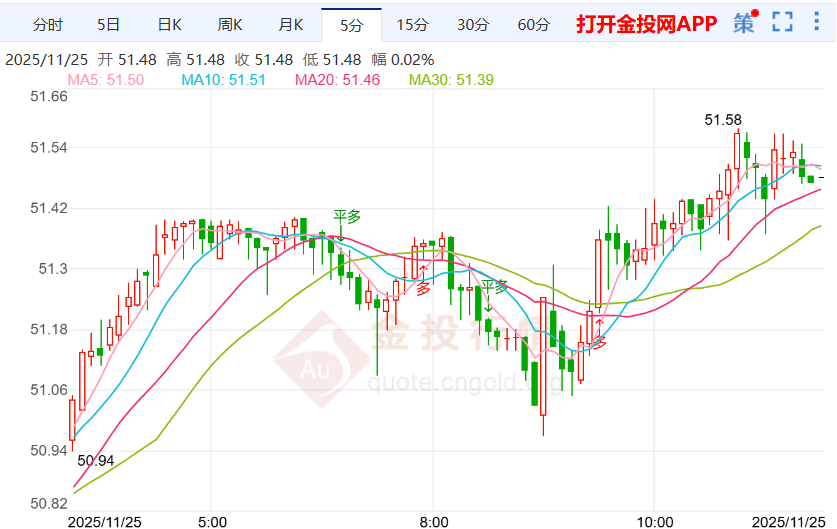
Group 1 - The international silver price is currently trading above $41.42, with a recent opening at $51.37 per ounce and a current price of $51.47, reflecting a 0.24% increase [1] - The highest price reached today was $51.58, while the lowest was $50.97, indicating a short-term bearish trend in the silver market [1] - Analysts expect silver to trade within the range of $48.5 to $52.5, with a potential breakout above $52.5 leading to a single-direction trend towards previous highs [5] Group 2 - The U.S. government has designated Venezuela's "Sun Group" as a "foreign terrorist organization," with Venezuelan Vice President Rodriguez accusing the U.S. of military intervention aimed at seizing Venezuela's natural resources [3] - Rodriguez emphasized that the U.S. aims to control Venezuela's oil, gas, gold, diamonds, iron, and bauxite, indicating that the motivations behind U.S. pressure include both economic and ideological factors [4] - The U.S. has deployed multiple naval vessels in the Caribbean under the pretext of anti-drug operations, despite reports indicating that Venezuela is not a major source of drugs entering the U.S. [4]

《邓南遮占领阜姆自由邦》——媒介力量下的历史复现
Xin Lang Cai Jing· 2025-09-21 05:08
Core Viewpoint - The documentary "Fiume o Morte!" directed by Igor Bezinović explores the historical event of Gabriele D'Annunzio's occupation of Fiume, highlighting the dangers of fascist politics and the impact of media on public memory, while connecting past events to contemporary political issues [1][3][22]. Group 1: Film Overview - The film combines historical footage with contemporary reenactments, allowing local citizens to participate in the recreation of the 1919 occupation of Fiume, thus revealing the dangers of fascist politics and the intrusion of media into public memory [3][4][10]. - It received the highest honor, the Golden Tiger Award, at the Rotterdam International Film Festival, recognized for its experimental and rebellious nature [1][3]. Group 2: Historical Context - The story is set in Rijeka (formerly Fiume), where the aftermath of World War I led to a political vacuum and ethnic conflicts over the city's governance, with competing factions causing violence [4][5]. - D'Annunzio's rise to power during this chaotic period is depicted through a satirical lens, showcasing how he capitalized on the situation to declare the occupation of Fiume [5][12]. Group 3: Narrative Techniques - The film employs a unique narrative structure that integrates historical images with citizen performances, creating multiple narrative voices and revealing the emptiness of historical footage [6][8]. - It uses juxtaposition of past and present imagery to critique the official narratives and highlight the performative nature of political events [8][10]. Group 4: Ideological Implications - D'Annunzio's understanding of media's power is emphasized, as he utilized photography to promote his political ideology, which later influenced fascist propaganda techniques [11][12]. - The film critiques the glorification of D'Annunzio as a heroic figure, instead focusing on the ordinary soldiers and their sacrifices, thus challenging the traditional heroic narrative [17][19]. Group 5: Conclusion and Reflection - The film ultimately serves as a cautionary tale about the dangers of political absurdity and the need for vigilance against the repetition of history, urging viewers to critically assess historical narratives and the role of media [22][23]. - The closing imagery of bridges symbolizes the connection between past and present, reinforcing the importance of remembering historical events to prevent future atrocities [23].

扎根三尺讲台 潜心铸魂育人(最美新时代革命军人风采)
Ren Min Ri Bao· 2025-07-31 22:22
Core Insights - The article emphasizes the importance of effective teaching methods in military education, particularly in the context of political theory courses, to enhance the combat readiness of military personnel [1][2]. Group 1: Teaching Philosophy and Methods - The instructor, Fu Wanjun, advocates for a teaching approach that combines theoretical knowledge with practical application, aiming to produce results that genuinely enhance combat effectiveness [1]. - Fu employs interactive, exploratory, and on-site teaching methods to engage students and stimulate their critical thinking [1][2]. - She actively seeks to understand students' interests and concerns before each semester, ensuring that the curriculum is relevant and engaging [1]. Group 2: Team Collaboration and Course Development - Fu leads a team of over 20 political theory educators in intensive lesson preparation sessions, dedicating significant time to refining teaching materials and addressing challenging topics [4]. - The collaborative effort is described as a rigorous process, akin to a major examination, highlighting the commitment to high-quality education [4]. - Fu emphasizes the dual approach of providing both substantial content and teaching methodologies to empower fellow educators [4]. Group 3: Mentorship and Continuous Learning - Fu's mentorship extends beyond the classroom, as she provides guidance to former students who are now instructors in military units, ensuring they are well-prepared to teach complex subjects [4][5]. - The interaction between Fu and her mentees reflects a commitment to continuous improvement and knowledge sharing within the military education framework [4][5]. - Fu expresses a deep sense of fulfillment in her role as an educator, viewing the ability to inspire and guide students as a source of happiness [5].

关于比特币,你可能不知道的(一)
Hu Xiu· 2025-07-16 04:42
Group 1 - Bitcoin was initially difficult to categorize as it did not fit traditional asset definitions, lacking backing from companies or sovereign credit [1] - Many prominent figures in China, including Professor Lang Xianping and others, have expressed strong skepticism towards Bitcoin, labeling it as a Ponzi scheme or worthless [2][3][4][5][6] - The challenge in defining Bitcoin stems from its novelty, as it exists outside established financial frameworks [7] Group 2 - Bitcoin does not fit into the textbook categories of money, which are commodity money and credit money, as it lacks intrinsic value and institutional backing [8] - The comparison between water and gold illustrates that scarcity is more important than utility in determining what constitutes money [9] - Bitcoin's fixed supply of 21 million coins and its mining process contribute to its perceived value and ability to maintain purchasing power over time [10] Group 3 - The ability to generate interest is irrelevant for Bitcoin, similar to gold, which does not produce interest but has maintained value over decades [11] - Bitcoin has experienced a long-term bull market, reinforcing its status as a hard currency [12] Group 4 - The success of Bitcoin is not solely due to blockchain technology, as many cryptocurrencies based on this technology have failed [14][15] - The community and ideology surrounding Bitcoin play a crucial role in its success, with early adopters motivated by shared beliefs rather than financial gain [16][19] Group 5 - The growth of Bitcoin has created a self-reinforcing cycle, where its increasing scale enhances its resilience against external shocks and malicious attacks [22][23] - The Bitcoin community operates under established rules that prevent changes that could undermine its value, creating a protective mechanism [24] Group 6 - Bitcoin's unique characteristics have led to its dominance in the cryptocurrency market, despite frequent skepticism and negative media coverage [25] - A survey indicated that a significant portion of participants in the cryptocurrency space are motivated by both financial gain and ideology, with 53% indicating a dual interest [26] Group 7 - Bitcoin has evolved into a massive ecosystem valued at approximately $3.5 trillion, serving as a savings method and investment vehicle for millions [27] - Despite its growth, the distribution of power and resources within the cryptocurrency space remains concentrated among a few entities, raising concerns about true decentralization [28] Group 8 - The cryptocurrency market presents both opportunities and risks, with Bitcoin representing a more stable option compared to the volatile nature of many new coins [30] - The ongoing social experiment surrounding Bitcoin may lead to the emergence of a new reserve currency or the proliferation of fleeting cryptocurrencies [30]

普京称西方与俄矛盾在于地缘政治
news flash· 2025-07-14 06:35
Core Viewpoint - The conflict between Russia and the West is rooted in geopolitical issues rather than ideological differences, as stated by President Putin [1] Geopolitical Context - Putin believes that the West has consistently disrespected Russia's national strategic interests since the dissolution of the Soviet Union, despite initial assumptions that ideological differences were the main issue [1] - He emphasizes that the West's desire to gain geopolitical advantages over Russia is evident and has been a driving force in the ongoing tensions [1] NATO Expansion - Since the 1990s, NATO has allegedly made promises to Russia not to expand eastward, which Putin claims have been broken through deceitful actions by Western countries [1] - This perceived betrayal has contributed to Russia's current stance on asserting and defending its national interests as a sovereign state [1]
有关俄罗斯与西方矛盾根源 普京最新表态
news flash· 2025-07-13 10:27
Core Viewpoint - The root of the conflict between Russia and the West is geopolitical rather than ideological, as previously thought [1] Group 1 - Russian President Putin stated that the underlying issues with the West stem from geopolitical factors [1]