
投融管退

Search documents
新城控股(601155):申报商业不动产REIT,商场价值持续显性化
Shenwan Hongyuan Securities· 2026-03-09 15:18
Investment Rating - The report maintains a "Buy" rating for the company, indicating a positive outlook for its performance relative to the market [6]. Core Insights - The company is expanding its equity financing channels by applying for commercial real estate REITs, aiming to raise 1.625 billion yuan, which will help create a positive cycle of investment, financing, management, and exit [4]. - The underlying assets for the REIT include two commercial properties with stable operational performance and good asset quality, with expected distribution rates of 5.5% and 5.59% for 2025 and 2026, respectively [4]. - The company has shown a significant increase in its commercial revenue and gross profit contribution, with commercial revenue accounting for 29% and gross profit for 77% in the first half of 2025, compared to 14% and 48% in 2024 [6]. - The company successfully issued a $355 million credit bond, indicating improved creditworthiness and financing capabilities, which will alleviate debt pressure [6]. - The sales performance has shown a decline, with a 52% year-on-year drop in sales amount for 2025, but the average selling price has started to recover, suggesting a potential stabilization in value [6]. Financial Data and Profit Forecast - Total revenue is projected to decline from 88,999 million yuan in 2024 to 47,421 million yuan in 2026, with a year-on-year decrease of 25.3% and 20.7% respectively [5]. - The net profit attributable to the parent company is expected to increase from 945 million yuan in 2025 to 1,113 million yuan in 2026, reflecting a growth rate of 17.8% [5]. - The company's gross margin is anticipated to improve from 24.9% in 2025 to 30.0% in 2026, indicating better cost management and operational efficiency [5]. - The return on equity (ROE) is projected to rise from 1.5% in 2025 to 1.6% in 2026, and further to 2.4% in 2027, suggesting enhanced profitability [5].

克而瑞:2025年房企融资仍呈现收缩态势 全年融资规模为4143亿元
智通财经网· 2026-02-24 06:14
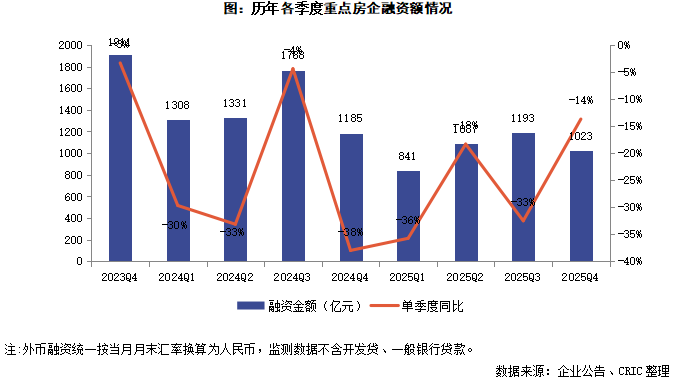
Group 1 - The core viewpoint is that the real estate policy will remain accommodative in 2025, with a continued focus on infrastructure REITs, while financing for real estate companies is expected to contract, with a total financing scale of 414.3 billion, a year-on-year decrease of 26% [1] - In Q4 2025, financing is projected to be 102.3 billion, reflecting a quarter-on-quarter decrease of 14% and a year-on-year decrease of 14%, remaining at historically low levels [1] - By 2026, the debt repayment pressure for real estate companies is anticipated to ease, supported by public REITs that will help companies transition from heavy to light asset structures [1][4] Group 2 - The cost of offshore bond financing for 2025 is noted to be 6.21%, with significant variations in costs among different companies, such as Greentown China at 8.45% and New World Development at 11.88% [2] - Domestic bond financing costs are expected to decrease to 2.55% in 2025, down 0.36 percentage points from 2024, primarily due to a more accommodative monetary environment and the predominance of state-owned and high-quality private enterprises in bond issuance [2][3] - The overall new bond financing cost for 2025 is projected to be 2.89% [3] Group 3 - The total debt maturity scale for real estate companies in 2026 is expected to decline significantly to approximately 403.8 billion, with the first quarter seeing about 129.8 billion due and the third quarter peaking at 118 billion [6] - Public REITs are being actively promoted in China, aiding real estate companies in releasing funds tied up in self-owned properties for debt repayment and liquidity [8] - Companies like China Resources Land and China Merchants Shekou have expressed intentions to expand their REITs scale, indicating a shift from traditional "heavy asset" models to a more operational focus [8]

消费基础设施REITs业绩攀升,借鉴海外经验破局地产转型,“中国蓝海”潜力待释放
Hua Xia Shi Bao· 2025-11-17 12:32
Core Insights - The domestic economy has shown signs of recovery since 2025, leading to increased consumer confidence and spending, which has positively impacted the performance of real estate investment trusts (REITs) in the consumer infrastructure sector [2][3] - The consumer REITs market has become one of the most prominent sectors in the capital market this year, with 12 listed consumer infrastructure REITs achieving a total market capitalization of 41.865 billion yuan [2][3] - The average increase in the share prices of consumer REITs has significantly outperformed other types of REITs, with some newly listed products showing remarkable growth [4][5] Consumer REITs Performance - In 2025, five consumer infrastructure REITs were successfully listed, bringing the total to 12, with a notable diversification in asset types from traditional shopping centers to outlets [3][4] - Key financial metrics for consumer REITs have remained high, with average occupancy rates of 97.20% and collection rates of 99.65% reported in Q3 2025, indicating strong operational resilience [4][6] - The top-performing consumer REITs have shown significant price increases, with the highest being 71.36% for the E-Fund Huawai Market REIT [4][5] Market Trends and Future Outlook - The REITs market is viewed as a "blue ocean" with potential for future growth, although the current transformation path remains unclear [2][7] - The introduction of policies to facilitate the expansion of REITs, such as reducing the listing period for expansion from 12 months to 6 months, is expected to drive growth in the sector [6][9] - The operational capabilities of REITs are becoming increasingly important for performance differentiation, with a focus on optimizing brand portfolios and enhancing asset appeal [6][9] Industry Insights - The REITs market in China is still in its nascent stage, with a total market size of over 200 billion yuan, which is relatively small compared to the global REITs market of 2 trillion USD [7][9] - Industry experts emphasize the need for innovative thinking and learning from mature markets like Japan and Singapore to enhance the development of China's REITs [7][9] - The REITs model is seen as a solution to the challenges of real estate investment, providing liquidity and flexible exit options for investors, thereby transforming the investment and management landscape [9]

公募REITs便利数据中心“投融管退”
Zheng Quan Shi Bao· 2025-08-03 18:51
Core Viewpoint - The approval and issuance of public REITs for data centers provide a flexible and effective exit platform for the asset lifecycle in the data center industry, highlighting the role of REITs as an "accelerator" for new productive forces [1] Group 1: Data Center REITs Insights - Data centers are crucial infrastructure for the deep transformation of the digital economy [1] - The selection of assets for public REITs should consider additional indicators beyond regulatory requirements, including location, asset scale, compliance procedures, and telecommunications business licenses [1] - High demand for data centers is concentrated in first-tier cities, suggesting a focus on mature and stable data center assets in these areas [1] Group 2: Capital Expenditure and Valuation - Important considerations for data center public REITs include capital expenditure for upgrades and the need for modernization to meet green and intensive development trends [2] - Careful assessment of the revenue side of data center asset valuation is necessary, particularly regarding the reasonable prediction of management fees and future listing rates [2]

戴德梁行北区董事总经理胡峰:公募REITs新业态希望能不断突破
Zheng Quan Ri Bao Wang· 2025-04-21 12:19
Core Viewpoint - The listing of Southern SF Logistics REIT on the Shenzhen Stock Exchange marks the seventh public REIT product since 2025, indicating a growing trend in the public REITs market and its potential as a financial tool for revitalizing existing assets and new infrastructure development [1] Group 1: Market Development - The expansion of the stock of existing assets, coupled with policy support for asset revitalization, has led to an increase in companies opting for asset securitization products like CMBS and REITs to meet financing needs [1][2] - The market has seen a shift in perception, with original equity holders recognizing the importance of public REITs in enhancing brand strength and establishing a comprehensive investment and financing strategy [2] Group 2: Challenges and Opportunities - High issuance requirements for public REITs necessitate stable cash flow and a minimum valuation of 1 billion yuan (or 800 million yuan for affordable rental housing), leading to challenges in asset selection and compliance [2] - The lack of a mature secondary market for underlying assets has made it difficult to obtain fair asset value data, necessitating rigorous valuation processes [2] Group 3: Future Prospects - Despite being the largest public REIT market in Asia, the market's value-to-stock ratio is only 0.14%, compared to around 2% in mature international markets, indicating significant growth potential [3] - Future market development is expected to focus on expanding product scale and diversifying product types, with new projects anticipated in sectors like hotels and elder care following recent regulatory relaxations [3][4] Group 4: Information Disclosure and Industry Trends - Enhanced information disclosure is crucial for improving public REIT products, as current rules require high operational transparency but often fail to capture market trends effectively [4] - The real estate industry is transitioning from development to operation, necessitating a balance between maintaining core values and embracing innovation to seize opportunities in a changing market [4]