插电式混合动力汽车(PHEV)

Search documents
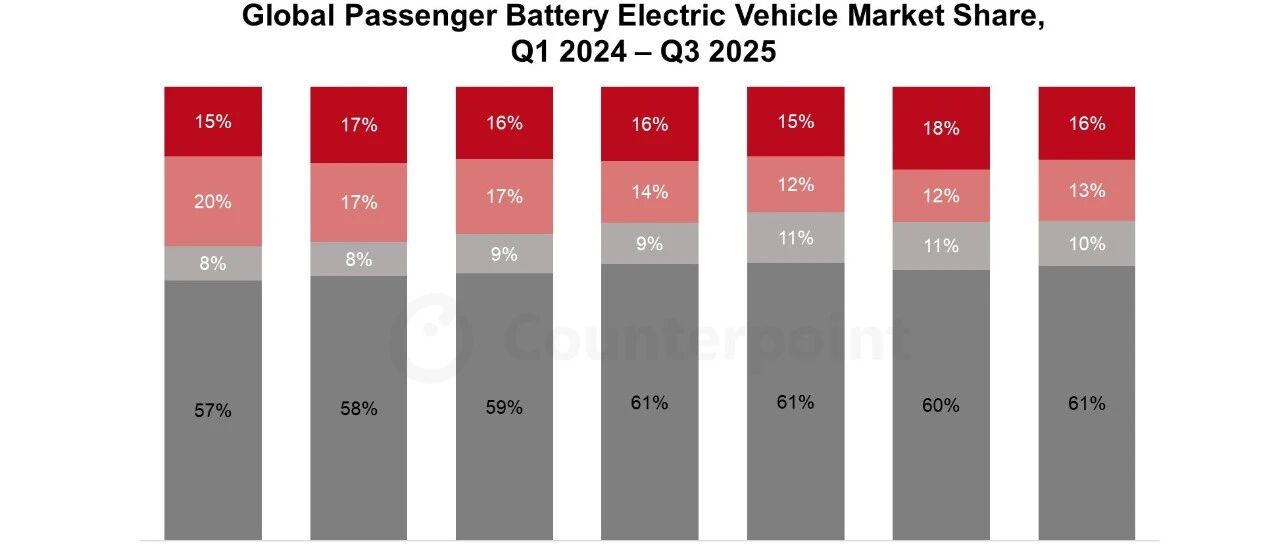
全球电动汽车市场份额季度数据(2024 年 Q1 - 2025 年 Q3)
Counterpoint Research· 2025-12-11 01:42
Core Insights - The article discusses the performance and market share of major Battery Electric Vehicle (BEV) manufacturers, highlighting the growth trends and competitive landscape in the electric vehicle market [6][9][11]. Group 1: Market Performance - BYD continues to lead the global BEV market with nearly 600,000 units sold in Q3 2025, representing a 33% year-on-year growth. The company has a strong presence in overseas markets, contributing 27% to its sales [6]. - Tesla ranks second with over 13% global market share, achieving a 7% increase in sales year-on-year in Q3 2025, driven by the strong performance of the updated Model Y and preemptive purchases in the U.S. before the EV tax credit expiration [11]. - Geely Holding ranks third with a 10% global BEV market share, experiencing a 51% year-on-year increase in sales in Q3 2025, supported by its brands targeting the economy and mid-range electric vehicle segments [7][10]. Group 2: Sales and Market Share Trends - Global sales of new energy vehicles saw a significant year-on-year increase of 32% in Q3 2025, with BEVs accounting for two-thirds of total electric vehicle sales. The BEV penetration rate reached a record high of 18% of global passenger car sales, up from 14% the previous year [9]. - China remains the core driver of global growth, contributing 60% of global BEV sales, followed by Europe and the U.S. [9]. - The top-selling electric vehicles in Q3 2025 included Tesla Model Y, Geely Galaxy, and Tesla Model 3, indicating strong competition among leading brands [9]. Group 3: Competitive Strategies - BYD's competitive advantage lies in its diverse product offerings in BEV and PHEV segments, particularly in compact SUVs and sedans, maintaining its market leadership through competitive pricing and scale effects [6]. - Geely's strategy of combining affordable pricing with advanced software has resonated well with consumers in the competitive Chinese market, with its Galaxy brand contributing over half of its total BEV sales [10].




铂涨了,现在是出手铂的时机吗?
Sou Hu Cai Jing· 2025-07-06 05:40
Core Viewpoint - Platinum prices have surged significantly since May 2025, reaching approximately 300 RMB per gram and 1286 USD per ounce, marking a nearly 40% increase year-to-date and a five-year high [1][2]. Group 1: Factors Driving Platinum Price Increase - Supply-side challenges include unstable electricity supply and frequent strikes in South Africa, the largest producer, leading to a noticeable decline in platinum production [2]. - The discovery of new large platinum mines is becoming increasingly difficult, and existing mines are experiencing declining ore grades and rising extraction costs, further constraining supply [2]. - Although recycled platinum can supplement market supply, growth in recycling is slow due to technological limitations and complex recovery channels [2]. Group 2: Demand-Side Support - The jewelry market is shifting towards platinum due to its relative price advantage over gold, with global demand for platinum jewelry expected to grow by 5% to 66 tons by 2025, and a 15% increase in China to 15 tons [5]. - The green hydrogen industry is emerging as a significant demand driver for platinum, as it is essential for proton exchange membrane electrolyzers in hydrogen production [5]. - The automotive sector is undergoing structural changes, with increased demand for platinum from new plug-in hybrid electric vehicles (PHEVs), despite an overall expected decline in global automotive production [6]. Group 3: Market Perspectives - Optimistic analysts predict a supply-demand gap of 41.2 tons in 2025, with supply growth at -0.4% and demand growth at 10.8%, supporting a bullish outlook for platinum prices [9]. - Cautious analysts warn that the current price surge may be driven by speculation and ETF demand rather than fundamental improvements, suggesting potential price corrections if speculative interest wanes [10]. Group 4: Investment Considerations - Investors should assess their investment goals and risk tolerance, considering short-term trading strategies or long-term holding based on macroeconomic conditions and market dynamics [12]. - Monitoring macroeconomic trends and geopolitical stability in major producing countries is crucial, as these factors can significantly impact platinum supply and prices [13]. - Continuous tracking of industry developments in the automotive and green hydrogen sectors is essential, as shifts in these markets can influence platinum demand and pricing [14].