
汽车行业

Search documents
【广发宏观郭磊】经济开年数据简析
郭磊宏观茶座· 2026-03-16 08:16
Core Viewpoint - The economic data for January-February 2026 shows a positive start, with significant growth in exports and industrial output, a rebound in fixed asset investment, and improvements in retail sales outside of the automotive sector, indicating a reduced risk of short-term economic downturn [5][6][25]. Group 1: Economic Data Overview - The six major economic indicators for January-February 2026 are all better than December 2025, with exports and industrial output showing significant increases, fixed asset investment turning positive year-on-year, and service production index slightly above previous values [6][5]. - Exports grew by 21.8% year-on-year, significantly higher than December's 6.6% and the annual value of 5.5% [7]. - Industrial output increased by 6.3% year-on-year, continuing last year's strong performance, driven mainly by exports and technological innovation [8][12]. - Fixed asset investment rose by 1.8% year-on-year, a recovery from December's -16% and last year's -3.8% [10][17]. Group 2: Sector-Specific Insights - High-tech industries saw a year-on-year increase of 13.1%, expanding their relative advantage, while equipment manufacturing maintained a high growth rate of 9.3% [12][13]. - Retail sales of consumer goods grew by 2.8% year-on-year, with a notable increase of 4.7% when excluding automotive and fuel sales, indicating a rebound in other consumer categories [14][15]. - Fixed asset investment in infrastructure rebounded significantly, with a year-on-year growth of 11.4%, driven by substantial investments in aviation, gas production, and public facilities [16][17]. Group 3: Real Estate Market Trends - Real estate indicators continue to show negative year-on-year growth, but the decline in sales and investment has narrowed, with initial positive changes in housing prices observed [21][22]. - The sales area of commercial housing decreased by 13.5% year-on-year, but the decline is less severe than in previous months [22]. - The price index for new and second-hand residential properties in first-tier cities showed signs of stabilization, with new home prices returning to zero growth for the first time in ten months [23][24]. Group 4: Employment and Consumer Behavior - Employment data slightly exceeded seasonal expectations, with the urban survey unemployment rate decreasing by 0.1 percentage points year-on-year [24]. - The rebound in consumer spending, particularly in food and clothing categories, reflects the positive impact of the Spring Festival holiday [14][15]. Group 5: Overall Economic Outlook - The overall economic data for January-February 2026 suggests a strong start, with key indicators supporting a positive outlook, while geopolitical factors continue to complicate the asset landscape [5][25]. - The market may seek new pricing narratives amid ongoing fluctuations, supported by policy dividends and the gradual implementation of the "14th Five-Year Plan" [5][25].


3·15前夕,“大字吸睛、小字免责”等广告乱象遭重点整治
第一财经· 2026-03-13 12:12
Core Viewpoint - The article discusses the recent notification issued by the State Administration for Market Regulation (SAMR) aimed at addressing misleading advertising practices, particularly focusing on the "big words, small words" phenomenon and other marketing irregularities [2][3]. Group 1: Regulatory Actions - The SAMR has launched a six-month campaign to clean up misleading advertising practices, targeting issues such as "big words attracting attention, small words disclaiming" and the use of absolute terms like "first" or "best" without proper substantiation [2]. - The notification outlines six key tasks for regulatory enforcement, including the prohibition of misleading size distinctions in advertisements and the requirement for clear disclosure of disclaimers [2][3]. - The SAMR aims to alleviate marketing anxiety for advertisers and encourages them to abandon misleading advertising tactics [2]. Group 2: Industry Impact - The article highlights that the automotive industry has been particularly affected by these marketing irregularities, with previous reports revealing the prevalence of misleading advertising practices [2]. - The SAMR's efforts are expected to lead to a more transparent advertising environment, which could reshape competitive practices within the industry [3].

美国将对中国等启动新的贸易调查,中方表态
中国能源报· 2026-03-12 08:43
Core Viewpoint - The Chinese government opposes unilateral tariff measures and emphasizes the need for negotiations based on equality, respect, and mutual benefit in addressing trade issues with the United States [1]. Group 1 - The U.S. government has initiated two new trade investigations concerning "excess industrial capacity" involving 16 major trading partners, including China, which may lead to new tariffs [1]. - The Chinese Foreign Ministry spokesperson stated that the concept of "excess capacity" is a false proposition and opposes using it as a pretext for political manipulation [1].

美国将对中国等启动新的贸易调查,中方表态
券商中国· 2026-03-12 08:19
Core Viewpoint - The article discusses the recent trade investigations initiated by the U.S. government against 16 major trading partners, including China, focusing on "excess industrial capacity" and the potential for new tariffs. It emphasizes China's opposition to unilateral tariff measures and the notion of "excess capacity" as a political manipulation [1][2]. Group 1 - The U.S. Trade Representative announced the initiation of a 301 investigation against 16 trading partners, including China, which may lead to unilateral sanctions [1]. - China's Ministry of Foreign Affairs reiterated its consistent stance against unilateral tariffs and emphasized the need for negotiations based on equality and mutual respect [1]. - The term "excess capacity" is described by China as a false narrative used for political purposes, rejecting its validity [1]. Group 2 - China's Ministry of Commerce expressed hope that the U.S. would objectively assess the implementation of the Phase One trade agreement and avoid shifting blame or escalating tensions [2]. - The Chinese side is willing to work with the U.S. to focus on existing economic consensus and explore mutual interests, while warning that it will take necessary measures to protect its rights if the U.S. proceeds with investigations or tariffs [2].

【广发宏观陈嘉荔】美国通胀数据:预期与现实
郭磊宏观茶座· 2026-03-12 02:09
Core Viewpoint - The article discusses the stability of U.S. inflation data in February 2026, with the Consumer Price Index (CPI) increasing by 2.4% year-on-year and the core CPI rising by 2.5%, both in line with expectations and previous values. It highlights the impact of tariff transmission effects on core goods and anticipates potential upward pressure on the Personal Consumption Expenditures (PCE) index due to rising energy prices and other factors [1][6]. Group 1: Inflation Data Analysis - In February, the core goods prices increased by 0.1% month-on-month, rebounding from 0% in the previous month. Notable increases were seen in appliances (3.1%), clothing (1.3%), and software (6.5%) due to tariff impacts [2][11]. - The PCE inflation index, which has a higher weight for goods compared to CPI (approximately 38% vs. 25%), is expected to reflect a more pronounced effect from the rebound in core goods inflation, with Cleveland Fed predicting a month-on-month increase of 0.3% for February PCE [11][12]. Group 2: Service Sector Insights - The core service prices increased by 0.3% month-on-month in February, down from 0.4% in the previous month, while year-on-year growth remained stable at 2.9% [3][13]. - Rent prices showed a slight increase of 0.2%, with owner’s equivalent rent (OER) continuing to slow down, indicating a downward trend in housing inflation [15][13]. Group 3: Future Inflation Expectations - The article suggests that U.S. core inflation is in a state of asymmetric risk, with expectations for the core CPI to center between 2.6% and 2.9% over the next three months. Factors influencing this include ongoing tariff cost transmission, energy price shocks from geopolitical conflicts, and a tight labor market [4][15][17]. - The geopolitical situation, particularly regarding Iran and oil prices, is identified as a critical factor for future inflation trends, with potential upward pressure on prices due to energy costs not yet fully reflected in the data [19][20]. Group 4: Market Reactions - The market has shown signs of tightening expectations regarding interest rate cuts, with the next anticipated cut projected for July 2026. The 2-year and 10-year U.S. Treasury yields have increased, reflecting market adjustments to inflation data and geopolitical developments [5][19]. - Stock market performance has been mixed, with sectors such as software and energy outperforming, while others like private equity and transportation lagged behind [5][19].

“龙虾”概念股,集体回调
财联社· 2026-03-11 08:53
Group 1 - The Hong Kong Hang Seng Index closed down 0.24%, while the Hang Seng Tech Index fell by 0.11% [1] - Automotive stocks led the gains, with NIO rising by 14%, WeRide increasing over 7%, and XPeng Motors up nearly 4% [1] - The lithium battery sector showed strength, with CATL rising by 9% and China Innovation Aviation increasing over 8% [1] - The optical communication sector exhibited mixed performance, with Cambridge Technology rising over 6% while Yangtze Optical Fibre and Cable fell over 7% [1] Group 2 - The "lobster" concept stocks experienced a pullback, with MINIMAX and Zhiyuan falling over 6% [2] Group 3 - HK MINIMAX-WP opened at 1180.000, reached a high of 1320.000, and a low of 1101.000, closing down 6.48% at 1141.000 with a trading volume of 2.627 million shares and a total transaction value of 3.098 billion [3]

15个月首次!日本东京CPI跌破2%目标,但央行加息路径未受动摇
Hua Er Jie Jian Wen· 2026-02-27 06:20
Core Viewpoint - Tokyo's inflation unexpectedly cooled, but analysts believe this slowdown will not hinder the Bank of Japan's (BOJ) path towards further tightening monetary policy [1][4] Group 1: Inflation Data - The consumer price index (CPI) in the Tokyo region, excluding fresh food, rose by 1.8% year-on-year in February, down from 2.0% in January, marking the first drop below the BOJ's 2% target since October 2024 [1] - The primary reason for this decline was the government's subsidy policy, which led to a 9.2% year-on-year drop in energy prices [2] - Core inflation, excluding fresh food and energy, increased from 2.5% in January to 2.5% in February, indicating persistent underlying price pressures [2][3] Group 2: Economic Indicators - Retail sales in January grew by 1.8% year-on-year, demonstrating sustained consumer momentum [5] - Industrial output rose by 2.2% month-on-month in January, a significant rebound from a 0.1% decline in December, partly due to pre-holiday stocking [5] - Despite short-term improvements, there are concerns that factory activity may weaken in the coming months, which could diminish the rationale for further rate hikes [5] Group 3: Monetary Policy Outlook - Economists and market participants agree that the BOJ's normalization process is not significantly impacted by the recent inflation slowdown [4] - The probability of a rate hike in April is close to 60%, according to market pricing [1] - The BOJ has maintained a cautious yet proactive stance on rate hikes since raising the policy rate to 0.75% in December [4]
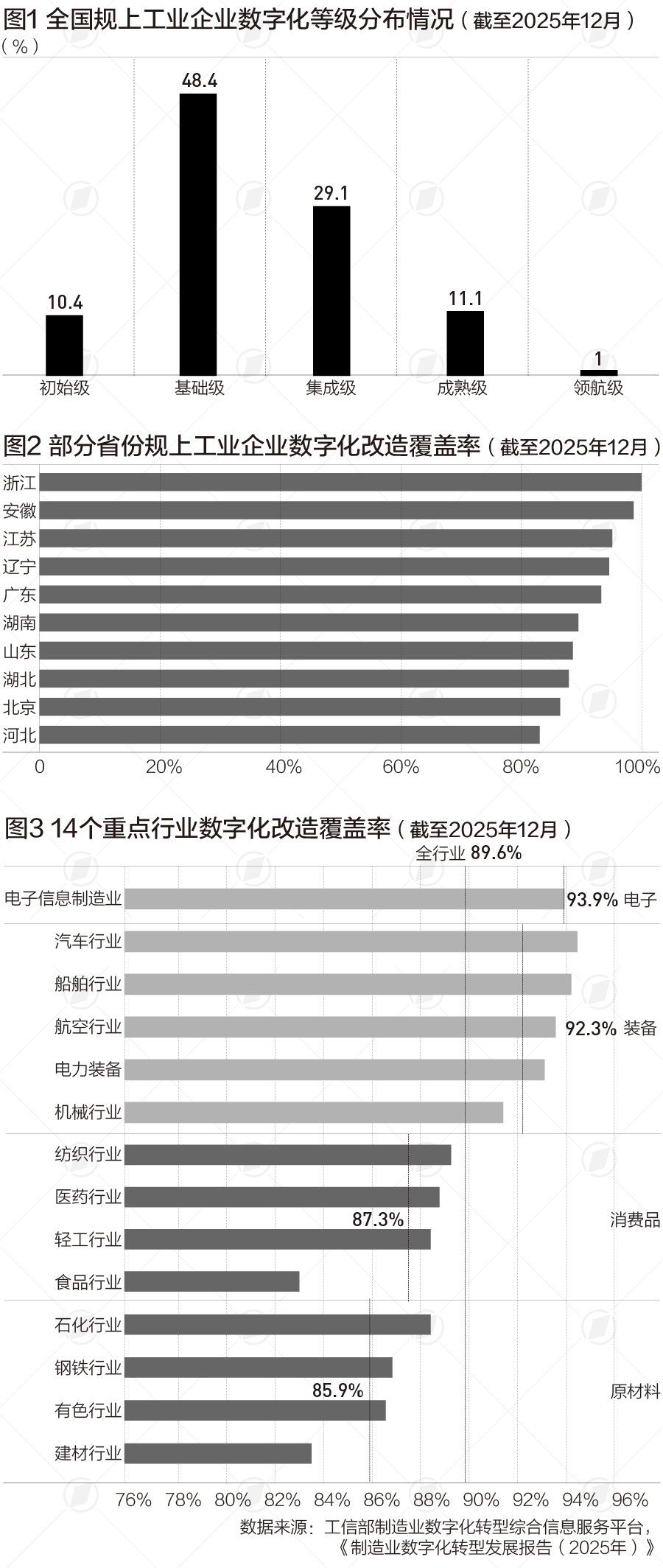
制造业智能化转型加快,重点行业存结构差异
Di Yi Cai Jing· 2026-02-26 12:50
Core Viewpoint - By 2030, China aims to complete a round of digital transformation for industrial enterprises, amidst pressures from global industrial restructuring and the need for intelligent transformation in manufacturing [1][2]. Group 1: Digital Transformation Goals - The report outlines that by 2027, major industrial provinces and key parks will achieve full coverage of digital transformation for industrial enterprises, with a target for all industrial enterprises to complete digital transformation by 2030 [2]. - As of December 2025, the Ministry of Industry and Information Technology (MIIT) plans to issue digital transformation implementation plans for 14 key industries, setting clear transformation goals [2]. Group 2: Current Status and Growth - According to data from the National Taxation Administration, the procurement of automation and digital equipment by manufacturing enterprises is expected to grow by 11.3% and 10% year-on-year, respectively, by 2025 [3]. - The proportion of industrial enterprises engaged in digital transformation is projected to reach 89.6% by the end of 2025, with a digital production equipment penetration rate of 57.7% [3]. Group 3: Regional and Industry Disparities - Different provinces show varying levels of digital transformation, with Zhejiang, Anhui, and Guangdong nearing or exceeding 90% coverage among industrial enterprises [3][10]. - The automotive, shipbuilding, and electronic information manufacturing sectors have the highest rates of digital transformation, with 94.4%, 94.2%, and 93.9% of enterprises engaged in such efforts, respectively [10]. Group 4: Challenges and Recommendations - The report identifies challenges such as weak transformation foundations, insufficient technological products, and inadequate resource support for digital transformation [14]. - Recommendations include establishing unified industrial data interfaces, promoting data sharing among industry players, and leveraging central financial resources to support digital transformation projects [15].
日入5亿美元买卖被判违法,特朗普押注全球加征10%关税
Sou Hu Cai Jing· 2026-02-21 12:11
Core Viewpoint - The U.S. Supreme Court ruled that President Trump's large-scale tariff measures implemented under the International Emergency Economic Powers Act (IEEPA) lack clear legal authorization, effectively overturning many of his tariff policies from his second term [2][3][5]. Group 1: Supreme Court Ruling - The Supreme Court's decision, with a 6-3 vote, stated that the IEEPA does not grant the president the authority to impose tariffs without Congressional approval [3][6]. - The ruling specifically limits the president's ability to impose tariffs through the IEEPA but does not entirely strip the president of the power to levy tariffs under other trade laws [6][12]. Group 2: Economic Implications - The ruling raises significant concerns regarding tax refunds, with estimates suggesting that over $175 billion in tariff revenue may be at risk of refund [7][11]. - If the full $175 billion is refunded, it would account for more than half of the total tariff revenue projected over the next decade, which is estimated to generate about $300 billion annually [7][11]. Group 3: International Trade Relations - The ruling has prompted reactions from international trade partners, with the EU and UK expressing a desire to understand the implications for their trade relations with the U.S. [9]. - The decision may impact ongoing trade agreements, as countries like Indonesia have recently negotiated trade deals to mitigate the effects of U.S. tariffs [6][9]. Group 4: Future Tariff Actions - In response to the ruling, Trump announced plans to impose an additional 10% tariff on global goods based on the Trade Act of 1974, which is expected to take effect shortly [5][6]. - The ruling does not affect tariffs imposed under other legal frameworks, such as those on steel, aluminum, and specific national security tariffs [12].

美国1月通胀相对温和
GF SECURITIES· 2026-02-14 08:04
Inflation Data - In January 2026, the US CPI increased by 2.4% year-on-year, lower than the expected 2.5% and the previous value of 2.7%[3] - Month-on-month, CPI rose by 0.2%, below the expected and previous value of 0.3%[3] - Core CPI year-on-year increased by 2.5%, in line with expectations, while the previous value was 2.6%[3] Price Trends - Energy prices saw a significant decline, with a month-on-month decrease of 1.5%, driven mainly by gasoline (-3.2%) and fuel oil (-5.7%) price drops[3] - Food prices increased by 0.2% month-on-month, down from 0.7% previously, with household food and restaurant prices also showing notable declines[3] Core Goods and Services - Core goods prices remained flat month-on-month at 0%, with a year-on-year increase of 1.1%, down from 1.4% previously[4] - The core services price index rose by 0.4% month-on-month, up from 0.3% previously, indicating resilience in service sector inflation[7] Market Reactions - Following the inflation data release, market expectations for a Fed rate cut in June increased to 51.8% from 48.9%[9] - US Treasury yields fell slightly, with the 2-year yield dropping by 7 basis points to 3.4% and the 10-year yield down by 5 basis points to 4.04%[9] Economic Outlook - The report suggests that the volatility in used car prices is more of a technical adjustment rather than a collapse in consumer demand, which may mask underlying inflation trends in other core goods[5] - The Cleveland Fed predicts that January's core PCE will remain at 2.8% year-on-year, indicating a slowdown in the downward trend of core inflation[8]