
支付+服务

Search documents
迈过万亿元门槛后,商业健康险将走向何方?
Xin Lang Cai Jing· 2026-01-25 14:11
Core Insights - The development of commercial health insurance is crucial for the implementation of the Healthy China strategy, with a significant average annual growth rate of over 20% in the past decade, supporting the health security system for the public [1][2][3] Group 1: Industry Growth and Trends - The commercial health insurance sector experienced rapid growth from 2010 to 2016, with a peak growth rate of 51.87% in 2015, transitioning from a premium scale of hundreds of billions to trillions [2] - Despite a slowdown in growth rates in recent years, the sector remains resilient, with a projected premium scale of 944 billion yuan by November 2025, indicating a 2.39% year-on-year increase [3][4] - The focus of commercial health insurance is shifting from "insuring healthy people" to "ensuring people's health," aiming for a comprehensive transformation into "health managers" [1][6] Group 2: Product Structure and Market Dynamics - Medical insurance and critical illness insurance are the two main driving forces behind the growth of commercial health insurance, with medical insurance expected to generate approximately 455 billion yuan in premiums in 2025, accounting for 46% of the market [4] - The market landscape is diversifying, with various entities, including large insurers and internet platforms, placing medical insurance at the core of their business strategies, leading to a notable differentiation in growth among different types of insurers [4][5] Group 3: Innovations and Challenges - Significant breakthroughs have been made in the non-standard body insurance sector, with the application of smart underwriting technology and customized products for specific diseases, allowing for conditional underwriting for previously uninsurable groups [5][6] - The integration of health management into insurance services is becoming more prevalent, with leading insurers establishing health management companies to create a closed-loop health ecosystem [5][6] - Despite advancements, challenges remain in the non-standard body insurance market, including narrow coverage, high deductibles, and inadequate pricing mechanisms, necessitating improved data support and risk control models [6]
万亿商业健康险结构重置究竟多“逆天”?财险公司医疗险暴涨11%,重疾险承压难见“第二波繁荣”
Sou Hu Cai Jing· 2026-01-14 16:18
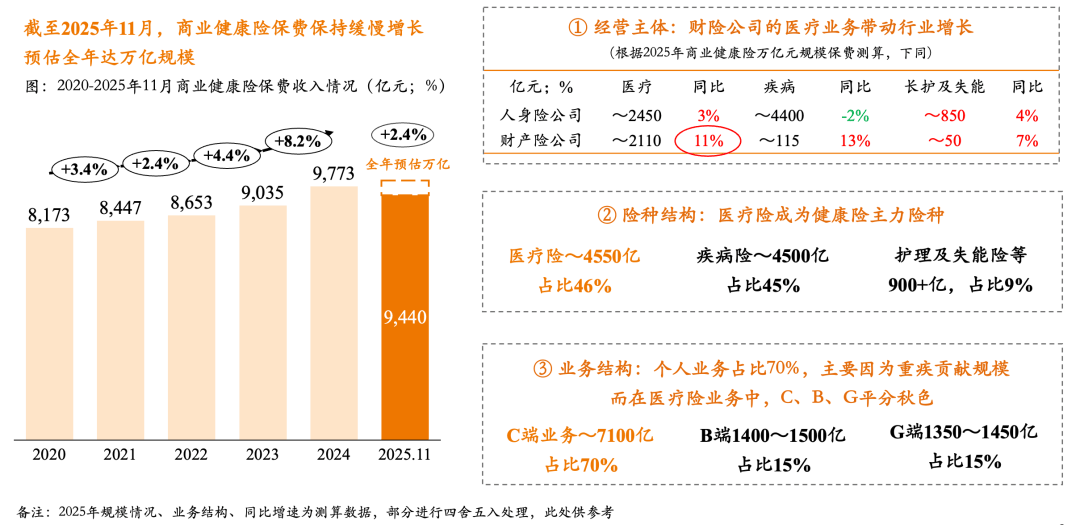
Core Insights - The Chinese commercial health insurance market is at a crossroads, experiencing both low premium growth and high demand driven by policy support [1][2][3] Group 1: Market Overview - As of November 2025, the commercial health insurance premium reached 944 billion yuan, with a year-on-year growth of 2.39%, marking the lowest growth rate in five years [8] - The medical insurance segment continues to dominate, accounting for approximately 46% of the total premiums, with a growth rate of nearly 7% [8] - The industry is expected to surpass the trillion yuan mark in total premiums for the first time in 2025, despite the low growth rate [8] Group 2: Product and Business Types - Medical insurance remains the primary growth driver, while long-term care and disability insurance are experiencing stable growth [9] - The C-end (individual) business dominates the market, accounting for nearly 70% of the total, while B-end (enterprise) and G-end (government) businesses make up about 14% to 16% [12] - The online health insurance market is growing rapidly, with a scale of 77 billion yuan and a year-on-year growth rate of approximately 16% as of September 2025 [12] Group 3: Regulatory Environment - 2025 is a significant year for policy releases aimed at promoting commercial health insurance, with multiple departments introducing various supportive measures [17] - Key policy documents include the "Guiding Opinions on Promoting High-Quality Development of Health Insurance," which emphasizes the need for collaboration between group and individual insurance [17][18] - The establishment of a long-term care insurance system is set to be fully implemented, with expectations for the national long-term care fund to exceed 250 billion yuan in revenue over the next five years [19] Group 4: Growth Drivers - The demand for high-quality medical services is expected to rise, driven by the aging population and increasing healthcare costs [16] - Medical and long-term care insurance are identified as the main growth points, with a focus on product innovation and service integration [20][21] - The trend of "payment + service" integration is accelerating, with hospitals increasingly embracing commercial insurance [33] Group 5: Technological Impact - AI is reshaping industry efficiency, with significant developments in health management applications that enhance user engagement and data collection [35][36] - The integration of electronic health records and AI-driven solutions is seen as a key factor in improving healthcare delivery and insurance services [35][36] Group 6: Future Outlook - The health insurance market is expected to navigate uncertainties while anchoring on five key growth points, including the demand for high-quality medical services and the integration of health payment and services [37]

泰康在线引领健康险高质量发展:从保障支付到全生命周期健康生态
Bei Jing Shang Bao· 2025-12-08 13:29
Core Insights - The article highlights the transformative role of commercial health insurance in addressing healthcare disparities and reducing patient burdens, particularly in the context of the "Healthy China 2030" strategy and ongoing healthcare reforms [1][2] Group 1: Regulatory Guidance and Market Needs - The development of high-quality health insurance is significantly influenced by regulatory policies aimed at expanding coverage and enriching product offerings for patients with pre-existing conditions [2] - Traditional insurance products primarily focus on healthy individuals, but nearly 40% of the population has health issues, indicating a gap in coverage for patients with chronic diseases and tumors [2][3] Group 2: Product Innovation - In response to rising breast cancer rates, the company launched the "Pink Guardian" insurance product in 2022, providing specialized coverage for post-operative patients and filling a market gap for patients with pre-existing conditions [3] - The "Pink Guardian" product has undergone six iterations by March 2025, now covering all 58 domestic innovative breast cancer drugs with a reimbursement rate of 100% [3] Group 3: Service Integration - The company emphasizes a shift from traditional compensation models to an "insurance + service" approach, addressing gaps in disease prevention, treatment assistance, and rehabilitation [4] - A comprehensive health management solution is provided, including basic health management and high-end medical services, to meet diverse consumer health needs [4][5] Group 4: Payment and Service Model - The "payment + service" model is identified as a key innovation in health insurance, reflecting a shift in consumer expectations from merely financial risk coverage to seeking quality medical service solutions [6][7] - The company has developed a disease management system that utilizes data and technology to provide proactive health management services throughout the healthcare continuum [7][8] Group 5: Ecosystem Collaboration - The integration of health insurance with the pharmaceutical industry is crucial for achieving the goal of "protecting people's health," necessitating collaboration across various sectors [9] - The company has established a health protection ecosystem that links insurance payments, medical services, and pharmaceutical supply, facilitating mutual benefits and collaborative development [9][10]
报告征集 | 2025年中国第三方支付行业研究报告
艾瑞咨询· 2025-11-11 00:05
Core Insights - The Chinese third-party payment industry is entering a critical phase of stock competition and value reconstruction, driven by regulatory compliance and market dynamics [2] - The industry is shifting from rapid growth to a phase of stock competition, with a consensus on "payment +" services, particularly in enterprise payment and cross-border payment sectors [2] - Technological innovations, such as NFC and generative AI, are enhancing payment experiences and service personalization [2] Research Background - The implementation of the "Non-bank Payment Institutions Supervision Management Regulations" has led to a compliance reshuffle, with non-compliant institutions exiting the market [2] - The industry is experiencing stable growth in online industrial payments and a rise in cross-border payments, which are becoming dual supports for market expansion [2] - Globalization and digital transformation are deepening, with increased convenience for foreign payments in China, becoming a key part of the dual circulation strategy [2] Research Objectives - The iResearch Consulting Institute plans to release the "2025 China Third-Party Payment Industry Research Report" in Q4 2025, inviting industry participants to contribute [3] Research Content - The report will outline the development history of the third-party payment industry, analyze market size and structural changes, and explore mainstream business models and regulatory environments [4] - Insights into industry trends will be provided, focusing on policy incentives, market structure, and application scenarios [4] Challenges and Solutions - The report will discuss the challenges faced by third-party payment institutions and explore potential solutions for overcoming these challenges [5] Case Studies - The report will feature case studies of outstanding companies in the third-party payment industry, highlighting innovative practices [6] Expert Insights - The research team will conduct in-depth interviews with industry experts to summarize key viewpoints, providing forward-looking insights for third-party payment enterprises [7] Participation Value - Companies participating in the report will have opportunities to enhance brand visibility and influence through inclusion in the industry map and case studies [9][10] - Participants will also have the chance to engage in online and offline events with industry experts and stakeholders [10] Participation Details - The call for participation is open to all stakeholders in the third-party payment industry, with a submission deadline of November 22 [12][13]

报告征集 | 2025年中国第三方支付行业研究报告
艾瑞咨询· 2025-10-11 00:05
Core Insights - The Chinese third-party payment industry is entering a critical phase of stock competition and value reconstruction, driven by regulatory compliance and market dynamics [2] - The industry is shifting from rapid growth to a phase of competitive pressure, with a consensus on "payment +" services, particularly in enterprise payment and cross-border payment sectors [2] - Technological innovations, such as NFC and generative AI, are enhancing payment experiences and service personalization [2] Research Background - The implementation of the "Non-Bank Payment Institution Supervision and Management Regulations" has led to a compliance reshuffle, with non-compliant institutions exiting the market [2] - The industry is experiencing stable growth in online industrial payments and a rise in cross-border payment demands, particularly in emerging markets like Southeast Asia and Latin America [2] Research Objectives - The iResearch Consulting Institute plans to release the "2025 China Third-Party Payment Industry Research Report" in Q4 2025, inviting industry participants to contribute [3] Research Content - The report will analyze the development history of the third-party payment industry, market size, structural characteristics, regulatory environment, and key players in the industry chain [4] - Insights into industry trends will be provided, focusing on policy incentives, market structure, and application scenarios [4] Challenges and Solutions - The report will explore the challenges faced by third-party payment institutions and potential strategies for overcoming these challenges [5] Case Studies - The report will feature case studies of outstanding companies in the third-party payment industry, highlighting innovative practices [6] Expert Insights - The research team will conduct expert interviews to gather insights on industry trends, which will be presented in the report [7] Participation Value - Companies participating in the report will have opportunities to enhance brand visibility and influence within the industry [9][10]

解民忧、惠民生、暖民心——银联商务“支付+”服务助力实体经济发展
Cai Fu Zai Xian· 2025-06-30 06:24
Group 1: Consumer Upgrade Policy - The "old-for-new" policy has been continuously updated since last year, effectively promoting consumption and driving significant industrial transformation and upgrades [1] - The Beijing Municipal Bureau of Commerce announced an expansion of the subsidy categories for the "old-for-new" program, which includes automobiles, home appliances, electric bicycles, and digital products [1] Group 2: Payment Solutions for Small Merchants - UnionPay Business has been appointed as the payment and technology service provider for the "old-for-new" initiative in Beijing starting in the second half of 2024 [2] - The company introduced a combination solution of "Xiao U single product + Jing Tong mini program + merchant mini program assistant" to facilitate easier system integration for small merchants, overcoming previous technical barriers [2] - UnionPay Business has assisted hundreds of merchants and over a thousand stores in Beijing, generating transaction amounts exceeding 10 billion yuan [2] Group 3: Smart Elderly Care Services - The Beijing Civil Affairs Bureau provides meal subsidies to eligible elderly residents through a reimbursement model, and the "Parents' Canteen" brand was launched in September 2022 to enhance meal services [3] - UnionPay Business has collaborated with the Xicheng District Civil Affairs Bureau to provide smart terminal devices and payment services for the "Parents' Canteen," streamlining the meal ordering and payment process for elderly residents [3] - The service has been implemented in over 200 "Parents' Canteens," covering 263 communities, allowing elderly individuals to pay conveniently using facial recognition [3] Group 4: Elderly Assistance Card Payment Integration - The Elderly Assistance Card serves as a credential for elderly residents to access various social welfare benefits in Beijing [4] - UnionPay Business has integrated the payment function for the Elderly Assistance Card at 125 meal points, enabling a seamless payment process for elderly users [4] - In 2024, the company launched a mini program in the "Cloud Flash Payment" app for online binding of the Elderly Assistance Card, facilitating easy payments for users [4] Group 5: Smart Agricultural Wholesale Market - The Xinfadi Market in Beijing is one of the largest agricultural wholesale markets in Asia, with a daily foot traffic exceeding 30,000 [5] - UnionPay Business, in collaboration with Beijing Bank, developed a smart settlement service solution to enhance payment efficiency in the market, including a "cash register scale + C-scan B payment" product combination [6] - The company has also introduced customized services such as voice broadcasting and online shopping carts to improve market management and merchant operations [7] Group 6: Upgraded Transportation Payment Systems - Beijing's urban rail transit has become the first in the world to support five major card organizations for contactless entry [8] - UnionPay Business played a key role in the system upgrades for ticketing machines and entry gates to accommodate international cards, ensuring smooth transaction processes [8] - The company has also implemented various payment methods for local residents and foreign visitors, enhancing the overall travel experience in Beijing [9] Group 7: Commitment to Social Services - UnionPay Business is dedicated to empowering social services through technology and payment solutions, contributing to various initiatives such as "old-for-new," elderly meal services, smart agriculture, and transportation improvements [9] - The company aims to continue enhancing financial services and digital solutions to benefit the public and support high-quality development in Beijing [9]