政府债务高企

Search documents
高市早苗再出狂言
券商中国· 2025-12-02 06:50
Core Viewpoint - The article highlights Japan's severe fiscal challenges, with government debt exceeding 200% of GDP, the highest among developed countries, and suggests potential implications for investment strategies in the region [1][2]. Group 1: Economic Indicators - The Bank of Japan's Governor, Kazuo Ueda, strongly hinted at an interest rate hike in December, leading to a significant drop in the Nikkei index by nearly 1000 points [1]. - Japan's government debt has surpassed 200% of its GDP, indicating a critical fiscal health situation compared to other developed nations [2]. Group 2: Government Response - Prime Minister Sanae Takaichi's comments at an international investment conference aimed to encourage investment in Japan, but they risk being misinterpreted given the current economic climate [1]. - Takaichi has indicated plans to establish a new fiscal target that allows for more flexible spending over several years, which may dilute the government's commitment to fiscal consolidation [1].


每日机构分析:9月23日
Xin Hua Cai Jing· 2025-09-23 14:18
Group 1 - Eurozone inflation is on a downward trend, increasing the likelihood of the European Central Bank (ECB) cutting interest rates again in 2025, with core inflation expected to fall below 2% due to slowing wage growth and declining commodity prices [1] - Bridgewater Associates warns of high government debt in the US and UK, leading to economic strain and social polarization, with UK productivity stagnating since the mid-2000s [1] - Deutsche Bank strategists predict a continued weak dollar, as investors shift away from US assets amid a new easing cycle from the Federal Reserve and concerns over its independence [2] Group 2 - German manufacturing is facing challenges, with a decline in manufacturing PMI to 48.5 indicating increased contraction, despite a rise in services PMI to 52.5 [2] - Malaysia's fiscal deficit target for 2025 is expected to remain at 3.8%, benefiting from lower Brent crude prices and a stronger ringgit, with inflation expectations adjusted down to 1.5% [2] - The H-1B visa reform in the US may reduce the outflow of Indian talent, benefiting India's economy, but could also lead to decreased remittances from the US, putting downward pressure on the Indian rupee [3]


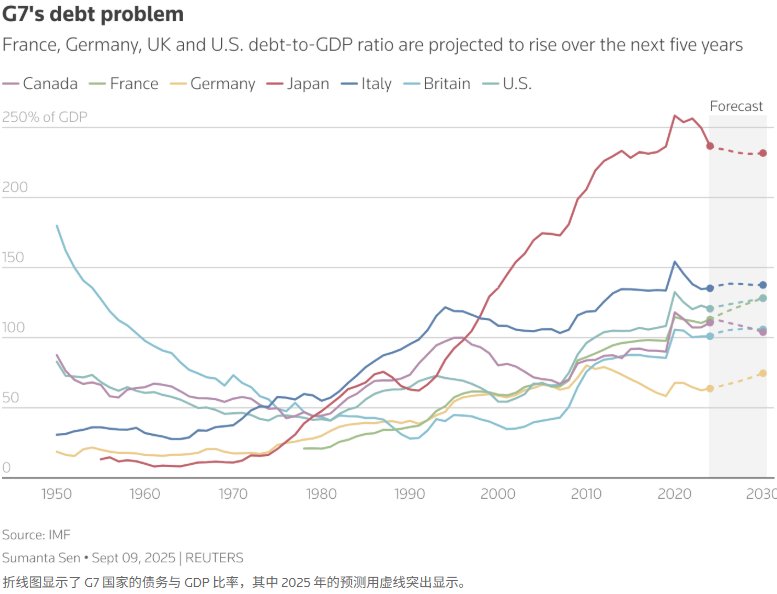
G7国家政府债务高企 债券市场已拉响警报
智通财经网· 2025-09-11 09:25
Group 1: Global Debt Concerns - Major economies are facing a storm in the bond market, with rising concerns over high government debt levels and insufficient measures to address them [1] - Guy Miller, Chief Market Strategist at Zurich Insurance Group, emphasizes the alarming levels of government debt and the lack of adequate solutions [1] Group 2: France - France has risen to the top of the concern list, with political uncertainty hindering efforts to manage debt exceeding 100% of GDP and a budget deficit nearly double the EU limit [3] - The French Court of Auditors warns that if economic growth slows or deficit reduction is relaxed, debt payments could exceed €100 billion (approximately $117 billion) by 2029, up from €59 billion last year [3] - Carol Kong, currency strategist at Commonwealth Bank of Australia, suggests a bond market disruption may be necessary to compel the coalition government to pass a budget [3] Group 3: United Kingdom - UK Prime Minister Keir Starmer's reshuffle and the upcoming annual budget raise concerns about the country's fiscal control, with long-term borrowing costs reaching the highest level since 1998 [6] - Economists predict that Chancellor Rachel Reeves will need to raise at least £20 billion (approximately $27 billion) in taxes to cover revenue shortfalls due to weak growth and high borrowing costs [6] - The UK has the highest borrowing costs and inflation among G7 economies, making it a target for market anxiety [6] Group 4: United States - The U.S. debt totals nearly $37 trillion, with the Congressional Budget Office estimating that tax cuts and spending bills could add $3.3 trillion over the next decade [9] - Despite having the world's deepest and most liquid capital markets, rising debt levels are leading investors to demand higher compensation for holding government bonds [9] - Recent signs of weak auction demand raise concerns about the sustainability of U.S. debt [9] Group 5: Japan - Japan has one of the highest debt levels globally, with rising interest rates and inflation pushing borrowing costs higher [12] - Weak demand in recent bond auctions exacerbates market distress, and political uncertainty following Prime Minister Shigeru Ishiba's resignation has driven 30-year bond yields to record highs [12] Group 6: Germany - Debt sustainability is not an immediate concern for Germany, which has the lowest debt-to-GDP ratio among G7 countries, allowing for increased spending to stimulate economic growth [15] - However, the market is attentive to the implications of large-scale stimulus measures, as Germany plans to borrow more through bond sales [15] - The confirmed high infrastructure and defense investments in the 2025 budget total €591 billion, including a €100 billion special fund for defense [15]