新兴业务转型

Search documents
研报掘金丨中邮证券:首予兆驰股份“买入”评级,新兴业务多赛道突破筑牢转型确定性
Ge Long Hui A P P· 2026-02-27 05:28
Core Viewpoint - The report from Zhongyou Securities highlights that by the third quarter of 2025, Zhaochi Co., Ltd.'s emerging businesses in LED, optical communication, and internet video operations will significantly contribute to profits, accounting for over 60% of total profit, thus becoming the core engine for performance growth [1] Group 1: Business Performance - Zhaochi's LED, optical communication, and internet video operations are expected to show outstanding performance, with profit contributions exceeding 60% [1] - The company is advancing high-end transformation across the entire LED industry chain, covering chips, packaging, and terminal applications, with market shares of high-end products like Mini/MicroLED displays, automotive LEDs, high-end lighting, home theaters, and all-in-one machines continuously increasing [1] Group 2: Technological Advancements - The company leverages its R&D and manufacturing capabilities across chips, light boards, and complete machines to launch RGB MiniLED backlight solutions, enhancing high-end display layouts and driving profitability through high value-added product structures [1] - In the optical communication sector, Zhaochi is deepening vertical integration of the "optical chip - optical device - optical module" supply chain, improving supply chain autonomy and cost competitiveness [1] Group 3: Future Developments - The company plans to start the construction of a PCB production line in the second half of 2025 to support the expansion of optical communication and Mini/MicroLED businesses, enhancing product performance and yield [1] - Steady progress in product technology iteration is noted, with stable mass production and good profitability of low-speed optical modules below 200G, while 400G/800G high-speed optical modules are in the sample testing phase with leading domestic customers, expecting small batch shipments by the second quarter of 2026 [1]

兆驰股份(002429):兆芯筑链,驰耀新域
China Post Securities· 2026-02-26 14:38
Investment Rating - The report assigns a "Buy" rating for the company, marking its first coverage [2][8]. Core Insights - The company is experiencing significant growth in emerging business sectors, with LED, optical communication, and internet video operations contributing over 60% to profit, establishing these areas as core growth engines [4]. - The company is advancing its high-end transformation across the LED industry chain, enhancing its market share in high-end products such as Mini/Micro LED displays and automotive LEDs [4]. - The optical communication segment is focusing on vertical integration of the "optical chip-optical device-optical module" supply chain, which is expected to improve cost competitiveness and product performance [4]. - The internet video business is leveraging AI tools to create a comprehensive content ecosystem, with a strong distribution network and a growing number of creators [4]. - Traditional business segments are undergoing a global expansion and smart upgrade, with overseas production capacity expected to reach 11 million units annually by mid-2025 [5]. Financial Projections - Revenue forecasts for the company are projected at 188 billion, 218 billion, and 254 billion for the years 2025, 2026, and 2027 respectively [6]. - The expected net profit attributable to the parent company is projected to be 13.4 billion, 16.8 billion, and 22.0 billion for the same years [8]. - The company is expected to see a revenue growth rate of -7.6% in 2025, followed by 15.9% and 16.7% in 2026 and 2027 respectively [10].
中国交通建设股份有限公司2025年1-12月主要经营数据公告
Xin Lang Cai Jing· 2026-02-12 20:33
Core Viewpoint - In 2025, China Communications Construction Company (CCCC) reported a new contract amount of 1,883.67 billion yuan, reflecting a year-on-year growth of 0.13%, achieving 93% of the annual target [2] Group 1: Main Operating Conditions - The new contract amount by business type includes infrastructure construction at 1,722.42 billion yuan, infrastructure design at 42.50 billion yuan, dredging at 106.88 billion yuan, and other businesses at 11.87 billion yuan [3] - The new contracts from the "Five Full" business areas totaled 703.31 billion yuan from all transportation, 795.46 billion yuan from all cities, 141.15 billion yuan from all water areas, 199.03 billion yuan from all green projects, 17.83 billion yuan from all digital projects, and 26.89 billion yuan from other sectors [5] Group 2: Regional Distribution - The new contracts from overseas regions amounted to 392.44 billion yuan (approximately 55.16 billion USD), representing a year-on-year increase of 9.09%, accounting for 21% of the total new contracts [6] Group 3: Emerging Business Market Development - New contracts from emerging business sectors, including energy conservation, new energy, new materials, and next-generation information technology, reached 665.54 billion yuan, showing a year-on-year decline of 5.64%, but still contributing 35% to the overall company performance [7] Group 4: New Business Field Development - New contracts in new business fields included energy engineering projects at 122.37 billion yuan (up 50.36%), agriculture, forestry, animal husbandry, and fishery projects at 20.06 billion yuan (up 135.89%), and water conservancy projects at 76.69 billion yuan (up 0.37%) [8] Group 5: Infrastructure Investment Projects - The contract amount for infrastructure investment projects, based on the company's equity, was 88.54 billion yuan (80.09 billion yuan domestically and 8.45 billion yuan overseas), reflecting a year-on-year decrease of 31.57% [9]
三大运营商电信服务增值税上调,你的话费会涨吗?
Bei Jing Ri Bao Ke Hu Duan· 2026-02-02 08:35
Core Viewpoint - The adjustment of the value-added tax rate from 6% to 9% for telecom services by major Chinese telecom operators will impact their revenue and profits, as announced by China Mobile, China Telecom, and China Unicom [1] Group 1: Tax Rate Adjustment - The tax rate for telecom services will increase from 6% to 9% starting January 1, 2026, as per the announcement from the Ministry of Finance and the State Taxation Administration [1] - The adjustment categorizes mobile data services, SMS, MMS, and internet broadband access from value-added telecom services to basic telecom services [1] Group 2: Financial Performance - For the first three quarters of 2025, China Mobile, China Telecom, and China Unicom reported revenues of 794.7 billion, 394.3 billion, and 293 billion respectively, with a decline in growth rates [1] - China Mobile's average revenue per user (ARPU) decreased to 48 yuan from 49.5 yuan year-on-year, while China Telecom's ARPU for 2024 was reported at 45.6 yuan [1] Group 3: Market Dynamics - Despite the tax increase, experts suggest that significant price hikes for consumers are unlikely due to the competitive market environment [2] - The shift from value-added to basic telecom services indicates a trend towards more inclusive pricing for mobile data and related services [2] Group 4: Emerging Business Growth - Telecom operators are accelerating their transition from traditional services to emerging businesses such as AI, computing power, and cloud computing [2] - Revenue from emerging businesses reached 168.1 billion, growing by 28.8% year-on-year, with cloud computing and big data showing remarkable growth rates of 94.8% and 33.3% respectively [2]



总量向好、增收乏力 通信业仍处转型阵痛期
Zhong Guo Jing Ying Bao· 2026-01-30 19:33
Core Insights - The Chinese telecommunications industry is at a crossroads as the 2025 statistics reveal a mixed performance, with total telecom business volume growing by 9.1% year-on-year, significantly outpacing GDP growth by 4.1 percentage points, contributing positively to economic growth [2] - However, telecom business revenue growth has declined to only 0.7% in 2025, a drop of 2.5 percentage points from 2024, indicating a trend of stagnation in revenue growth despite overall market improvements [3][4] Group 1: Industry Performance - By the end of 2025, the number of 5G base stations reached 4.838 million, accounting for 37.6% of mobile phone base stations, with an average of 34.4 5G base stations per 10,000 people, exceeding the "14th Five-Year Plan" target [2] - The number of mobile phone users in China reached 1.827 billion, with a penetration rate of 130 devices per 100 people, surpassing the global average by 22.5 percentage points [2] - The number of 5G mobile phone users reached 1.204 billion, with a net increase of 190 million users, representing over 65.9% of total mobile phone users, which is 2.1 times the global average [2] Group 2: Revenue Trends - Telecom business revenue for 2025 was 1.75 trillion yuan, with a growth rate of only 0.7%, down from 3.2% in 2024, and significantly lower than the 6.2% and 8% growth rates in 2023 and 2022, respectively [3][4] - Traditional business revenues, including mobile data and voice services, are declining due to competition from OTT services and pricing pressures, with traditional business revenue down by 0.5% in 2025 [4] Group 3: Emerging Business Growth - New emerging businesses, including cloud computing, big data, and IoT, accounted for 25.7% of telecom industry revenue in 2025, growing by 4.7% year-on-year and contributing 1.2 percentage points to overall revenue growth [6] - Big data business revenue grew by 69.2% year-on-year, driven by demand from enterprise clients for data governance and intelligent applications [6] - The number of IoT terminal users reached 2.888 billion, significantly exceeding the number of mobile phone users, indicating a shift from low-value connections to revenue-generating opportunities [7] Group 4: Transition Challenges - The growth rate of cloud computing revenue slowed to 2.9% in 2025, a significant drop from nearly 30% in 2023, highlighting challenges in the sector [8] - Operators face difficulties in the cloud business due to pricing structures and competition from major cloud providers, which limits their market share in high-end cloud services [9] - Continued investment in data centers and computing networks is squeezing profit margins for operators, with China Mobile's computing network investment reaching 37.3 billion yuan in 2025 [9] Group 5: Future Outlook - The ability of emerging businesses to transition from volume growth to high-quality monetization will depend on the industry's execution in building capabilities, ecosystem cooperation, and capital efficiency [10] - If operators can effectively integrate network advantages with computing services into scalable products, emerging businesses may become a sustainable profit driver for the telecommunications industry [10]


中国移动第三季度营收同比增2.5%,AI直接收入实现高速增长
Hua Er Jie Jian Wen· 2025-10-20 13:40
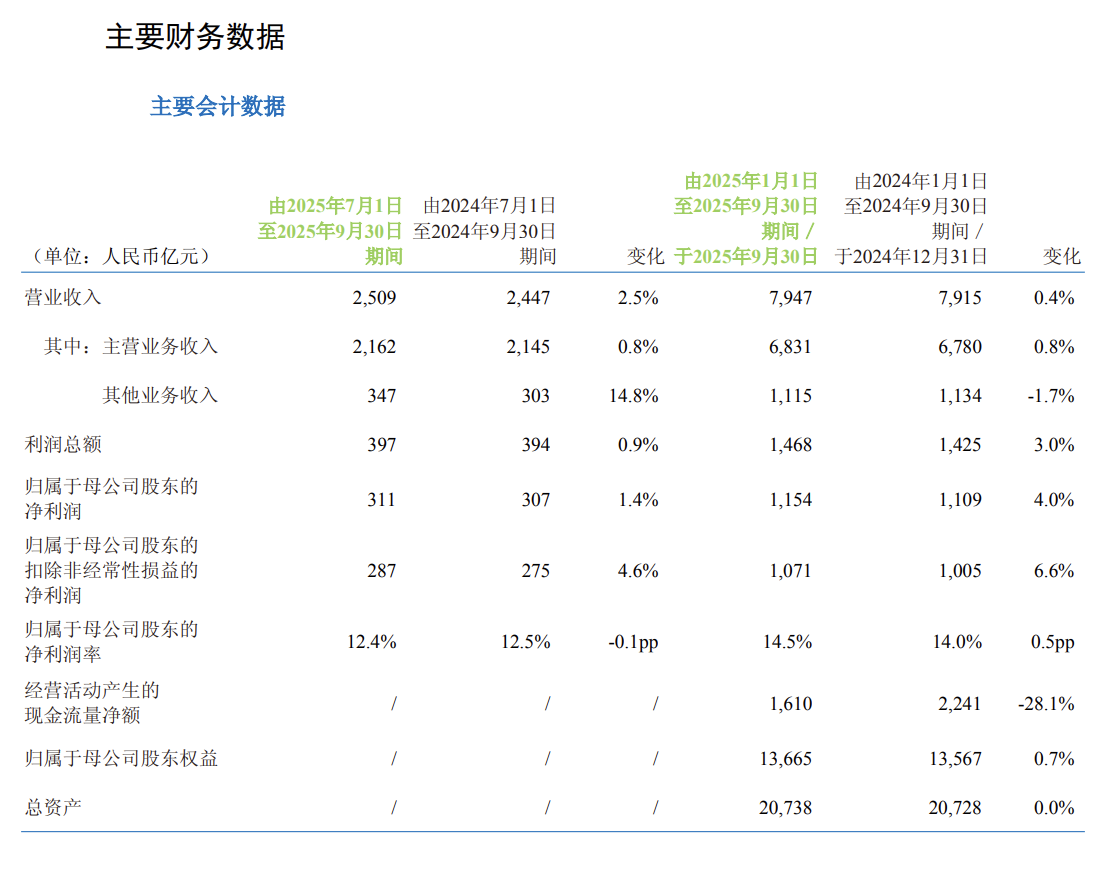
Core Viewpoint - China Mobile's third-quarter performance shows signs of improvement, with a year-on-year revenue increase of 2.5% in Q3, although overall growth remains weak for the first three quarters, reflecting challenges in traditional business segments [1][2][3]. Financial Performance - For the first three quarters, total revenue reached 794.7 billion yuan, a slight increase of 0.4% year-on-year, while net profit attributable to shareholders was 115.4 billion yuan, up 4.0% [2][3]. - In Q3 alone, revenue was 250.9 billion yuan, marking a 2.5% year-on-year growth, indicating a sequential improvement [1][3]. - The net profit margin increased to 14.5%, up 0.5 percentage points year-on-year, reflecting enhanced profitability [2][3]. Profitability and Cost Management - EBITDA for the first three quarters was 265.4 billion yuan, a 0.9% increase year-on-year, but Q3 EBITDA margin fell to 31.7%, down 1.3 percentage points [2][4]. - Operating costs remained stable at 547.6 billion yuan, with effective cost control leading to reduced selling and administrative expenses [3][4]. Cash Flow and Financial Health - Operating cash flow for the first three quarters dropped significantly by 28.1% to 161.0 billion yuan, highlighting pressure on working capital management [2][4]. - Accounts receivable surged by 47% from the beginning of the year, reaching 111.5 billion yuan, indicating potential challenges in cash collection [4]. User Growth and Business Segments - The number of 5G network customers reached 622 million, with a net addition of 23 million in Q3, while total mobile customers stood at 1.009 billion [2][3]. - DICT (Data, Information, Communication Technology) and AI (Artificial Intelligence) businesses showed strong growth, with AI direct revenue experiencing rapid increases [1][5]. Strategic Focus and Future Outlook - The company is focusing on new growth areas amid traditional business pressures, with international business also showing rapid growth [5]. - Key areas to monitor include the stabilization of ARPU (Average Revenue Per User), balancing capital expenditure with cash flow, and the profitability of emerging businesses like DICT and AI [6].