大数据

Search documents
中青旅:创格公司主营云计算等IT产品硬件销售代理及系统集成业务
Zheng Quan Ri Bao Wang· 2026-02-24 10:10
Core Viewpoint - Zhongqing Travel (600138) reported stable development of its subsidiary, Chuangge Company, which specializes in cloud computing, big data, information security, monitoring, and storage hardware sales and system integration [1] Group 1 - Chuangge Company has maintained a steady growth trajectory since its establishment, with operational methods and debt ratios aligning with industry characteristics [1] - The company demonstrated strong performance during the pandemic and the subsequent recovery period, providing robust support for business development [1] - Both Zhongqing Travel and Chuangge Company do not engage in practices such as inflating revenue or profits [1]

9.11事件后的仓促决定,如何让全球陷入监控泥潭?
Sou Hu Cai Jing· 2026-02-12 23:31
Group 1 - The emergence of knowledge-driven societies reflects a shift in structural power dynamics, where companies reliant on technology and intellectual property gain prominence globally [1][2] - The relative importance of different structures, such as military, manufacturing, finance, and technology, influences the behavior of state and non-state actors, reshaping national goals and methods of achieving them [2][3] - Companies often align with state departments that share their interests, influencing policy types based on their industry and business models [3][5] Group 2 - The relationship between state and non-state actors is complex, involving both competition and cooperation, particularly during critical moments that determine national policy directions [5][6] - The concept of "information-industrial complex" illustrates the interdependence between government and technology companies, reinforced by significant government investments and contracts [6][7] - Different national forms, such as financialized states, prioritize different structural powers and behaviors, impacting social resource allocation and policy implementation [7][8] Group 3 - The rise of information empire states is characterized by the commodification of knowledge and pervasive surveillance, driven by historical political struggles rather than inevitable capitalist developments [9][10] - Key historical events, including the strengthening of intellectual property in the 1970s and the commercialization of the internet in the 1990s, have shaped the characteristics of information empire states [9][10] - The U.S. has played a pivotal role in establishing global standards for intellectual property, significantly influencing the global political economy [12][10] Group 4 - The commercialization of the internet has transformed it from a decentralized network into a dominant global communication platform, enabling companies to play crucial roles in knowledge structuring [14][15] - The rise of surveillance capitalism, particularly post-9/11, has led to widespread monitoring of online activities, intertwining state and corporate interests [16][17] - The financial crisis of 2008 accelerated the development of knowledge-driven economies, with significant capital flowing into technology companies seeking monopolistic profits [19][20]




极光与PAG Pegasus Fund宣布战略合作,携手开展数据驱动投资,并发行三年期认股权证
Ge Long Hui· 2026-02-11 12:15
Core Viewpoint - Aurora Mobile has entered into a strategic partnership with PAG Pegasus Fund LP to leverage big data and AI for investment practices, with PAG Pegasus committing $10 million to support investment decisions based on Aurora's data [1] Group 1: Strategic Partnership - Aurora Mobile will collaborate with PAG Pegasus to utilize its big data for AI-driven investment practices [1] - PAG Pegasus plans to allocate $10 million in funding and will use Aurora's data to inform its investment decisions [1] - The partnership includes a revenue-sharing model based on the performance of the fund's investments [1] Group 2: Financial Instruments - Aurora has issued a three-year warrant to PAG Pegasus, allowing the purchase of 725,000 American Depositary Shares (ADS) at a price of $13.80 per ADS [1] - The exercise price represents a premium of over 85% compared to the average closing price of approximately $7.43 per ADS over the last 10 trading days [1] - If fully exercised, this issuance could generate $10 million in financing for Aurora [1] Group 3: Leadership Statements - The CEO of Aurora Mobile expressed optimism about the collaboration, emphasizing a steady approach to validating methods and scaling operations [1] - The founder of PAG Pegasus highlighted the long-term value of Aurora's data, particularly in the evolving landscape of AI-driven investments [1]

700亿紫光股份,宣布两大消息
Zhong Guo Ji Jin Bao· 2026-02-11 11:09
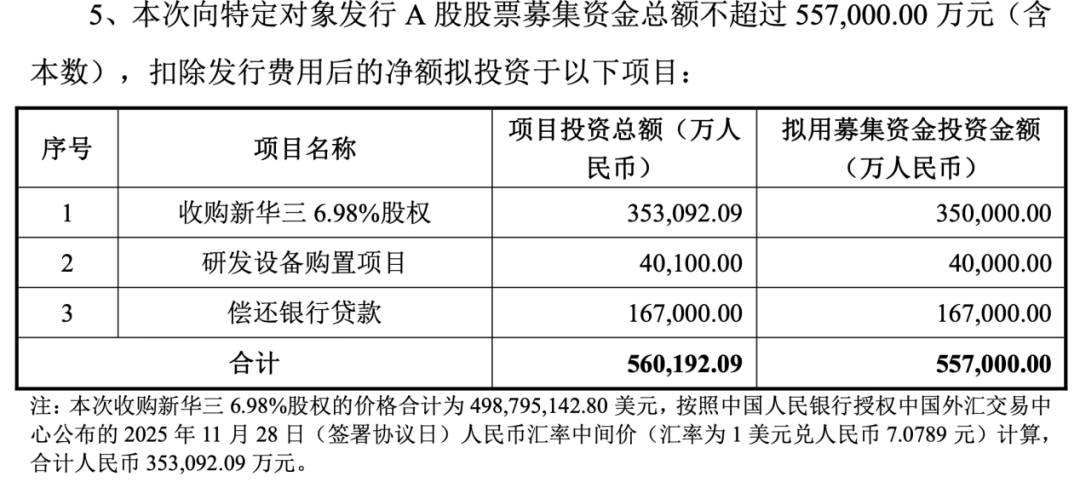
Core Viewpoint - Unisplendour Corporation plans to raise no more than 5.57 billion RMB through a private placement of A-shares while terminating the issuance of H-shares for listing on the Hong Kong Stock Exchange [1][6] Group 1: Fundraising and Investment Plans - The company intends to issue up to 430 million shares, with the net proceeds after issuance costs aimed at acquiring a 6.98% stake in H3C, purchasing R&D equipment, and repaying bank loans [1][2] - The total investment for acquiring the 6.98% stake in H3C is approximately 3.53 billion RMB, while the R&D equipment purchase is estimated at 401 million RMB, and bank loan repayment amounts to 1.67 billion RMB, totaling around 5.6 billion RMB [2] Group 2: Strategic Importance of H3C Acquisition - The acquisition of the additional stake in H3C is expected to enhance the company's control over H3C and improve profitability, as the company has seen significant growth in asset quality, revenue, and profit since acquiring a 51% stake in 2016 [2][3] - By increasing its stake in H3C to 81%, the company aims to bolster its net profit attributable to shareholders, thereby strengthening its operational sustainability [2][3] Group 3: R&D and Financial Structure - The company is focusing on capital investment to accelerate technological innovation in a rapidly evolving industry characterized by digital technologies such as AI, cloud computing, and big data [3] - The fundraising will also help reduce the company's debt-to-asset ratio, which has risen above 80% as of September 30, 2025, and optimize its financial structure by alleviating financial pressure through loan repayment [3] Group 4: H3C's Financial Performance - As of September 30, 2025, H3C reported total assets of 57.14 billion RMB, with revenues of 59.62 billion RMB and a net profit of 2.53 billion RMB for the first three quarters of 2025 [4][5]

低空经济迎利好!五部门联合印发
证券时报· 2026-02-10 08:07
Core Viewpoint - The article discusses the implementation opinions released by the Ministry of Industry and Information Technology and other departments to strengthen the information and communication industry's capacity to support the development of low-altitude infrastructure, which is crucial for the growth of the low-altitude economy [2][4]. Summary by Sections Overall Requirements - The initiative aims to enhance the technical foundation, industrial supply capacity, network support capability, and security assurance of the information and communication industry, facilitating the construction of low-altitude communication networks and intelligent network systems [7][8]. Key Tasks - The implementation opinions outline several key tasks, including: - Promoting low-altitude communication network coverage based on demand, particularly in areas below 300 meters, utilizing existing 5G infrastructure and optimizing network capabilities [9]. - Exploring multi-source detection capabilities for monitoring critical areas and enhancing navigation precision using the Beidou system and 5G networks [10]. - Supporting the construction of low-altitude intelligent network systems by leveraging new information technologies such as IoT, AI, and big data [10]. - Conducting experimental validations to improve low-altitude communication technologies and develop replicable solutions [11]. - Enhancing industrial supply capabilities by advancing 5G-A technology and reducing equipment costs [11]. - Promoting collaborative and standardized construction of low-altitude infrastructure [11]. - Establishing regulatory frameworks for telecommunications services and ensuring data security [12]. Organizational Support - The implementation opinions emphasize the need for inter-departmental collaboration and local government involvement to ensure the effective deployment of networks, technology enhancement, and safety measures [13].

齐启新程 共赢未来,淄博移动举办行业生态合作伙伴座谈会
Qi Lu Wan Bao· 2026-02-06 07:50
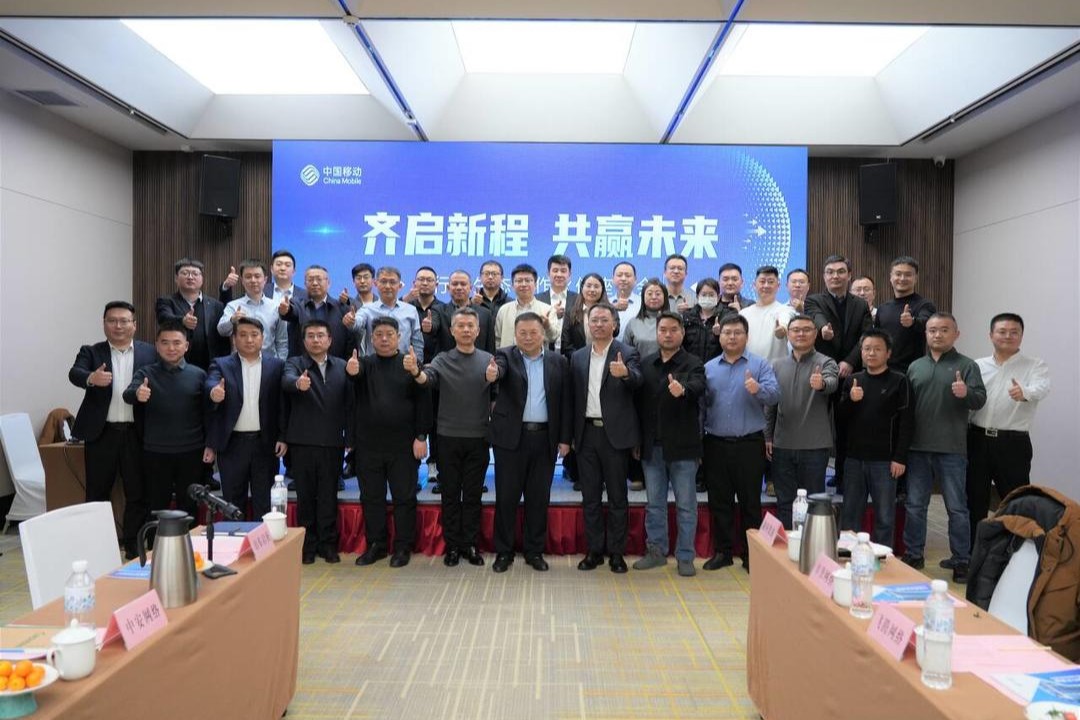
Core Viewpoint - The meeting aimed to deepen industry collaboration and create a new blueprint for high-quality development in the digital industry, emphasizing the importance of strategic partnerships and shared growth opportunities [1][3]. Group 1: Meeting Overview - The conference was themed "Starting a New Journey Together for a Win-Win Future," gathering representatives from various industry partners to reflect on past collaborations and discuss future opportunities [3]. - The atmosphere at the meeting was warm and collaborative, with partners sharing practical experiences and outcomes from their cooperation with Zibo Mobile [3]. Group 2: Key Discussions - Topics of deep discussion included the digital transformation of small and medium-sized enterprises, the development of the low-altitude economy, and innovations in artificial intelligence applications [3]. - Participants unanimously recognized Zibo Mobile's commitment to open collaboration and mutual benefits, leveraging its strengths in 5G networks, cloud computing, big data, and artificial intelligence to support partners [3]. Group 3: Future Directions - Zibo Mobile's General Manager, Yang Bin, expressed gratitude for the trust and support from partners and highlighted the importance of industry ecosystem collaboration in driving industrial transformation [4]. - The company plans to increase resource investment in 5G networks, computing infrastructure, and digital technology applications, focusing on industry digitalization needs and creating innovative solutions [4]. - The successful meeting reinforced strategic trust between Zibo Mobile and its partners, clarifying future cooperation directions and enhancing collaborative efficiency [4].
奋进“十五五”,努力为全省发展大局多作宿迁贡献
Xin Hua Ri Bao· 2026-02-05 22:52
Core Viewpoint - The article outlines the strategic direction for the "15th Five-Year Plan" in Jiangsu Province, emphasizing high-quality development and the construction of a new, prosperous, and beautiful Suqian city, while integrating various development paths and focusing on key industries and reforms [1][2]. Group 1: Economic Development - The entity aims to enhance industrial strength by focusing on the real economy and implementing a new round of a trillion-yuan industrial action plan, targeting key sectors such as "a beam of light, a film, a seed, a silk, and a bottle of wine" for core technology breakthroughs [1]. - The construction of a "619" industrial system is prioritized, with an emphasis on brand enhancement, extending industrial chains, and fostering new productive forces tailored to local conditions [1]. Group 2: Digital Integration - The strategy includes the integration of digital intelligence as a key engine for growth, with initiatives like the "Artificial Intelligence+" action plan aimed at strengthening major industries such as big data and intelligent robotics [2]. - The goal is to transition Suqian from an "e-commerce city" to a "digital intelligence new city" through the implementation of the "Hundred Scenes Application" project in artificial intelligence [2]. Group 3: Reform and Opening Up - The entity plans to deepen the "Four Modernizations" integrated reform, focusing on state-owned enterprises and market-oriented resource allocation to unleash development potential [2]. - Key infrastructure projects, such as the Su-Lian waterway and Weishui-Suqian railway, are being advanced to enhance the logistics system for cross-border e-commerce, transforming transportation corridors into economic corridors [2]. Group 4: Safety and Governance - Safety development is emphasized as a baseline requirement, with a focus on improving governance capabilities and public service systems in education, healthcare, and child welfare [2]. - The article highlights the importance of risk assessment and management in areas such as high-rise buildings, urban gas, and road traffic to enhance overall safety levels and protect public well-being [2].
三大运营商电信服务增值税上调,你的话费会涨吗?
Bei Jing Ri Bao Ke Hu Duan· 2026-02-02 08:35
Core Viewpoint - The adjustment of the value-added tax rate from 6% to 9% for telecom services by major Chinese telecom operators will impact their revenue and profits, as announced by China Mobile, China Telecom, and China Unicom [1] Group 1: Tax Rate Adjustment - The tax rate for telecom services will increase from 6% to 9% starting January 1, 2026, as per the announcement from the Ministry of Finance and the State Taxation Administration [1] - The adjustment categorizes mobile data services, SMS, MMS, and internet broadband access from value-added telecom services to basic telecom services [1] Group 2: Financial Performance - For the first three quarters of 2025, China Mobile, China Telecom, and China Unicom reported revenues of 794.7 billion, 394.3 billion, and 293 billion respectively, with a decline in growth rates [1] - China Mobile's average revenue per user (ARPU) decreased to 48 yuan from 49.5 yuan year-on-year, while China Telecom's ARPU for 2024 was reported at 45.6 yuan [1] Group 3: Market Dynamics - Despite the tax increase, experts suggest that significant price hikes for consumers are unlikely due to the competitive market environment [2] - The shift from value-added to basic telecom services indicates a trend towards more inclusive pricing for mobile data and related services [2] Group 4: Emerging Business Growth - Telecom operators are accelerating their transition from traditional services to emerging businesses such as AI, computing power, and cloud computing [2] - Revenue from emerging businesses reached 168.1 billion, growing by 28.8% year-on-year, with cloud computing and big data showing remarkable growth rates of 94.8% and 33.3% respectively [2]



2026年中国投资展望:过弯加油,马年牛腾;东升西不落——政策利好有望超预期
Sou Hu Cai Jing· 2026-02-01 02:18
Economic Outlook - The report predicts a GDP growth rate of approximately 4.7% for 2026, with CPI expected to rebound to around 0.5% [22][23] - Internal demand is anticipated to contribute more significantly to growth, with a stable recovery in investment driven by major project launches and government spending [22][23] - Fiscal and monetary policies are expected to remain moderately accommodative to support economic transition and structural upgrades [22][23] Policy Environment - The restructuring of local government responsibilities is nearing completion, providing a foundation for macro policies to shift from "defensive" to "proactive" [22][43] - The report suggests that policy benefits may exceed expectations, with a potential turnaround in market perceptions regarding PPI and CPI by mid-2026 [43][44] Market Strategy - The report expresses optimism for the stock market in 2026, predicting significant increases in major indices supported by corporate earnings growth and valuation recovery [2][23] - Key investment opportunities are identified in sectors such as technology, pharmaceuticals, military, and certain resource sectors, with a focus on companies that can leverage internal demand and technological innovation [2][23] Industry Insights - Strategic emerging industries, particularly AI, semiconductors, and biomedicine, are expected to drive high-quality economic development [2][22] - Traditional industries like real estate are still in an adjustment phase, but their marginal impact on the overall economy is diminishing [2][22] Sector-Specific Forecasts - The banking sector is projected to see revenue and profit growth of around 2.2% and 2.0% respectively in 2026, supported by improved capital strength and credit capacity [25] - The real estate market is expected to experience declines in new home sales and construction area, with prices projected to drop by 6% [26] - The oil and gas sector anticipates a further decline in Brent crude oil prices by 9% to $62 per barrel in 2026 due to global supply excess [27] - The copper market is expected to see a 24% increase in prices, driven by a projected global refined copper deficit of 300,000 tons [29] Technology Sector - The technology sector is expected to maintain high growth rates, with net profit growth projected at 20-25%, driven by demand in AI, smart hardware, and new energy vehicles [35] - The semiconductor industry is highlighted as a key area for growth, with domestic companies expected to gain market share [35] Consumer Sector - The consumer sector is anticipated to face challenges, with optional consumption companies experiencing performance volatility due to market conditions [36][39] - The essential consumer goods sector is expected to see stable growth, with a projected revenue increase of 0-5% in 2026 [39][40]

总量向好、增收乏力 通信业仍处转型阵痛期
Zhong Guo Jing Ying Bao· 2026-01-30 19:33
Core Insights - The Chinese telecommunications industry is at a crossroads as the 2025 statistics reveal a mixed performance, with total telecom business volume growing by 9.1% year-on-year, significantly outpacing GDP growth by 4.1 percentage points, contributing positively to economic growth [2] - However, telecom business revenue growth has declined to only 0.7% in 2025, a drop of 2.5 percentage points from 2024, indicating a trend of stagnation in revenue growth despite overall market improvements [3][4] Group 1: Industry Performance - By the end of 2025, the number of 5G base stations reached 4.838 million, accounting for 37.6% of mobile phone base stations, with an average of 34.4 5G base stations per 10,000 people, exceeding the "14th Five-Year Plan" target [2] - The number of mobile phone users in China reached 1.827 billion, with a penetration rate of 130 devices per 100 people, surpassing the global average by 22.5 percentage points [2] - The number of 5G mobile phone users reached 1.204 billion, with a net increase of 190 million users, representing over 65.9% of total mobile phone users, which is 2.1 times the global average [2] Group 2: Revenue Trends - Telecom business revenue for 2025 was 1.75 trillion yuan, with a growth rate of only 0.7%, down from 3.2% in 2024, and significantly lower than the 6.2% and 8% growth rates in 2023 and 2022, respectively [3][4] - Traditional business revenues, including mobile data and voice services, are declining due to competition from OTT services and pricing pressures, with traditional business revenue down by 0.5% in 2025 [4] Group 3: Emerging Business Growth - New emerging businesses, including cloud computing, big data, and IoT, accounted for 25.7% of telecom industry revenue in 2025, growing by 4.7% year-on-year and contributing 1.2 percentage points to overall revenue growth [6] - Big data business revenue grew by 69.2% year-on-year, driven by demand from enterprise clients for data governance and intelligent applications [6] - The number of IoT terminal users reached 2.888 billion, significantly exceeding the number of mobile phone users, indicating a shift from low-value connections to revenue-generating opportunities [7] Group 4: Transition Challenges - The growth rate of cloud computing revenue slowed to 2.9% in 2025, a significant drop from nearly 30% in 2023, highlighting challenges in the sector [8] - Operators face difficulties in the cloud business due to pricing structures and competition from major cloud providers, which limits their market share in high-end cloud services [9] - Continued investment in data centers and computing networks is squeezing profit margins for operators, with China Mobile's computing network investment reaching 37.3 billion yuan in 2025 [9] Group 5: Future Outlook - The ability of emerging businesses to transition from volume growth to high-quality monetization will depend on the industry's execution in building capabilities, ecosystem cooperation, and capital efficiency [10] - If operators can effectively integrate network advantages with computing services into scalable products, emerging businesses may become a sustainable profit driver for the telecommunications industry [10]