新能源全面市场化

Search documents
专访李琼慧:“十五五”能源转型迎两大机遇,零碳园区与市场化
2 1 Shi Ji Jing Ji Bao Dao· 2025-10-28 09:47
Core Insights - The article emphasizes the importance of accelerating the construction of a new energy system in China, focusing on increasing the share of renewable energy and ensuring a reliable transition from fossil fuels to a new power system [1][3]. Group 1: New Energy System Development - The "15th Five-Year Plan" aims to establish a new energy system with non-fossil energy as the main supply, supported by fossil energy as a backup, and a new power system as a key support [3][5]. - By 2025, the focus will be on implementing a new energy security strategy and enhancing the resilience of the power system [3][4]. Group 2: Achievements in Renewable Energy - During the "14th Five-Year Plan," China led the world in renewable energy scale, with wind and solar power installations exceeding 1.7 billion kilowatts, accounting for over 40% of global capacity [4][5]. - The renewable energy sector has contributed to a reduction of approximately 4.1 billion tons of carbon emissions globally, nearly one-tenth of the world's annual emissions [4][5]. Group 3: New Opportunities in the Energy Market - The establishment of national zero-carbon parks is expected to create new demands for distributed smart grids and carbon management platforms, requiring a 90% reduction in carbon intensity compared to current levels [2][7]. - The transition to a fully market-oriented renewable energy sector will compel companies to enhance their technological capabilities to compete effectively [2][5]. Group 4: Technological Innovations - Significant technological innovations include advancements in electric vehicles, lithium batteries, and photovoltaic products, as well as ultra-high voltage transmission technology [4][5]. - New business models such as integrated energy systems and green electricity supply are emerging, fundamentally changing the development patterns of the power grid [6][9]. Group 5: Zero-Carbon Park Standards - The core indicator for national zero-carbon parks is the carbon emissions per unit of energy consumed, with strict requirements for energy consumption and clean energy usage [7][8]. - The parks must primarily rely on green electricity, with a minimum of 50% of energy sourced from renewable sources [8][9].
中绿电(000537):25Q2录得良好增长 中期分红回购加码市值管理
Xin Lang Cai Jing· 2025-09-01 10:37
Core Viewpoint - The company reported its 2025 H1 financial results, showing significant growth in revenue and net profit, while also announcing plans for dividend distribution and share buyback [1][2][3][4] Financial Performance - In 2025 H1, the company achieved revenue of 2.333 billion yuan, a year-on-year increase of 29.30%, and a net profit attributable to shareholders of 618 million yuan, up 33.06% [1] - For Q2 2025, revenue was 1.308 billion yuan, reflecting a year-on-year growth of 37.87%, with net profit of 364 million yuan, increasing by 22.23% [1] Power Generation and Capacity - The company generated 9.299 billion kWh of electricity in 2025 H1, a remarkable increase of 101.50% year-on-year, with Q2 contributing 5.245 billion kWh, up 104.24% [2] - The installed capacity reached 19.926 million kW by the end of 2025 H1, with wind power at 3.936 million kW and solar power at 15.7895 million kW [2] Pricing and Market Dynamics - The average on-grid electricity price for 2025 H1 was 0.258 yuan/kWh, down 36.01% year-on-year, influenced by lower prices from new projects and an increase in market-based transactions, which accounted for 72.14% of total electricity sales [2][3] - The company’s financial costs rose to 269 million yuan in 2025 H1, a 16.88% increase year-on-year, with Q2 financial costs surging by 55.35% [3] Policy and Regional Insights - The implementation of the Xinjiang 136 document is expected to support project revenues, with the company’s operational capacity in Xinjiang accounting for 67% of total capacity [3] - The document specifies a mechanism for subsidy and parity projects, which is favorable compared to other regions, enhancing the company’s revenue expectations [3] Project Development - The company has a strong pipeline of projects, with 12.36 million kW under construction, primarily in wind power, indicating a strategic shift towards wind energy [4] - The focus on wind energy is expected to yield better pricing advantages due to its more consistent output compared to solar power [4] Investment Outlook - The company is projected to achieve net profits of 1.310 billion yuan, 1.426 billion yuan, and 1.771 billion yuan for the years 2025 to 2027, with corresponding price-to-earnings ratios of 14.04x, 12.90x, and 10.38x [4]

从规模化发展迈向全面商业化!第13届储能国际峰会暨展览会盛大开幕
中关村储能产业技术联盟· 2025-04-11 07:54
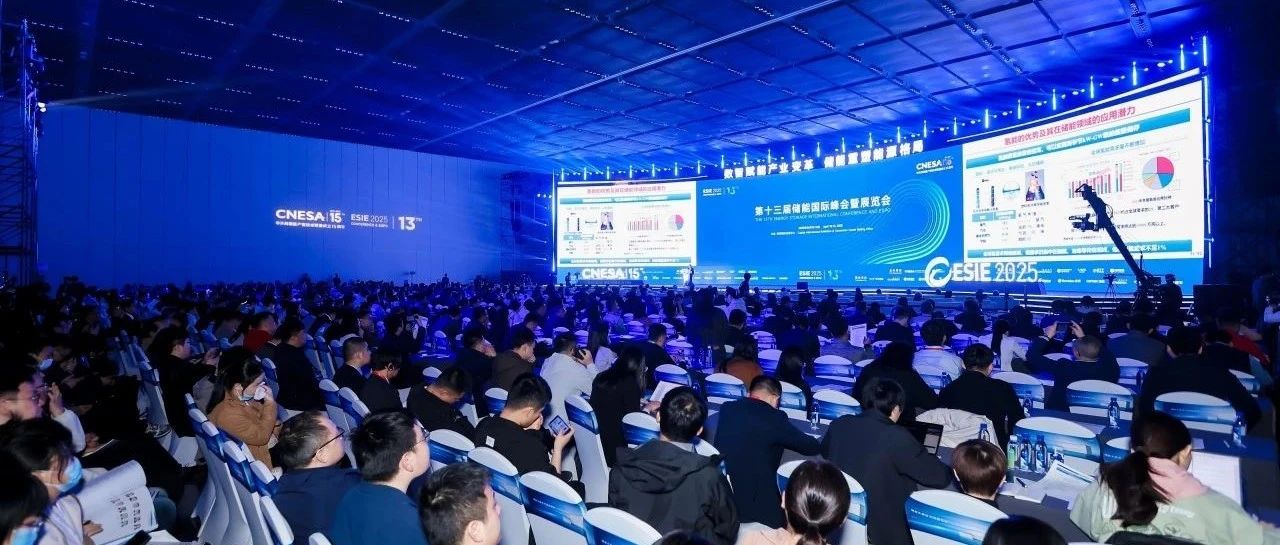
Core Viewpoint - The 13th Energy Storage International Summit and Exhibition (ESIE2025) emphasizes the transformation of the energy landscape through intelligent empowerment and the market-driven development of the energy storage industry [1][7]. Group 1: Event Overview - The summit took place on April 10, 2025, in Beijing, attracting over 1,000 participants from government, research institutions, and leading companies in the energy storage industry, with more than 230 million online views [1]. - The event featured a record exhibition area of 160,000 square meters, nearly 800 exhibitors, over 50 meetings, and more than 100 product launches, with over 50,000 attendees on the first day [1]. Group 2: Key Speakers and Guests - Notable speakers included leaders from the China Energy Research Society, the National Energy Administration, and the State Grid Corporation, highlighting the importance of policy and technological innovation in the energy storage sector [2][9][11][13]. - Academics and industry experts, including several Chinese Academy of Sciences and Engineering members, contributed insights on the future of energy storage technologies [3][4][5]. Group 3: Policy and Market Trends - The introduction of the "136 Document" signifies a shift from policy-driven to market-driven dynamics in the energy storage industry [7]. - The National Energy Administration plans to enhance the development of new energy storage technologies through strategic planning, innovation support, and market mechanisms [9]. - The State Grid's new energy storage capacity is projected to reach 58.6 GW/137.9 GWh by the end of 2024, with a significant increase in market transactions [13]. Group 4: Technological Innovations - The summit highlighted the need for breakthroughs in energy storage technologies, including solid-state batteries and other advanced systems, to address cost and safety challenges [18][22]. - The integration of AI and big data into energy storage systems is seen as crucial for enhancing efficiency and reducing costs [26][30][32]. Group 5: Industry Dialogue and Future Directions - The summit facilitated high-level discussions on the opportunities and challenges presented by the marketization of new energy, focusing on sustainable development paths for the energy storage industry [34][35]. - Experts emphasized the importance of establishing sustainable business models and pricing systems to enhance the economic viability of energy storage systems [34].

重磅预告丨ESIE2025高端对话:新能源全面市场化给新型储能带来的机遇与挑战(深度解读136号文)
中关村储能产业技术联盟· 2025-04-01 09:59
Core Viewpoint - The article emphasizes the need for the energy storage industry to explore sustainable development models in the context of the comprehensive marketization of new energy, which has become a focal point for the entire sector [2][8]. Group 1: Event Overview - The 13th International Energy Storage Summit and Exhibition (ESIE2025) will take place on April 10, 2025, focusing on the opportunities and challenges presented by the marketization of new energy for the energy storage sector [3][15]. - The main forum will feature eight industry experts and business leaders discussing strategies and future directions for the energy storage industry in the context of new energy marketization [2][9]. Group 2: Policy Impact - The "136 Document," released on February 9, 2025, by the National Development and Reform Commission and the National Energy Administration, marks a significant turning point in the new energy sector, stating that all new energy projects must enter the electricity market, with prices determined through market transactions [5][6]. - The document prohibits making energy storage configuration a prerequisite for the approval, grid connection, and online access of new energy projects, which will profoundly change the development and revenue models of both energy storage and independent energy storage stations [7][9]. Group 3: Market Dynamics - According to the CNESA Global Energy Storage Database, the planned and contracted energy storage project capacity for 2024 is expected to reach 73.9 GW/219.8 GWh, with independent energy storage accounting for 88% and new energy storage accounting for 8% [7]. - The revenue model for independent energy storage will primarily depend on the electricity market, which is subject to price fluctuations and capacity price design, leading to high uncertainty and risk for future energy storage revenues [7][9]. Group 4: Industry Challenges - The energy storage industry urgently needs to establish sustainable business models and a reasonable electricity pricing system to restore the value of new energy storage through market mechanisms, enhancing the economic viability and sustainability of energy storage systems [9][10]. - The upcoming high-level dialogue at ESIE2025 aims to provide strategic development and operational recommendations for the sustainable growth of the energy storage industry [9][10].