
智能工厂梯度培育

Search documents
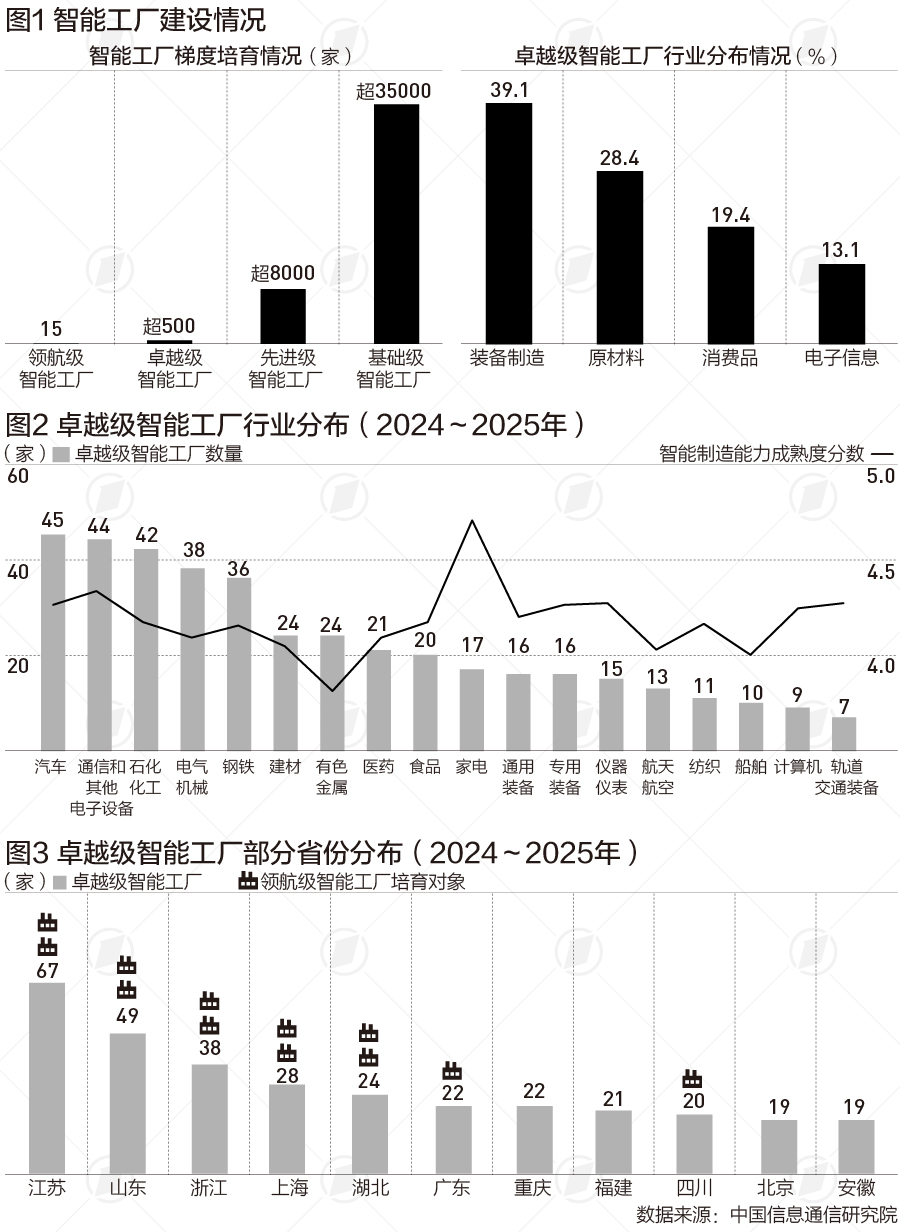
智能工厂建设初具规模,江苏山东浙江卓越级数量居前三
Di Yi Cai Jing· 2026-02-12 13:03
Core Viewpoint - The development of smart factories is becoming a crucial support for industries to respond to market changes, especially in the context of slowing global economic growth and increasing pressure on China's manufacturing sector [1][4]. Group 1: Current State of Smart Factories - As of 2024, China has cultivated 15 leading smart factories, over 500 excellent smart factories, more than 8,000 advanced smart factories, and over 35,000 basic smart factories, indicating a significant scale in smart factory construction [2]. - The report from the China Academy of Information and Communications Technology (CAICT) outlines that smart factories are expected to evolve from single factory construction to a "platform + cluster" collaboration model over the next five years [2]. - The nominal growth rate of global manufacturing has shown a declining trend, with the average growth rate dropping from 2.83% (2004-2013) to 2.66% (2014-2023), and is expected to decline further in the next decade [2]. Group 2: Government Initiatives and Industry Coverage - In October 2024, six ministries, including the Ministry of Industry and Information Technology, launched the 2024 Smart Factory Gradient Cultivation Action to accelerate the digital transformation and intelligent upgrade of the manufacturing sector [3]. - The action plan categorizes smart factories into four levels: basic, advanced, excellent, and leading, with over 90% of manufacturing industry categories covered by various levels of smart factories [3]. - The construction goal for excellent smart factories includes enhancing digital and network optimization capabilities and integrating design, production, and operational data [3]. Group 3: Industry Distribution and Regional Insights - Industries such as petrochemical, electrical machinery, steel, and building materials have over 32% of their factories classified as excellent smart factories, driven by the need for digital transformation and efficiency improvements [4]. - Jiangsu province leads in the number of excellent smart factories, with 67, followed by Shandong (49), Zhejiang (38), and others, indicating a strong regional focus on smart manufacturing [7]. - Large enterprises account for 92.5% of participation in smart factory initiatives in Jiangsu, which is 12.1 percentage points higher than the national average, showcasing the province's robust industrial structure [7]. Group 4: Future Trends in Smart Factory Development - The report identifies five future trends for smart factories: transitioning from physical construction to virtual-digital twin models, shifting from traditional experience-based R&D to data and model-driven paradigms, evolving production from localized flexibility to large-scale reconfigurable systems, advancing management from predetermined rules to dynamic optimization, and enhancing operational management from data-assisted decision-making to intelligent decision-making and proactive services [8].

工信部:一批领航级智能工厂将亮相
Bei Jing Shang Bao· 2026-01-21 16:04
Core Insights - Artificial intelligence has penetrated over 70% of business scenarios in leading factories, with the Ministry of Industry and Information Technology (MIIT) supporting leading enterprises to explore future manufacturing models and cultivate a batch of leading factories to drive overall industry transformation [1][3][6]. Group 1: Development of Smart Factories - A total of over 35,000 basic-level, over 8,200 advanced-level, and over 500 excellent-level smart factories have been established, along with 15 leading-level smart factories [2]. - The first batch of 15 leading factories showcased at the 2025 World Intelligent Manufacturing Conference have made beneficial explorations in manufacturing models, achieving an average production efficiency increase of 29% and a reduction in product defect rates by 47% [3]. - The leading factories have developed over 6,000 vertical domain models and facilitated the large-scale application of over 1,700 key intelligent manufacturing equipment and industrial software [3]. Group 2: Strategic Initiatives - The cultivation of leading-level smart factories is a strategic measure to seize opportunities in industrial intelligence development and build future manufacturing competitive advantages [4]. - Starting in 2024, MIIT will launch a gradient cultivation action for smart factories, establishing a four-level system to meet the transformation needs of manufacturing enterprises of different scales and foundations [5]. - The goal is to create a flexible supply network that enhances the efficiency of industrial resource utilization and strengthens China's core position in the global supply chain [5]. Group 3: 6G Technology Development - The first phase of 6G technology trials has been completed, with over 300 key technology reserves formed, and the second phase of trials has recently commenced [8]. - China has built the world's largest and most advanced information infrastructure, with 5G standard essential patent declarations accounting for 42% globally [8]. - The number of 5G base stations has reached 4.838 million, covering all towns and 95% of administrative villages, with over 12 billion 5G users [8].
为“中国智造”持续注入新动能 一批领航级智能工厂将亮相
Bei Jing Shang Bao· 2026-01-21 10:21
Core Viewpoint - The Ministry of Industry and Information Technology (MIIT) of China is promoting the development of leading smart factories to enhance the country's manufacturing competitiveness and support the digital transformation of the global manufacturing industry [1][6]. Group 1: Development of Smart Factories - Over 35,000 basic-level, more than 8,200 advanced-level, and over 500 excellent-level smart factories have been established, along with 15 leading smart factories [4]. - The first batch of 15 leading smart factories showcased their advancements at the 2025 World Intelligent Manufacturing Conference, achieving an average production efficiency increase of 29% and a reduction in product defect rates by 47% [5]. - The leading smart factories have integrated artificial intelligence into over 70% of their business scenarios, creating over 6,000 vertical domain models and facilitating the large-scale application of more than 1,700 key intelligent manufacturing equipment and industrial software [5]. Group 2: Strategic Initiatives - The MIIT, in collaboration with several government departments, aims to cultivate a batch of leading smart factories that represent the highest level of global intelligent manufacturing, serving as a model for the overall upgrade of China's manufacturing industry [6]. - A four-tier system for smart factory cultivation has been initiated, focusing on basic, advanced, excellent, and leading levels, with specific requirements for AI application scenarios [7]. - The MIIT plans to continue implementing intelligent manufacturing projects and support leading enterprises in exploring future manufacturing models, which will help overcome bottlenecks in high-end and intelligent development in the manufacturing sector [8].

云南聚焦三大重点任务梯度培育智能工厂
Zhong Guo Chan Ye Jing Ji Xin Xi Wang· 2025-07-21 22:19
Core Viewpoint - The implementation plan aims to significantly enhance the cultivation of intelligent factories in Yunnan Province by 2027, with specific targets for different levels of intelligent factories [1][2]. Group 1: Basic Level Intelligent Factories - The plan sets a goal for over 50% of self-evaluated enterprises to reach the basic level of intelligent factories by the end of 2027 [1]. - It emphasizes the need for large-scale equipment updates in the industrial sector and supports projects focused on high-end, digital, and green transformations [1]. Group 2: Advanced Level Intelligent Factories - The initiative aims to recognize over 80 advanced level intelligent factories by the end of 2027, focusing on key industries and regional leadership [2]. - All key enterprises in the industry are encouraged to complete assessments of their intelligent manufacturing capabilities to facilitate upgrades [2]. Group 3: Excellent and Leading Level Intelligent Factories - The plan supports advanced level intelligent factories in optimizing and integrating manufacturing processes to achieve excellent level status [2]. - It encourages the exploration of new-generation artificial intelligence and advanced manufacturing technologies, aiming to establish over 10 excellent level intelligent factories by 2027 [2].
黑龙江:分层分级推进智能工厂建设,加快构建智能工厂梯度培育体系
Zheng Quan Shi Bao Wang· 2025-06-27 01:23
Core Viewpoint - The implementation plan aims to promote the construction of smart factories in Heilongjiang Province, establishing a tiered cultivation system to enhance the digital transformation and intelligent upgrade of the manufacturing industry [1][3]. Group 1: Implementation Goals - The overall goal is to widely promote basic-level smart factories, scale up advanced-level smart factories, and cultivate leading smart factories with global influence [1]. - The plan encourages manufacturing enterprises to develop improvement plans based on smart manufacturing maturity assessment results and to upgrade production processes accordingly [1][2]. Group 2: Smart Factory Levels - The plan outlines a tiered approach: basic-level, advanced-level, excellent-level, and leading-level smart factories, with specific criteria for each level [3]. - Advanced-level smart factories are expected to integrate production and management processes, while excellent-level factories should promote smart manufacturing solutions and standards [2][3]. - Leading-level smart factories are encouraged to apply new technologies and lead innovations in manufacturing models and organizational structures [2]. Group 3: Management and Evaluation - The plan establishes a collaborative system among provincial, municipal, and county levels to manage the smart factory cultivation process [3]. - Dynamic management of the lists for basic and advanced-level factories will be implemented, with annual evaluations and a three-year term for qualification [4].
工信部等六部门开展2025年度智能工厂梯度培育行动
news flash· 2025-06-20 11:51
Group 1 - The Ministry of Industry and Information Technology, along with five other departments, has launched the 2025 Smart Factory Gradient Cultivation Action [1] - The cultivation will be divided into four levels: Basic, Advanced, Excellent, and Leading Smart Factories [1]
《海南省智能工厂梯度培育工作方案(2025—2027年)》印发
Hai Nan Ri Bao· 2025-06-14 23:56
Core Viewpoint - The Hainan Province has issued a work plan for the cultivation of intelligent factories from 2025 to 2027, aiming to establish over 100 intelligent factories by 2027, categorized into four levels: basic, advanced, excellent, and leading [2][3]. Group 1: Intelligent Factory Levels - The plan outlines a tiered cultivation system for intelligent factories, with a target of over 100 basic-level factories, more than 20 advanced-level factories, and at least 5 excellent-level factories by 2027 [2]. - The leading-level intelligent factories will be cultivated to have a global influence, promoting innovation in manufacturing models and industry transformations [3]. Group 2: Basic-Level Intelligent Factories - The plan emphasizes the promotion of basic-level intelligent factories, encouraging manufacturing enterprises to assess their smart manufacturing capabilities and develop enhancement plans [2]. - Key actions include deploying necessary smart manufacturing equipment, industrial software, and systems to upgrade production processes and achieve real-time data collection and automation [2]. Group 3: Advanced-Level Intelligent Factories - Advanced-level factories will focus on integrating and coordinating key production and management processes, aiming for a digital transformation with regional and industry-specific characteristics [3]. - The plan supports the continuous enhancement of digital and network optimization capabilities in advanced-level factories [3]. Group 4: Excellent and Leading-Level Intelligent Factories - Excellent-level factories will implement comprehensive optimizations across the entire product lifecycle and supply chain, utilizing smart manufacturing technologies [3]. - Leading-level factories will integrate next-generation artificial intelligence and other digital technologies into the entire manufacturing process, driving innovation in research, production, and organizational structures [3].
巨能股份:以智能工厂梯度培育赋能制造业革新,助力产业智能化跃迁
Zheng Quan Shi Bao Wang· 2025-04-30 07:59
Core Insights - The article highlights the significant development phase of smart factory construction in China, driven by the global shift towards intelligent manufacturing. The company, Juneng Robotics Co., Ltd. (stock code: 871478), plays a leading role in this transformation by providing customized solutions to help clients transition from automation to intelligence [1][2]. Group 1: Company Overview - Juneng Robotics aims to be "a factory of smart factories," equipping other factories with intelligent production lines. The company leverages over 20 years of experience in automation to create a comprehensive knowledge base and modular, standardized smart factory solutions [2]. - The company has been actively involved in the Ministry of Industry and Information Technology's (MIIT) smart factory gradient cultivation initiative, focusing on three main paths: deep technology application, full-chain value reconstruction, and green low-carbon transformation [2]. Group 2: Key Projects - Three major projects that Juneng Robotics participated in were recognized in the MIIT's first batch of 235 exemplary smart factories: 1. **Fasite**: A data-driven "dark factory" representing the highest level of smart manufacturing in the commercial vehicle transmission sector, contributing to breakthroughs in domestic AMT transmission technology [3]. 2. **Hande Axle**: A benchmark for new energy full-chain intelligent manufacturing, integrating automation, smart production lines, and digital systems for seamless collaboration across various operational stages [4]. 3. **China Coal Science and Technology Institute Chongqing**: Focused on the intelligentization of mining equipment, utilizing technologies like 5G and industrial robots to enhance efficiency and safety in the mining drilling industry [5]. Group 3: Industry Impact - As of the end of 2024, over 30,000 basic-level, 1,200 advanced-level, and 230 exemplary smart factories have been established in China, covering more than 80% of manufacturing categories. Exemplary factories have achieved significant improvements, including a 28.4% reduction in R&D cycles, a 50.2% decrease in defect rates, and a 20.4% reduction in carbon emissions [6]. - In response to the manufacturing industry's shift from mass production to customized responses, Juneng Robotics plans to launch a highly flexible intelligent production line at the 2025 China International Machine Tool Show, enabling unmanned operations for diverse product types [6].