机器人触觉感知

Search documents
国内首篇!融合语言模型的多模态触觉传感器
具身智能之心· 2026-01-26 03:42
Core Insights - The article discusses the development of a biomimetic multimodal tactile sensor named SuperTac, inspired by the complex sensory systems of pigeons, which enhances robotic perception to human-like levels [1][2][4] Group 1: Biomimetic Logic - SuperTac's hardware design is inspired by the biological features of pigeons, which possess one of the most complex sensory systems in nature [7] - The sensor integrates a miniaturized multispectral imaging module that covers a wide frequency range from ultraviolet (390 nm) to mid-infrared (5.5–14.0 μm), allowing robots to analyze thermal radiation and fluorescence in a single interaction [10][11] Group 2: Core Mechanism - The core competitive advantage of SuperTac lies in its 1 mm thick light field modulation multi-layer sensing skin, which utilizes a conductive layer made of transparent PEDOT:PSS to achieve high-precision material classification [14] - The sensor's design allows for different electrical feedback when in contact with various materials, enabling accurate material recognition and proximity detection within 15 cm [14][16] Group 3: Tactile Language Model - The DOVE model, with 8.5 billion parameters, employs a hierarchical architecture to align physical signals with natural language, enhancing the system's understanding and reasoning capabilities [19] - DOVE processes complex tactile inputs by integrating pre-trained models to extract deep feature vectors from tactile characteristics such as color, texture, and temperature [19][20] Group 4: Application Scenarios - SuperTac and DOVE enable a transition from basic physical perception to advanced semantic cognition, allowing robots to interact in a more human-like manner [22] - In practical applications, DOVE can convert sensory impressions into human-understandable language, accurately identifying objects and suggesting actions based on tactile feedback [24][26] Group 5: Future Directions - The research outlines promising future directions for robotic tactile sensing, including sensor miniaturization and low-power chip development to enhance operational flexibility and thermal stability [28]

国内首篇!融合语言模型的多模态触觉传感器,推动机器人触觉迈向人类水平
机器之心· 2026-01-25 04:01
Core Viewpoint - The article discusses the development of a biomimetic multimodal tactile sensor, SuperTac, which enhances robotic perception by integrating advanced sensing technologies inspired by the complex sensory systems of pigeons, marking a significant step towards achieving human-like tactile perception in robots [2][4]. Group 1: Biomimetic Logic - SuperTac's hardware design is inspired by the biological features of pigeons, which possess one of the most complex sensory systems in nature [7]. - The sensor integrates a miniaturized multispectral imaging module that covers an ultra-wide frequency range from ultraviolet (390 nm) to mid-infrared (5.5–14.0 μm), enabling robots to analyze thermal radiation, fluorescence, and other physical information in a single interaction [10][11]. Group 2: Core Mechanism - The core competitive advantage of SuperTac lies in its 1 mm thick light field modulation multi-layer sensing skin, which utilizes a conductive layer made of transparent PEDOT:PSS to provide uniform electrical signals for high-precision material classification [14]. - The sensor's design allows it to capture micro-textures and deformations while also obtaining RGB color information, ensuring comprehensive data collection during interactions [16]. Group 3: Tactile Language Model - The DOVE model, with 8.5 billion parameters, employs a hierarchical architecture to align cross-modal physical signals with natural language representations, enhancing the system's language understanding and logical reasoning capabilities [19]. - DOVE's training involves a three-stage strategy that transforms heterogeneous sensor signals into a unified image representation, aligning tactile features with language model space for complex reasoning [20]. Group 4: Application Scenarios - SuperTac, combined with the DOVE model, enables robots to transition from basic physical perception to high-level semantic cognition, allowing for human-like embodied interactions [22]. - In practical applications, DOVE can accurately translate sensory impressions into human-understandable language, such as identifying an object as a "yellow, room temperature, metal material with patterned protrusions" [24]. - The model's capabilities are validated in challenging tasks, such as waste sorting, where it can deduce the characteristics of objects and make logical decisions based on tactile feedback [26]. Group 5: Future Directions - The research outlines promising future directions for robotic tactile sensing, including sensor miniaturization, low-power chips, and high-integration packaging to enhance operational flexibility and thermal stability [28].
半年两迭代,价格下探1299元,戴盟“自卷”如何撬动机器人触觉感知的千亿市场?
机器人大讲堂· 2025-11-20 10:05
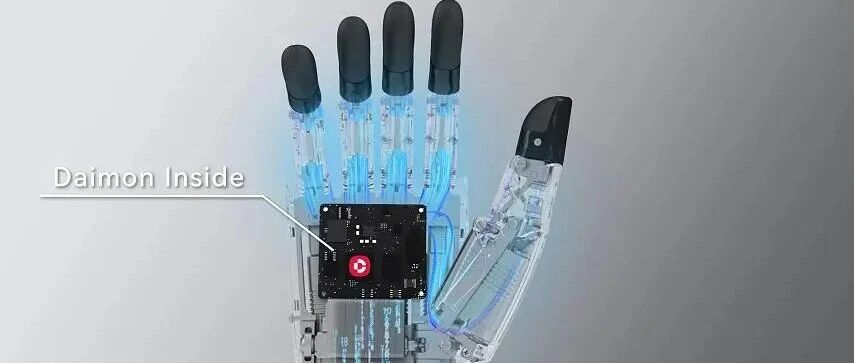
Core Viewpoint - The article highlights the advancements made by Daimeng Robotics in tactile perception technology, addressing the limitations of traditional robotic sensors and redefining the boundaries of robotic perception with innovative solutions [1][16]. Group 1: Technological Breakthroughs - Daimeng Robotics has developed a new generation of tactile sensors that overcome existing technical bottlenecks, such as insufficient resolution, poor durability, and weak anti-interference capabilities [2][4]. - The DM-Tac W2 series is the world's first tactile sensor to exceed the IP65 standard, allowing it to function effectively in wet and dusty environments, which is crucial for both industrial and household applications [2][4]. - The introduction of "micron-level texture recognition" technology enables robots to detect minute defects, such as scratches as small as 0.1mm, significantly enhancing precision in various applications [4]. Group 2: Product Innovations - Daimeng offers a range of tactile sensors in different sizes, including the DM-Tac W2 series for standard applications and specialized models for narrow spaces, enhancing operational flexibility [6]. - The DM-Flux edge AI computing platform acts as a "tactile decision-making brain," providing a closed-loop capability for perception, decision-making, and control, which distinguishes Daimeng from other sensor manufacturers [8][12]. Group 3: Pricing Strategy - The new generation of tactile sensors is priced starting at 1299 yuan, significantly lower than similar international products, positioning it as a high-value option in the market [13][15]. - The cost reduction is attributed to the advantages of the monochromatic light technology, which simplifies production and lowers hardware costs, allowing for a balance between technological upgrades and price reductions [15]. Group 4: Industry Impact - Daimeng's innovations are set to transform various sectors, including smart manufacturing, logistics, household services, and medical rehabilitation, by enabling robots to perform tasks with enhanced precision and adaptability [16]. - The company's vision aims to break the physical limits of perception and foster a harmonious coexistence between humans and machines, with plans to introduce wearable remote operation data collection devices in the near future [16].
深圳的咖啡馆里,又开始聊创业了丨一线
吴晓波频道· 2025-11-18 00:30
Core Viewpoint - The article highlights the emergence of a new golden era for hardware entrepreneurship in Shenzhen, particularly in the Nanshan Technology Park, where a diverse range of innovative startups are thriving and leveraging local resources to create impactful products [3][4][8]. Group 1: Entrepreneurial Landscape - Shenzhen's Nanshan Technology Park has become a hub for over ten thousand startup teams, indicating a high density of entrepreneurial activity [4][8]. - The article categorizes three types of entrepreneurs: top technical talents in hardware, young professionals transitioning from other industries, and traditional factory owners from Shenzhen's electronics sector [5][8]. - Many of these startups operate with small teams, often consisting of just 1-2 members, yet they are capable of developing mature hardware products [6][21]. Group 2: Success Stories - Entrepreneurs like Hou Ningzhe and Li Yilu exemplify the new wave of hardware creators, with Hou focusing on robotic tactile sensing technology and Li developing a portable water purifier [12][15]. - Li's team, consisting of only three people, managed to raise over one million RMB in overseas funding and won a design award, showcasing the potential of small teams in the hardware sector [15][22]. - Zhang Hailong transitioned from managing an electronics factory to creating his own brand of smart rings, demonstrating the shift from traditional manufacturing to innovative product development [16]. Group 3: Collaborative Ecosystem - The article emphasizes the importance of Shenzhen's efficient hardware supply chain, which allows startups to quickly source components and collaborate with experienced manufacturers [27][30]. - The presence of numerous incubators and maker spaces in Shenzhen supports young entrepreneurs by providing access to resources, technical support, and market connections [34][36]. - The local entrepreneurial ecosystem fosters collaboration, enabling startups to validate their products through crowdfunding before scaling up production [25][26]. Group 4: Market Potential and Innovation - Shenzhen is home to a significant number of high-tech enterprises, with over 2.5 million national high-tech companies and a high density of AI and robotics firms [49][50]. - The article notes that small startups are often more agile and innovative than larger corporations, which may hesitate to enter new markets due to potential risks [42]. - The growth of "super nodes" in the hardware sector, such as companies that have achieved significant market share, illustrates the potential for small teams to disrupt established industries [41][42].

【CCRS 2025】圆满落幕!中国第六届机器人学术年会在长沙画上完美句点
机器人圈· 2025-08-04 11:38
Core Viewpoint - The Sixth China Robotics Academic Annual Conference (CCRS 2025) focused on the theme "Human-Machine Integration, Intelligent Future," gathering over 200 experts and scholars to discuss cutting-edge robotics technology and industry applications [2][3]. Group 1: Conference Overview - The conference attracted more than 3,000 participants, including academicians and industry representatives from around the world [2]. - It featured 7 keynote speeches, 14 thematic reports, and 115 invited presentations across various robotics fields, including industrial, service, special, marine, and medical robotics [2][3]. - A total of 259 poster presentations and free communication sessions showcased the latest research and innovations in the robotics sector [3]. Group 2: Keynote Speakers and Topics - Notable speakers included academicians from the Chinese Academy of Engineering and the Chinese Academy of Sciences, discussing topics such as embodied intelligence, collaborative robots, humanoid and bionic robots [4][5]. - Ding Han emphasized the importance of human-machine integration in intelligent manufacturing, highlighting the need for deep coupling between physical entities and digital virtualities [7]. - Yang Huayong discussed the role of AI-enhanced tactile perception in robots, aiming to improve human-robot interaction and safety [9]. - Zheng Qinghua introduced three evolutionary paths for advancing artificial intelligence from weak to strong, addressing challenges in current large model technologies [11][12]. - Guo Lei presented a framework for bionic intelligent systems, focusing on the survival capabilities of unmanned systems in complex environments [14]. - Zhang Jianwei highlighted the challenges of mimicking human intelligence in robots and the importance of collaboration in addressing global challenges [16]. - Gao Feng discussed the challenges and opportunities in intelligent robot design, emphasizing the need for impactful industrial directions [18][19]. - Ji Xiangyang explored the significance of machine vision technology in various applications, including industrial and aerospace sectors [21]. Group 3: Event Highlights - The opening ceremony featured speeches from academicians outlining the future development of robotics [25]. - The conference sessions were well-attended, with significant engagement in discussions on advanced technologies [27]. - Various robot prototypes were showcased, attracting interest and discussions among attendees [37]. Group 4: Closing Remarks - The event concluded with gratitude expressed to the organizing and supporting units, emphasizing the successful establishment of a high-level communication platform for the robotics field [46]. - The anticipation for the next annual conference was highlighted, marking a new journey in the robotics era [47].
他山科技开源触觉模拟仿真,引领机器人触觉技术迭代方向
机器人大讲堂· 2025-06-07 10:43AI Processing