
机器人触觉传感器

Search documents
深圳的咖啡馆里,又开始聊创业了丨一线
吴晓波频道· 2025-11-18 00:30
Core Viewpoint - The article highlights the emergence of a new golden era for hardware entrepreneurship in Shenzhen, particularly in the Nanshan Technology Park, where a diverse range of innovative startups are thriving and leveraging local resources to create impactful products [3][4][8]. Group 1: Entrepreneurial Landscape - Shenzhen's Nanshan Technology Park has become a hub for over ten thousand startup teams, indicating a high density of entrepreneurial activity [4][8]. - The article categorizes three types of entrepreneurs: top technical talents in hardware, young professionals transitioning from other industries, and traditional factory owners from Shenzhen's electronics sector [5][8]. - Many of these startups operate with small teams, often consisting of just 1-2 members, yet they are capable of developing mature hardware products [6][21]. Group 2: Success Stories - Entrepreneurs like Hou Ningzhe and Li Yilu exemplify the new wave of hardware creators, with Hou focusing on robotic tactile sensing technology and Li developing a portable water purifier [12][15]. - Li's team, consisting of only three people, managed to raise over one million RMB in overseas funding and won a design award, showcasing the potential of small teams in the hardware sector [15][22]. - Zhang Hailong transitioned from managing an electronics factory to creating his own brand of smart rings, demonstrating the shift from traditional manufacturing to innovative product development [16]. Group 3: Collaborative Ecosystem - The article emphasizes the importance of Shenzhen's efficient hardware supply chain, which allows startups to quickly source components and collaborate with experienced manufacturers [27][30]. - The presence of numerous incubators and maker spaces in Shenzhen supports young entrepreneurs by providing access to resources, technical support, and market connections [34][36]. - The local entrepreneurial ecosystem fosters collaboration, enabling startups to validate their products through crowdfunding before scaling up production [25][26]. Group 4: Market Potential and Innovation - Shenzhen is home to a significant number of high-tech enterprises, with over 2.5 million national high-tech companies and a high density of AI and robotics firms [49][50]. - The article notes that small startups are often more agile and innovative than larger corporations, which may hesitate to enter new markets due to potential risks [42]. - The growth of "super nodes" in the hardware sector, such as companies that have achieved significant market share, illustrates the potential for small teams to disrupt established industries [41][42].


广东智造进化论:“AIR”驱动千行百业变革
2 1 Shi Ji Jing Ji Bao Dao· 2025-11-04 23:16
Core Insights - The article highlights the rapid growth and investment in the AI and robotics sector in Guangdong, particularly focusing on tactile sensors for robots and the commercialization of embodied intelligent robots [1][2] - Guangdong is positioned as a "super testing ground" for AI+ applications due to its robust industrial system, innovative ecosystem, and diverse market demands [1][2] Investment and Financing - The startup, PAXINI, has raised nearly 1 billion RMB in funding over the past six months, indicating strong investor interest in tactile sensors as essential components for robots [1] - The AI core industry in Guangdong has grown from 130 billion RMB to 220 billion RMB during the 14th Five-Year Plan, with an annual growth rate exceeding 15% [2] Policy and Development - The Guangdong government is actively promoting AI integration into manufacturing, as outlined in the "Guangdong Province AI Empowering High-Quality Development Action Plan (2025-2027)" [2] - A focus on large-scale applications of industrial AI has been established, with a recent release of the first batch of "AI+" application scenarios covering key sectors like manufacturing, healthcare, and education [2] Industry Transformation - Companies like LIGONG Industrial have transitioned from traditional manufacturing to smart factories, integrating AI training into daily operations [4][5] - The shift towards humanoid collaborative robots is driven by the need for machines that can perform tasks requiring dexterity, such as packaging and assembly [5][6] Technological Advancements - The development of intelligent mobile robots by companies like Blue Ocean Robotics has enabled automated operations in complex environments, significantly reducing the need for human labor [7][8] - The focus on creating robots that can operate autonomously without human control is seen as a hallmark of the AI era [8][9] Market Opportunities - The vast industrial landscape in Guangdong presents numerous opportunities for AI and robotics companies to innovate and expand into new sectors, including agriculture and logistics [9][10] - The establishment of companies like Turing New Intelligent Computing, which focuses on providing AI training solutions, reflects the growing demand for computational power in industrial applications [11][12]
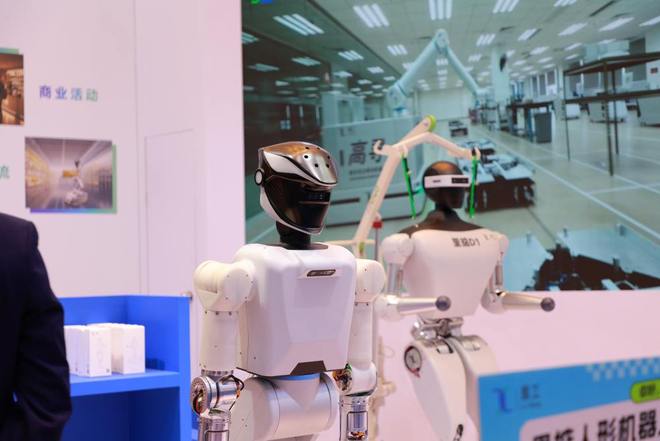
纽交所公司高管和厦大教授带队,半年走完研发到量产!「模量科技」获德宁资本千万天使轮投资!
机器人大讲堂· 2025-07-15 07:29
Core Viewpoint - The article highlights the recent angel round financing of "Modulus Technology," a startup specializing in tactile and flexible sensor technology, which raised tens of millions in funding to enhance product development, market promotion, and team building [1]. Company Overview - Modulus Technology, established at the end of 2024, focuses on multi-modal and multi-dimensional tactile sensing technology and tactile model research and application [1]. - The company offers a complete tactile perception solution, covering sensor materials, hardware, software, algorithms, and full systems [1]. Team Composition - The founder, Guan Hua, has extensive experience in strategic cooperation and investment in the supply chain chip, sensor, and smart hardware sectors [2]. - Co-founder Zhou Jianlin has a background in polymer materials and has led product introduction and business expansion in a well-known 3D printing company [2]. - The core team consists of nearly 20 members, with over 80% in R&D, covering key areas such as algorithms, hardware, software, and sensors [2]. Product Development and Business Expansion - Modulus Technology has developed high-sensitivity sensing materials and micro-structural processes, significantly improving sensor range, accuracy, and sensitivity [4]. - The company has created a flexible pressure sensing array that can be produced at low cost and in large quantities, addressing the high customization and production costs in the tactile sensor industry [4]. - The maximum pressure range achieved is 20 MPa, with linearity reaching 99.9%, comparable to international competitors [4]. Technological Advancements - The company has established a multi-dimensional tactile perception chain, enabling robots and dexterous hands to have richer and more precise sensing capabilities [5]. - Modulus Technology has built a full-stack R&D capability, providing a complete toolchain for sensor data collection, calibration, and software analysis [5]. Product Matrix - The core products include robotic tactile sensors, industrial pressure distribution detection devices, fabric-based flexible sensors, and flexible film sensors [6]. - The company has secured orders from leading companies in the humanoid robot and dexterous hand sectors, and is in the mass delivery phase [6]. - Collaborations have been established with top clients in robotics and industrial fields, as well as in consumer electronics segments like smart cockpits and wearables [6].
【深圳特区报】创投资本沃土育出“科创森林” 深圳超9700亿元私募股权创投基金支持创新创业
Sou Hu Cai Jing· 2025-07-13 23:31
Group 1 - Shenzhen-based company Digital Huaxia has completed its angel + round financing and is now initiating a second round of financing, highlighting the support from local venture capital for innovation and commercialization [1] - Shenzhen's private equity and venture capital funds have invested in over 20,000 projects with a total investment amount exceeding 970 billion yuan, focusing on early-stage investments in hard technology [1][7] - The city aims to form a "double ten thousand" structure by the end of 2026, with a target of 1 trillion yuan in "20+8" industry funds and over 10,000 registered equity and venture capital funds [7] Group 2 - The opening of a 12,000 square meter intelligent data factory by Shenzhen company Pasini aims to address the scarcity of high-quality datasets in the embodied intelligence industry, making it the largest data collection and model training base globally [4] - Pasini has secured two rounds of financing in less than two months, including strategic investments from BYD and other well-known investment institutions in Shenzhen [4] - Digital Huaxia has accelerated its development with the support of venture capital, launching a new humanoid robot and expanding its application scenarios across the country [4] Group 3 - Shenzhen is actively utilizing technology innovation bonds to raise low-cost, long-term funds to support the growth of hard technology companies, with a recent issuance of 400 million yuan by venture capital firm Dongfang Fuhai [5][6] - As of June 30, Shenzhen has issued 17 technology innovation bonds with a total scale of 13.777 billion yuan, with a significant portion issued by securities companies and venture capital institutions [6] - The financing environment in Shenzhen is improving, with a notable increase in the number of projects and investment amounts directed towards early-stage technology companies, particularly in aerospace, semiconductors, and biotechnology [7]

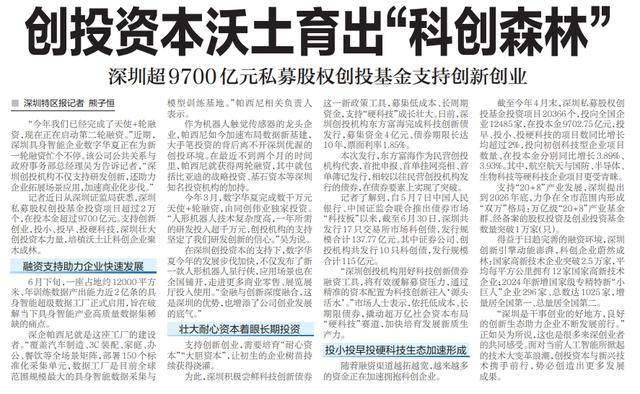
自研多模态触觉传感技术,「模量科技」获千万级天使轮融资 | 36氪首发
3 6 Ke· 2025-07-08 01:32
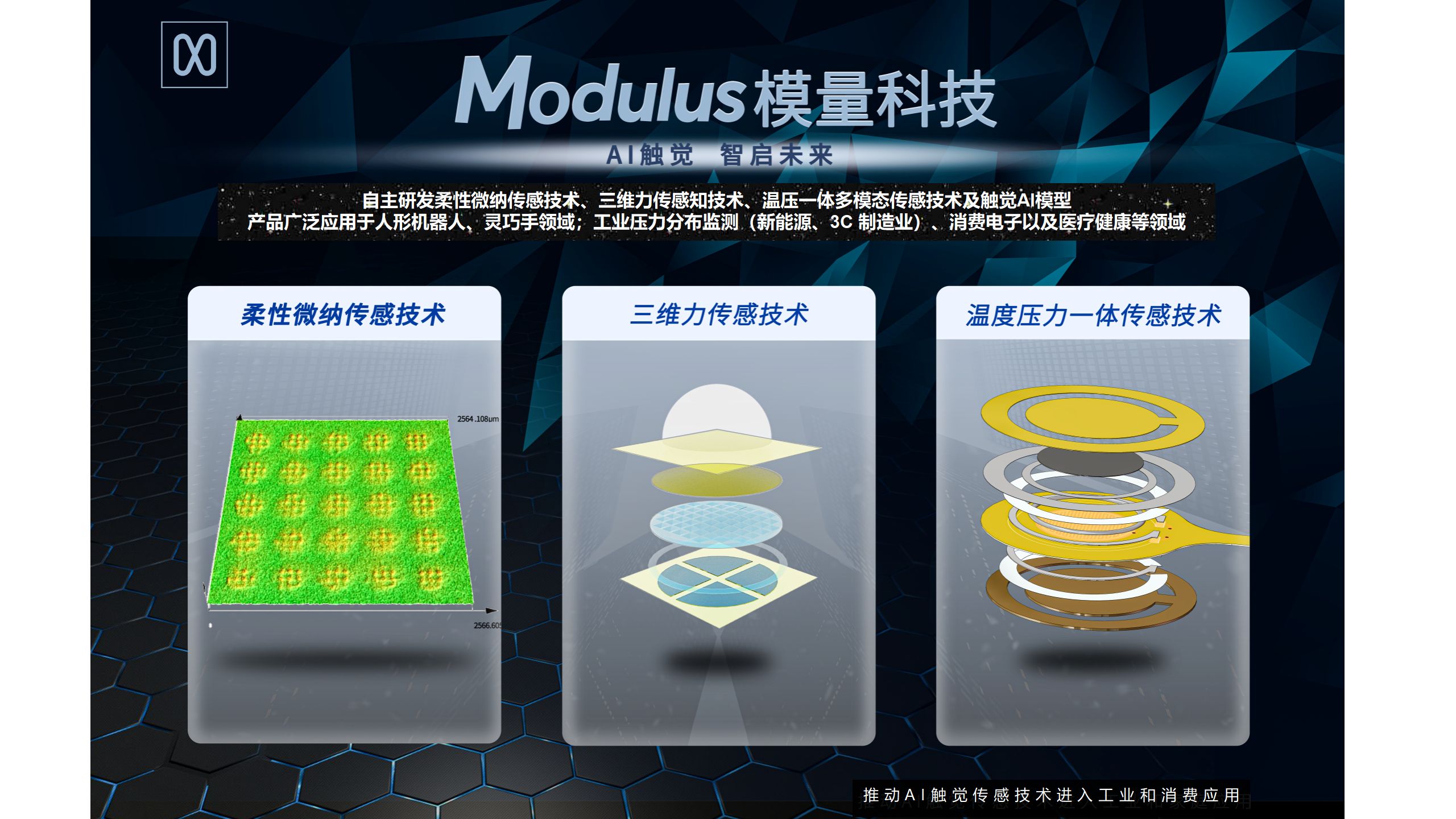
Company Overview - Shenzhen Modulus Technology Co., Ltd. has completed a multi-million angel round financing led by Denning Capital, with funds primarily allocated for product development, market promotion, and team building [1] - Founded in late 2024, the company focuses on multi-modal multi-dimensional tactile sensing technology and tactile model research and application, with products including robotic touch, industrial pressure distribution detection, flexible fabric sensors, and flexible film sensors [1][3] Technology and Product Development - The company’s self-developed technology is driven by the rapid growth of consumer electronics, healthcare, industrial automation, and emerging humanoid robotics industries, leading to increased demand for tactile and flexible sensors [3] - Modulus Technology addresses core issues in the flexible sensing industry, such as insufficient range and sensitivity, by developing high-sensitivity materials and micro-structural processes, achieving a maximum pressure range of 20 MPa and linearity of 99.9% [4][5] - The company has established a full-stack R&D capability, covering sensor materials, hardware, algorithms, and systems, facilitating sensor data collection, calibration, and software analysis [4] Market Applications - The core products include robotic touch and industrial pressure distribution detection, serving clients in humanoid robotics, dexterous hands, and mechanical arms, as well as providing real-time digital solutions for pressure distribution monitoring in industries like lithium batteries and 3C manufacturing [5][6] - Modulus Technology is also developing flexible fabric sensors for applications in smart cabins, smart mattresses, smart pillows, and smart clothing [5] Team and Expertise - The company has a team of nearly 20 people, with over 80% in R&D, covering key areas such as algorithms, hardware, software, and sensors [6] - The founder has extensive experience in supply chain collaboration and investment in the smart wearable sector, while co-founders possess backgrounds in polymer materials, electronic ink, and flexible sensor research [6] Investment Perspective - Denning Capital views robotic tactile sensors as essential components for robots to perceive their environment, with significant application value in humanoid robots and dexterous hands, as well as potential in 3C and new energy manufacturing [7] - The investment firm believes that the future of the sensor industry lies in multi-modal sensor integration and AI-driven sensor intelligence, aligning with Modulus Technology's business direction [7]
特高压建设持续推进,固态电池产业化加速
HUAXI Securities· 2025-06-08 13:25
Investment Rating - Industry Rating: Recommended [5] Core Insights - The humanoid robot industry is accelerating its commercialization, with tactile sensor technology being a key factor for safe interaction and intelligent control. Companies with technological and cost advantages are expected to benefit significantly as humanoid robots enter mass production [1][12][13] - The solid-state battery industrialization process is progressing, driven by the need for battery technology upgrades. Solid-state batteries are seen as the next-generation technology due to their high energy density and safety. Companies with technological advantages and early orders are expected to see growth [2][17][19] - The UK government has announced the indicative timeline for the seventh round of Contracts for Difference (CfD) auctions, with offshore wind auctions expected to start in August. This round is anticipated to have the highest auction capacity in history, supporting the growth of renewable energy, particularly offshore wind [3][24][25] Summary by Sections 1. Humanoid Robots - Tactile sensing technology is crucial for ensuring safe interaction between humanoid robots and their environment. The market is currently dominated by foreign companies, but domestic firms are making progress [1][12] - The commercialization of humanoid robots is expected to accelerate, with significant opportunities arising from advancements in AI and supportive policies. Key players in the supply chain are likely to benefit [13][16] 2. New Energy Vehicles - The solid-state battery technology is gaining traction, with significant milestones achieved in production capacity. The industry is expected to see continuous upgrades across the entire supply chain [2][17] - The growth of the new energy vehicle sector is supported by the introduction of high-performance models and advancements in battery technology, which are expected to enhance cost-effectiveness [18][19] 3. Renewable Energy - The UK government is set to launch the seventh round of CfD auctions, with a significant number of offshore wind projects expected to participate. This is part of a broader strategy to achieve a nearly fully clean power system by 2030 [3][24][25] - The renewable energy sector is anticipated to continue its growth trajectory, with a focus on offshore wind development and the establishment of a clean energy system [26][27] 4. Power Equipment & AIDC - The construction of ultra-high voltage transmission projects is set to advance, with several key projects approved for construction in 2025. This is expected to provide substantial support for core ultra-high voltage equipment manufacturers [4][7][8] - The demand for virtual power plants is expected to rise as new power system construction accelerates, benefiting companies actively involved in this sector [8]