村镇银行结构性重组

Search documents
村镇银行大瘦身:超百家被并购 城商行成最大“接盘侠”
Zhong Guo Jing Ying Bao· 2026-01-06 07:04
Core Viewpoint - The recent approvals for the acquisition of rural banks by city commercial banks indicate a significant trend towards the restructuring and consolidation of smaller banks in China, driven by the need to mitigate risks and enhance financial services in local areas [1][2]. Group 1: Acquisition Approvals - On January 5, the Pingdingshan Financial Regulatory Bureau approved Zhongyuan Bank's request to acquire shares in Jia County Guangtian Village Bank [1] - Zhongyuan Bank also received approvals for acquisitions of several other village banks, including Puyang Zhongyuan Village Bank and Henan Luan County Minfeng Village Bank [1] - Over 100 merger applications for rural banks have been approved from January 2025 to January 5, 2026, primarily involving city commercial banks [1] Group 2: Motivations Behind Mergers - The surge in mergers is largely driven by the urgent need for structural reorganization of rural banks to address risks, as noted by industry experts [1][2] - City commercial banks aim to enhance their market penetration and service capabilities by leveraging their parent banks' technology, funding, and risk management systems [2] Group 3: Restructuring Methods - There are four primary methods for the structural reorganization of rural banks: absorption by the main initiating bank, mergers of multiple rural banks, market exit through dissolution, and increasing shareholding by the main initiating bank [2] - The absorption method allows for direct management of rural bank operations, enhancing service and risk management capabilities [2] Group 4: Future Trends and Policy Implications - The restructuring of rural banks is expected to accelerate, leading to a gradual reduction in their numbers, with a focus on improving quality over quantity [4] - The central financial work meeting emphasizes strict entry standards and regulatory requirements for small financial institutions, suggesting limited potential for cross-regional operations by city and rural commercial banks [3][4] - There is a call for guiding policies to support the restructuring process, ensuring rural banks focus on their core missions while mitigating risks [4]
村镇银行撤牌背后:一场“毛细血管”的重构与新生
Zhong Guo Zheng Quan Bao· 2025-12-29 21:13
Core Insights - The article highlights the ongoing reform wave in China's rural banks, transitioning many from "village banks" to branches of larger banking institutions, enhancing their risk resilience and service capabilities [1][2][3] Group 1: Reform Trends - Over 250 village banks have been deregistered since 2025 due to regulatory approvals for mergers or dissolutions [1] - Many village banks are being restructured into branches of larger banks, such as the recent merger of Zhengzhou Bank with a village bank, which will dissolve the latter's legal entity [1][2] - In December alone, nearly 50 village banks were approved for mergers or dissolutions by regulatory authorities [2] Group 2: Structural Changes - The restructuring of village banks includes four main methods: absorption by the main initiating bank, mergers of multiple village banks, direct dissolution, and increasing shareholding in village banks by the main bank [2][3] - The focus of these reforms is not merely on reducing the number of banks but on enhancing the quality and governance of remaining institutions [3][4] Group 3: Service Enhancement - The fundamental goal of the reforms is to optimize the quality of rural financial services and improve support for agriculture and local economies [3][4] - Post-reform, village banks are expected to maintain their local customer relationships while benefiting from improved capital strength and risk management systems [4][5] - The reforms aim to stimulate the internal motivation of banks by enhancing governance and resource integration, ensuring they meet diverse financial needs effectively [4][5]

浦发银行又承接一村镇银行“村改支”提速
2 1 Shi Ji Jing Ji Bao Dao· 2025-11-27 00:29
Core Viewpoint - The rapid restructuring of rural banks under Shanghai Pudong Development Bank (SPDB) is a response to regulatory demands for financial risk mitigation, with several rural banks being dissolved and their assets transferred to SPDB branches [1][2]. Group 1: Recent Developments - As of November 2023, multiple rural banks under SPDB have been approved for dissolution, with their assets and liabilities being taken over by SPDB [1]. - A total of six rural banks have been dissolved this year, transitioning to branches of SPDB [1]. - The restructuring includes the acquisition of banks in various regions, such as Dalian, Yunnan, and Xinjiang, with new branches being established in their place [1]. Group 2: Financial Performance - By the end of 2024, the 28 rural banks established by SPDB will have total assets of 40.221 billion yuan, with deposits of 33.186 billion yuan and loans of 22.439 billion yuan [2]. - The number of clients served includes 1.4332 million settlement customers and 54,900 loan customers, with an average loan amount of 408,800 yuan [2]. - In 2024, these banks are projected to generate operating income of 693 million yuan, but will incur a net loss of 69 million yuan [2]. Group 3: Industry Outlook - Experts predict an acceleration in the structural reorganization of rural banks, leading to a gradual decrease in their numbers [3]. - There is a call for guiding policies to help rural banks refocus on their core missions and effectively manage risks while supporting rural revitalization and small enterprises [3]. - The importance of small and medium-sized banks is emphasized, with recommendations for differentiated regulatory support and incentives for banks that effectively manage rural bank investments [3].
国有大行再出手!农行村改支再获批
2 1 Shi Ji Jing Ji Bao Dao· 2025-10-13 01:13
Core Viewpoint - The restructuring of village banks into branches (referred to as "village to branch" or "村改支") is gaining momentum among major state-owned banks in China, with Agricultural Bank of China acquiring Zhejiang Yongkang Nongyin Village Bank and establishing three branches [1][2]. Group 1: Recent Developments - Agricultural Bank of China has received approval to acquire Zhejiang Yongkang Nongyin Village Bank and establish three branches: Yongkang Jinshan Branch, Yongkang Huku Branch, and Yongkang Houcheng Street Branch [1]. - This follows the earlier move by Industrial and Commercial Bank of China (ICBC) in June, which was the first state-owned bank to implement the "village to branch" model by acquiring Chongqing Bishan Nongyin Village Bank [1][2]. Group 2: Regulatory Context - The regulatory body has been focusing on the risks associated with village banks, which constitute over 90% of the banking sector in China and play a crucial role in local economic development and financial inclusion [2][3]. - In 2021, the former China Banking and Insurance Regulatory Commission issued guidelines to promote the merger and restructuring of village banks to mitigate risks, allowing high-risk village banks to be converted into branches if the parent bank has a local presence [2][3]. Group 3: Industry Implications - The restructuring is expected to enhance operational standardization, risk resilience, and expand the business scope and technological capabilities of the newly formed branches [4]. - Merging village banks into branches can lead to improved corporate governance and reduced operational costs, while also enhancing the ability to serve small and micro enterprises and rural areas [4][5]. - The pace of restructuring is anticipated to accelerate, resulting in a gradual decrease in the number of village banks [4][5].




国有大行再出手,农行系首例村改支获批
21世纪经济报道· 2025-10-11 14:45
Core Viewpoint - The article discusses the recent trend of state-owned banks in China converting village banks into branches, highlighting the acquisition of Zhejiang Yongkang Nongyin Village Bank by Agricultural Bank of China and the implications for the banking sector [1][3]. Group 1: Recent Developments - Agricultural Bank of China has received approval to acquire Zhejiang Yongkang Nongyin Village Bank and establish three branches [1][3]. - This acquisition follows a similar move by Industrial and Commercial Bank of China, which was the first to convert a village bank into a branch earlier this year [6][7]. - The number of village banks controlled by Agricultural Bank of China will decrease from six to five after this acquisition [3]. Group 2: Regulatory Context - The regulatory environment has been increasingly focused on the risks associated with village banks, with over 90 village banks approved for exit this year, surpassing the total from the previous year [7][8]. - The regulatory bodies have emphasized the need for structural reorganization of village banks to mitigate risks and improve governance [7][9]. Group 3: Benefits of Conversion - The conversion of village banks to branches is expected to enhance operational standardization, risk resilience, and business scope through the support of the parent bank [9][10]. - Merging village banks into branches can lead to economies of scale, reducing operational and regulatory costs while improving governance and risk management capabilities [9][10]. - The restructuring is anticipated to accelerate the reduction of village banks, with a focus on enhancing their ability to serve small and micro enterprises and rural areas [9][10].

再迎新进展!中山东凤珠江村镇银行发布解散债权申报公告
Nan Fang Du Shi Bao· 2025-09-19 10:32
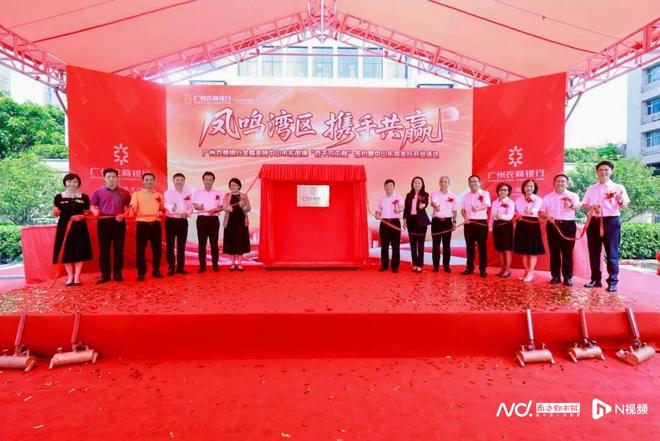
Group 1 - The Guangdong village bank reform has made new progress with the dissolution of Zhongshan Dongfeng Zhujiang Village Bank and the establishment of a liquidation team to handle the clearing process [1] - Guangzhou Rural Commercial Bank plans to absorb and merge Zhongshan Dongfeng Zhujiang Village Bank by December 2024, with the formal approval from the Guangdong Regulatory Bureau expected in May 2025 [1][4] - The merger aims to optimize the strategic layout of the group and integrate operational resources, in line with regulatory requirements for restructuring high-risk village banks [4] Group 2 - As of the end of 2024, Guangzhou Rural Commercial Bank holds a 35% stake in Dongfeng Village Bank, with 100% voting rights [6] - In 2019, Dongfeng Village Bank reported revenues of 56.659 million and a net profit of 27.174 million, with a year-on-year decline in net profit of 55.6% [6] - The successful merger of Dongfeng Village Bank marks the first case of a Pearl River system village bank being absorbed and upgraded to a commercial bank branch in Guangdong [7]
年内9家村镇银行获批退出 广东中小银行改革化险提速
2 1 Shi Ji Jing Ji Bao Dao· 2025-07-16 12:17
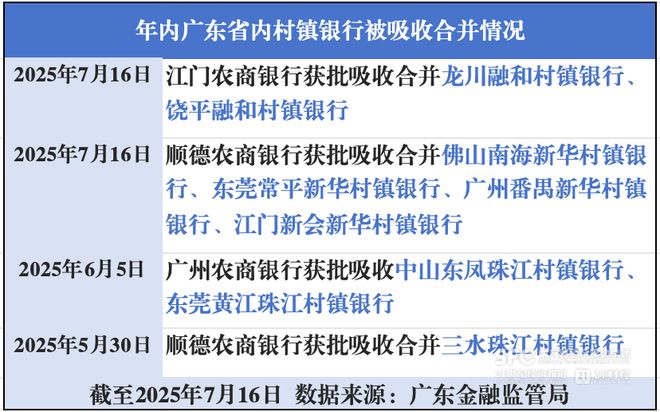
Core Viewpoint - Guangdong's financial regulatory authority has accelerated the absorption and merger of rural banks, with nine banks approved for mergers in 2025, surpassing the total for the previous year [1][2][5] Group 1: Mergers and Acquisitions - Jiangmen Rural Commercial Bank has been approved to absorb Longchuan Ronghe Village Bank and Raoping Ronghe Village Bank as of July 16, 2025 [1] - Shunde Rural Commercial Bank has been approved to absorb multiple banks including Foshan Nanhai Xinhua Village Bank and Dongguan Changping Xinhua Village Bank on the same date [1][2] - Guangzhou Rural Commercial Bank was approved to absorb Zhongshan Dongfeng Zhujiang Village Bank and Dongguan Huangjiang Zhujiang Village Bank on June 5, 2025 [2][3] Group 2: Regulatory Context - The acceleration of mergers aligns with the regulatory framework set in January 2025, emphasizing the need for risk management and restructuring of high-risk financial institutions [1][5] - The Guangdong financial regulatory authority aims to enhance collaboration between central and local governments to address risks in small financial institutions [1][5] Group 3: Industry Trends - The trend of mergers is indicative of a broader structural reorganization within the rural banking sector, with a significant increase in the number of banks being absorbed compared to previous years [2][6] - The concept of "village to branch" reform has gained traction, with Guangdong leading the way in implementing this model, allowing for broader service offerings and market expansion [5][6] Group 4: Future Outlook - Experts predict that the restructuring of rural banks will continue to accelerate, leading to a gradual reduction in the number of such banks [6] - There is a call for guiding policies to help rural banks refocus on their core missions and effectively support rural revitalization and small enterprises [6]
广州农商行拟再合并3家村镇银行,股东意见分歧背后有何挑战
Nan Fang Du Shi Bao· 2025-06-23 08:27
Core Viewpoint - Guangzhou Rural Commercial Bank plans to absorb and merge three additional Zhujiang Village Banks, following the approval of two previous mergers, indicating a strategic move to consolidate its financial services network in Guangdong Province [2][3][4]. Group 1: Mergers and Acquisitions - The recent shareholder meeting approved the absorption and merger of Xingning Zhujiang Village Bank, Heshan Zhujiang Village Bank, and Shenzhen Pingshan Zhujiang Village Bank, which will be converted into branches of Guangzhou Rural Commercial Bank [2][3]. - After the completion of these mergers, all six Zhujiang Village Banks in Guangdong will be dissolved, with Guangzhou Rural Commercial Bank absorbing five and transferring one [4]. - The merger process is part of a broader trend of structural reorganization among small and medium-sized banks in China, with over a hundred banks expected to merge in 2024 [6]. Group 2: Financial Network Expansion - The absorption of these banks will allow Guangzhou Rural Commercial Bank to establish new branches in several Greater Bay Area cities, enhancing its financial service network in Guangdong Province [5][6]. - The bank currently operates 11 central branches and 7 branches in various cities, and the merger will facilitate the opening of five new branches in Shenzhen, Zhongshan, Xingning, Dongguan, and Jiangmen [6]. Group 3: Challenges and Performance - The bank faces challenges such as declining performance and compliance issues, as evidenced by the financial struggles of Heshan Village Bank, which reported a 51% drop in net profit and an increase in non-performing loans [7][8]. - Guangzhou Rural Commercial Bank itself has experienced negative growth in revenue and net profit, indicating the need for effective management of the merged entities to stabilize performance [7][8]. - Shareholder opinions on the mergers are divided, with approximately 91% supporting the absorption of certain banks, while a minority expressed opposition [8].