标普500指数预测

Search documents
分析师普遍看涨股市,部分投资者心生担忧
Xin Lang Cai Jing· 2025-12-22 15:48
Core Viewpoint - Wall Street analysts are showing unprecedented optimism for the S&P 500 index in 2026, raising concerns among market observers due to the concentrated nature of their predictions, which may indicate a potential market imbalance [1][4]. Group 1: Analyst Predictions - The S&P 500 index year-end target predictions from various sell-side strategists have reached their most concentrated level in nearly a decade, with Oppenheimer's highest target at 8100 points and Stifel Nicolaus's lowest at 7000 points, reflecting only a 16% difference [1][4]. - Despite the concentration of predictions, analysts still expect the U.S. stock market to rise approximately 11% in 2026, following three consecutive years of double-digit gains [4][5]. - Oppenheimer and Deutsche Bank predict the S&P 500 will exceed 8000 points by the end of December 2026, while Stifel and Bank of America provide more conservative targets of 7000 and 7100 points, respectively, indicating potential upside from recent closing prices [4][5]. Group 2: Economic Factors and Market Sentiment - Analysts' bullish stance is primarily based on expectations of economic growth driving corporate earnings recovery, with optimistic views on tax cuts and deregulation boosting economic activity, alongside anticipated Fed rate cuts [2][5]. - The concentration of target prices suggests that market expectations may already be fully reflected in current stock prices, making the market more sensitive to negative news [2][5]. - Recent interest rate cuts and tax legislation have bolstered economic growth, leading to increased investor confidence, despite ongoing concerns about high concentration in tech stocks and potential bubbles in the AI sector [6]. Group 3: Market Dynamics - The consensus among analysts may indicate a lack of diversity in market outlook, which could lead to increased volatility in response to any negative developments, even in the absence of an economic recession [2][5]. - Historical data shows that S&P 500 target predictions often lag behind actual index performance by about two months, highlighting the potential unreliability of these forecasts [5]. - Market trends may serve as better indicators for future adjustments in consensus target prices, as the current upward momentum could amplify the impact of any external shocks [6].
10年来最一致的预测出炉!华尔街集体看好美股,这是狂欢还是陷阱?
Xin Lang Cai Jing· 2025-12-22 12:21
Core Viewpoint - Wall Street's stock market predictions for 2026 show an unprecedented level of optimism, raising concerns among market observers about potential market imbalances [1][5]. Group 1: Market Predictions - Sell-side strategists' predictions for the S&P 500 index are currently at their closest level in nearly a decade, with Oppenheimer's highest forecast at 8100 points and Stifel's lowest at 7000 points, reflecting only a 16% difference [1][5]. - Despite the S&P 500 index having recorded double-digit returns for three consecutive years, strategists expect an average increase of about 11% for 2026 [6]. Group 2: Market Sentiment and Risks - The consensus view among Wall Street analysts is seen as a contrarian indicator, suggesting that when expectations converge, market corrections may follow [1][5]. - Concerns include persistent inflation above the Federal Reserve's target, rising unemployment rates, and the lack of tangible returns from significant AI investments [1][5]. - The high level of agreement among predictions is viewed as potentially dangerous, as it indicates that expectations may already be priced into the market, making it sensitive to negative news [2][7]. Group 3: Historical Context and Analysis - Historical data indicates that Wall Street's stock predictions typically lag behind actual market performance by about two months [9]. - Analysts suggest that market movements dictate target prices rather than the other way around, indicating that current predictions may simply reflect bullish or bearish sentiments [9].
黄金冲万机构称主升浪2026启动
Jin Tou Wang· 2025-12-04 06:13
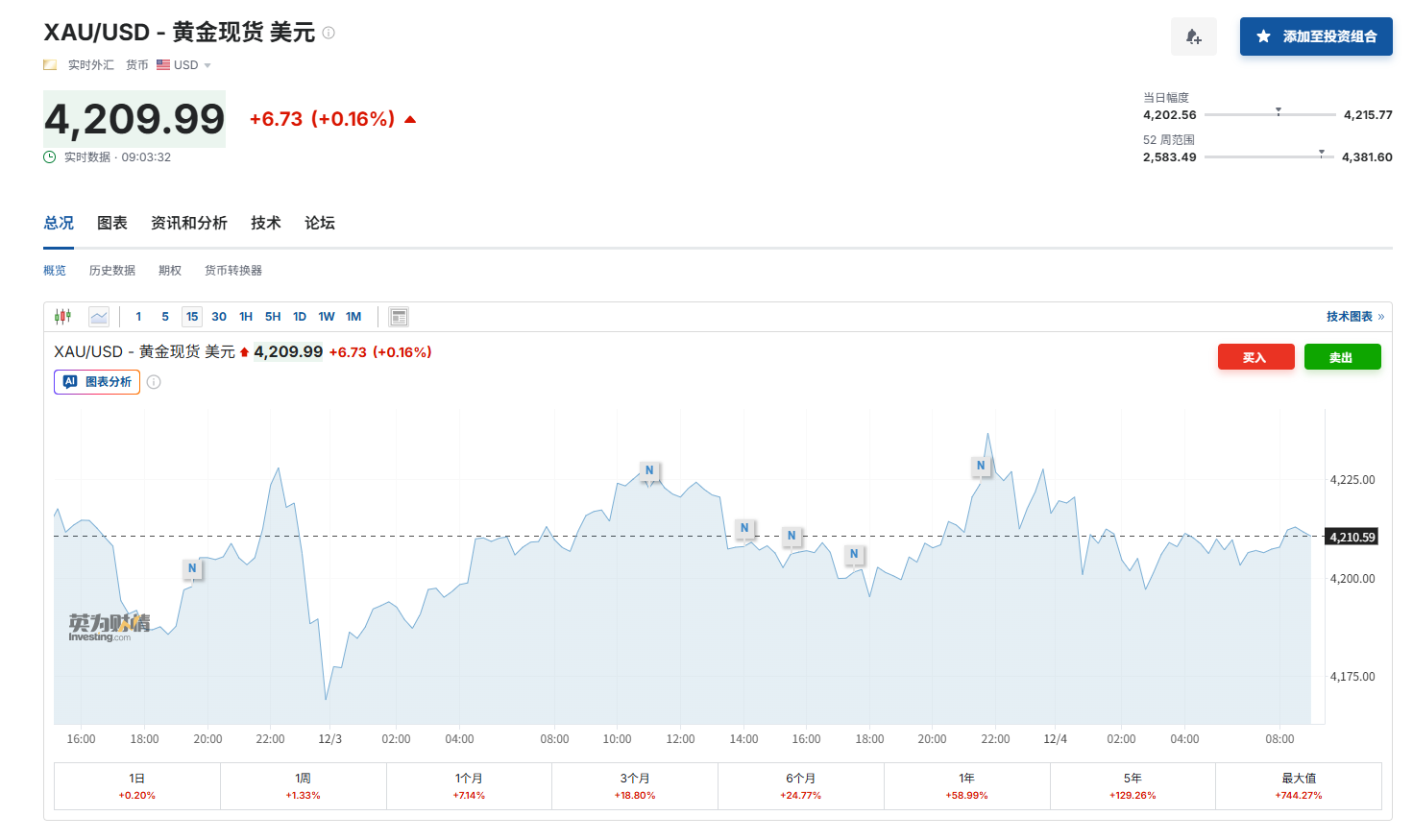
Group 1 - Current spot gold trading is around $4,191.59 per ounce, with a slight decline of 0.28% from earlier levels, indicating a short-term bearish trend [1] - A significant long-term market forecast predicts gold prices will reach $10,000 per ounce by the end of 2029, with the S&P 500 index also expected to hit 10,000 points [2] - The report highlights that gold prices have surged past $3,000 this year, with expectations to stabilize above $4,000, and a potential rise to $5,000 by the end of 2026 [2] Group 2 - Gold is currently experiencing narrow fluctuations while attempting to gain bullish momentum, with a key resistance level at $4,225 [3] - The price movement is supported by trading above the 50-day exponential moving average (EMA50), reinforcing the stability of the short-term bullish trend [3] - The relative strength index (RSI) indicates an extreme oversold level, suggesting a potential bullish wave if positive technical signals emerge [4]
华尔街老兵震撼预言:到2029年底,金价和标普500将双双冲击“1万大关”
Feng Huang Wang· 2025-12-04 02:15
Group 1 - Ed Yardeni, founder of Yardeni Research, predicts that gold prices will reach $10,000 per ounce and the S&P 500 index will hit 10,000 points by the end of 2029 [1][4] - Key factors driving this bullish outlook include economic instability and geopolitical events, leading to increased demand for gold [1] - Central banks are continuously buying gold, with 95% planning to increase their gold reserves in the coming year, and 43% intending to actively raise their gold allocation, the highest level since 2019 [1] Group 2 - Yardeni notes that gold prices are in an upward channel, with the next price surge expected to begin in mid-2026, targeting $5,000 per ounce by the end of next year [1] - The S&P 500 index is currently at 6,849.72 points, having increased by 0.3% as of the latest market close [4] - The relationship between gold and the S&P 500 is typically negative in the short term, but their long-term trends are nearly identical [4] Group 3 - Yardeni expresses no opinion on Bitcoin, referring to it as "digital gold" and previously likening it to "digital tulips," indicating uncertainty in its valuation [5] - The company highlights the growing role of cryptocurrency ETFs and regulated investment tools in the market [5] - The impact of the Genius Act, signed by President Trump, is noted, as it establishes new rules for issuing stablecoins backed by U.S. liquid assets, which may reduce demand for Bitcoin trading [5]

川普“变脸大师”,投行“两边打脸”、报告来不及撕了
Hua Er Jie Jian Wen· 2025-05-14 00:58
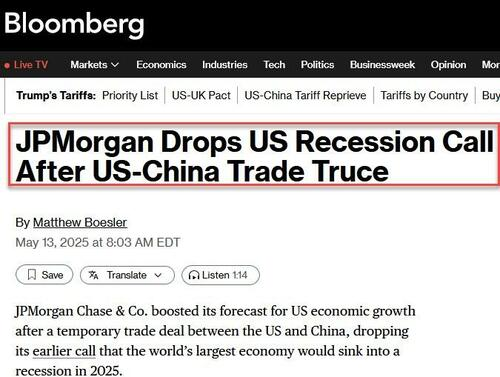
Core Viewpoint - Wall Street analysts have dramatically reversed their economic and stock market predictions within a month due to a sudden shift in Trump's tariff policies, leading to a collective acknowledgment of previous misjudgments [1][3]. Group 1: Economic Predictions - JPMorgan's chief economist Michael Feroli has abandoned his previous recession forecast, raising the GDP growth expectation for the year from 0.2% to 0.6% and lowering the recession risk assessment to "well below 50%" [1]. - Goldman Sachs' chief economist Jan Hatzius also retracted a recession prediction shortly after its release, adjusting growth expectations upward following Trump's announcement of a 90-day tariff suspension [3]. Group 2: Stock Market Predictions - Goldman Sachs' chief equity strategist David Kostin has revised his S&P 500 return forecasts upward, now predicting a 3-month return of +1% and a 12-month return of +11%, with index levels adjusted to 5900 and 6500 points respectively [5]. - Ed Yardeni has increased his S&P 500 year-end target from 6000 to 6500 points, attributing the change to market pressures on Trump to make concessions [7]. Group 3: Market Sentiment - Despite the chaotic predictions from strategists, the stock market has rebounded, with the S&P 500 erasing all losses for the year, aided by favorable CPI inflation data [10]. - Hedge funds are reportedly still net sellers, with leverage near historical lows, indicating a cautious sentiment among institutional investors despite the market's strong performance [10]. Group 4: Challenges in Forecasting - The frequent changes in predictions highlight the difficulty of forecasting in an environment heavily influenced by Trump's unpredictable policy shifts, as noted by JonesTrading's chief market strategist Michael O'Rourke [9].