标题风险

Search documents
港股异动丨基石药业一度重挫约23% 消息称美国拟加强审查中国创新药+股东减持
Ge Long Hui· 2025-09-11 07:52
Industry Insights - The U.S. government, under President Trump, is reportedly discussing measures to restrict Chinese pharmaceuticals, including drafting an executive order aimed at limiting the entry of innovative Chinese drugs into the U.S. market [1] - Goldman Sachs' latest report indicates that this situation could introduce "headline risk" to the Chinese biotech and pharmaceutical sector, potentially increasing stock price volatility [1] Company Specifics - Shares of 基石药业-B (2616.HK) experienced a significant drop of 22.88%, reaching a low of 9.1 HKD, marking the lowest point since August 25 [1] - Recent disclosures from the Hong Kong Stock Exchange reveal that non-executive director 胡正国 sold 223,000 shares at an average price of 12.007 HKD per share on September 5, totaling approximately 2.678 million HKD. Following this transaction, his ownership percentage decreased from 0.18% to 0.17% [1]


高盛:美国拟加强审查中国创新药消息带来“标题风险”,分析三类企业的短期风险
Ge Long Hui· 2025-09-11 04:04
Core Viewpoint - Goldman Sachs reports that the Trump administration is discussing restrictions on Chinese pharmaceuticals and drafting an executive order aimed at limiting the entry of innovative Chinese drugs into the U.S. market, which could create "headline risk" for the Chinese biotech/pharmaceutical sector and increase stock price volatility [1] Group 1: Short-term Stock Price Risk Analysis - Companies are categorized into three groups based on their global presence and partnerships: - The first group includes companies with established global operations (e.g., BeiGene, Legend Biotech), which are expected to be less affected due to their solid foundations in markets like the U.S. and low expectations for new transactions [2] - The second group consists of companies with strong global partners (e.g., Kelun Biotech, 3SBio, Hansoh Pharmaceutical, Hengrui Medicine), where the impact is minimal as the executive order primarily targets new licensing transactions, leaving already licensed assets largely unaffected [2] - The third group includes companies with high expectations for external licensing that have not yet materialized, further divided into those planning global clinical trials (e.g., Innovent Biologics, Zai Lab, CSPC) who may enhance clinical value through differentiated data, and those unable or unwilling to conduct global trials (e.g., Galactico, Eucure Biopharma, CStone Pharmaceuticals) who may need to expedite transactions before policy implementation [2] Group 2: Long-term Valuation Considerations - The long-term valuation of companies remains dependent on three core factors: - The quality of data and differentiated clinical value of their pipelines [2] - The execution capability of the companies [2] - The financial condition of the companies [2]
警惕熊市反弹陷阱!高盛:当前股市如同“带刺的玫瑰”
Zhi Tong Cai Jing· 2025-05-06 11:24
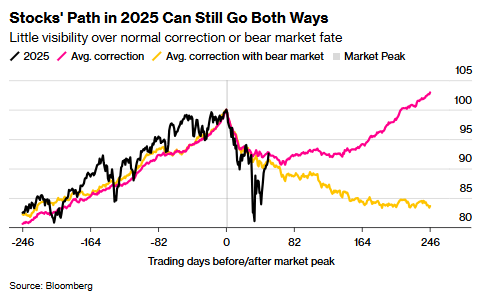
Core Viewpoint - The recent rapid rebound in global stock markets is characterized as a typical bear market rally, indicating that investors will face pain regardless of market direction [1][3] Group 1: Market Dynamics - High volatility in stock prices is primarily driven by short-term news headlines and speculation regarding the evolving U.S. tariff policies and their impact on corporate earnings and valuations [1] - The current risk-reward ratio for stock investments is deemed unfavorable, with significant uncertainty prevailing among investors regarding long-term bullish or bearish consensus [1][6] - Historical data shows that bear market rallies typically last an average of 44 days with an average gain of 14%, while the recent rebound since April 7 has seen an 18% increase [3][4] Group 2: Investor Behavior - Market participants are caught in a dilemma of either chasing a fading rally or missing out on potential gains, leading to increased difficulty in decision-making [3] - Many investors have been forced to reduce risk exposure due to unclear tariff prospects, only to be compelled to buy at higher prices later [3][6] - Retail investors have significantly increased their risk exposure, with record buying intensity observed in individual stocks and ETFs [9] Group 3: Systematic and Macro Investors - Systematic macro investors have increased their buying scale, reaching $51 billion last week, with expectations to hit $57 billion this week, although the rapid fluctuations may slow down the inflow of funds [8] - Macro investors are reducing their stock exposure despite recent market gains, indicating a divergence between stock market performance and investor sentiment [6][8]