死亡循环

Search documents
美股“SaaS末日”来临:“软件-PE”陷入“死亡循环”
华尔街见闻· 2026-02-04 11:56
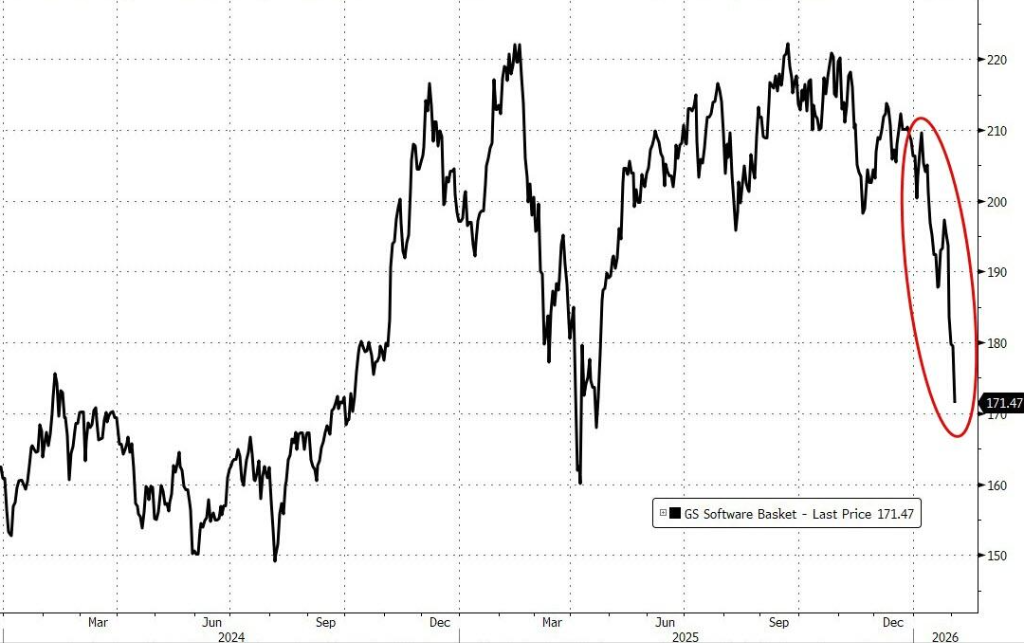
Core Viewpoint - The software industry is experiencing a significant downturn, with the S&P North American Software Index dropping 15% in January, marking the largest monthly decline since October 2008. This decline is exacerbated by fears surrounding AI advancements that threaten traditional software companies' market positions and pricing power [1][6]. Group 1: Market Sentiment and Trends - The current market sentiment is characterized by panic selling, described as a "get me out" mentality, with no signs of stabilization [3]. - The release of Anthropic's productivity tool for corporate lawyers has intensified fears, leading to a sharp decline in legal software and publishing company stocks [1][6]. - There is a stark divide in the market, with semiconductor companies viewed as beneficiaries of the AI supercycle, while software companies are seen as major losers [6]. Group 2: Impact on Private Credit and BDCs - The software sector's decline is impacting private credit markets, with software companies representing about 20% of Business Development Companies' (BDCs) portfolios, totaling approximately $100 billion [4][9]. - As software valuations plummet, BDCs like Blue Owl, Blackstone, and Ares are experiencing stock price declines due to concerns over potential contagion effects [10]. - The risk exposure of BDCs to software loans is significant, with Morgan Stanley reporting that software loans account for about 16% of their tracked BDC loan portfolios, totaling around $70 billion [12]. Group 3: Potential Losses and Stress Testing - Stress tests conducted by JPMorgan indicate that if 33% of software companies default, BDCs could face losses of $22 billion, reducing net asset values by 11%. In a more severe scenario with a 75% default rate, cumulative losses could approach $50 billion, diluting book values by 24% [14]. - Specific software loans are already showing signs of pressure, with secondary market prices significantly lower than BDC book valuations, indicating a disconnect between market perceptions and reported values [15][16]. Group 4: Future Outlook and Investor Sentiment - There is a prevailing view that the software industry could face a fate similar to that of print media or department stores, leading to uncertainty in growth projections and valuations [7]. - Despite potential long-term buying opportunities, current investor confidence remains low, complicating the assessment of what constitutes a "cheap" investment in the software sector [7].


美股“SaaS末日”来临:“软件-PE”陷入“死亡循环”
美股IPO· 2026-02-04 01:02
Core Viewpoint - The software industry is facing a "doomsday crisis" due to the impact of AI, with the S&P North American Software Index experiencing a 15% drop in January, the largest monthly decline since 2008, leading to panic selling among investors [1][2][3]. Group 1: Market Impact - The S&P North American Software Index has seen a continuous decline for three weeks, with a significant drop of 15% in January, marking the largest monthly decline since October 2008 [2]. - The panic intensified after AI startup Anthropic released a productivity tool for corporate lawyers, causing stock prices of legal software and publishing companies to plummet [2][7]. - The software sector's crisis is not limited to the stock market but is also affecting the private credit market, with software companies representing about 20% of the portfolios of Business Development Companies (BDCs), totaling approximately $100 billion [3][10]. Group 2: Private Credit Risks - The collapse of the SaaS sector poses risks not only to the equity market but also to the debt market, with BDCs being particularly sensitive to declines in software stock and credit valuations [10]. - As software company valuations plummet, BDCs face asset impairment pressures, leading to potential credit tightening that could further squeeze the growth space of already struggling software companies, creating a "death spiral" [6][12]. - Analysts warn that if AI causes significant disruption to corporate borrowers, the default rate in U.S. private credit could soar to 13% [13]. Group 3: Stress Testing and Asset Valuation - JPMorgan conducted stress tests on BDC portfolios, indicating that under a scenario where 33% of companies default, the tracked BDCs could face losses of $22 billion, reducing net asset value by 11% [14]. - In a more severe scenario with a 75% default rate, cumulative net losses could approach $50 billion, diluting book value by 24% [14]. - Specific loan assets are already showing signs of pressure, with significant discrepancies between secondary market prices and BDC book valuations for software loans [15][18].
美股“SaaS末日”来临:“软件-PE”陷入“死亡循环”
Hua Er Jie Jian Wen· 2026-02-04 00:40
Core Viewpoint - The software industry is experiencing a significant downturn, with the S&P North American Software Index dropping for three consecutive weeks and a 15% decline in January, marking the largest monthly drop since October 2008 [1][3]. Group 1: Market Sentiment and Impact - The current market sentiment is characterized by panic selling, described as a "get me out" mentality, with no signs of stabilization [3]. - The release of Anthropic's productivity tool for corporate lawyers has intensified fears, leading to a sharp decline in legal software and publishing company stocks [1][7]. - There is a growing concern that advancements in AI technology may erode the competitive advantages of traditional software companies, leading to fears of being completely replaced [7]. Group 2: Private Credit Exposure - The software sector's decline poses risks not only to the stock market but also to the private credit market, with software companies representing about 20% of the portfolios of Business Development Companies (BDCs), totaling approximately $100 billion [3][9]. - As software company valuations plummet, private credit institutions face pressure to reassess their balance sheets, potentially tightening credit availability, which could further squeeze struggling software companies [5][10]. Group 3: Financial Analysis and Projections - Morgan Stanley's analysis indicates that if AI disrupts corporate borrowers aggressively, the default rate in U.S. private credit could soar to 13% [12]. - Stress tests conducted by Morgan Stanley suggest that under a scenario where 33% of companies default, tracked BDCs could face losses of $22 billion, reducing net asset value by 11% [13]. - In a more severe scenario with a 75% default rate, cumulative net losses could approach $50 billion, diluting book value by 24% [13]. Group 4: Market Dynamics and Valuation Challenges - The divergence in market performance is stark, with semiconductor companies benefiting from the AI supercycle while software companies are viewed as major losers [5]. - Despite some companies passing earnings tests, the overall pass rate is declining, indicating a harsh competitive environment within the industry [7]. - The market is struggling to assign reasonable valuations to software companies due to the uncertainty brought by AI, complicating the identification of attractive buying opportunities [7].