民间资本投资

Search documents
四季度以来多份民间资本推介项目清单发布
Zheng Quan Ri Bao· 2025-12-16 16:09
Core Insights - Multiple regions in China are actively promoting projects to attract private capital, with a total of 120 projects in Beijing alone, amounting to an investment of approximately 110.6 billion yuan, aiming to draw in about 33.1 billion yuan from private investors [1] - The focus on new technologies, new infrastructure, and new consumption sectors is expected to inject sustainable momentum into high-quality development, enhancing economic structure optimization and public service improvement [2][3] Group 1: Project Promotion - Beijing's Development and Reform Commission has initiated the second batch of projects for private capital, totaling 120 projects with an investment of around 110.6 billion yuan [1] - Other regions, such as Chongqing and Hubei, have also launched initiatives to attract private investment, with Hubei planning to introduce 275 projects with a total investment of 216.99 billion yuan [1] - The projects cover various sectors, including advanced materials, new energy vehicle components, and digital economy, showcasing the potential for investment in these areas [2] Group 2: Investment Opportunities - The project lists emphasize emerging industries, particularly in technology and advanced manufacturing, which align with market demands for high-growth sectors [3] - Infrastructure, urban renewal, and public services are also highlighted as key areas for investment, catering to different risk preferences among private investors [3] - The inclusion of projects related to AI, hydrogen-powered drones, and other innovative technologies indicates a strategic focus on fostering new production capabilities [2][3]
北京今年向民间资本公开推介项目投资超2300亿元
Zhong Guo Xin Wen Wang· 2025-12-15 17:29
Core Viewpoint - Beijing has introduced over 230 billion RMB in projects for private capital investment this year, focusing on various sectors including technology innovation, infrastructure, and public services [1][2] Group 1: Project Overview - In the first half of the year, Beijing promoted 119 projects to private capital with a total investment of approximately 124.4 billion RMB [1] - A second batch of 120 projects has been identified, with a total investment of around 110.6 billion RMB, aiming to attract about 33.1 billion RMB from private capital [1] Group 2: Sector Distribution - The projects span advanced manufacturing, commercial services, cultural tourism, and rural agriculture [1] - The distribution of projects by region shows that Fangshan District has the highest number of projects at 37, followed by Shijingshan District with 11, and Changping District with 9 [1] Group 3: Investment Types - There are 66 equity investment projects with a total investment of about 34.9 billion RMB, seeking to attract approximately 16.1 billion RMB from private investors [2] - Debt investment projects total 10, with an investment of 8.5 billion RMB, aiming for 1 billion RMB from private capital [2] - Cooperative operation projects consist of 26, with a total investment of 63.2 billion RMB, targeting 12.8 billion RMB from private capital [2] - There are 18 franchise projects with a total investment of 4 billion RMB, looking to attract 3.2 billion RMB from private investors [2]
总投资超1100亿元 北京2025年第二批面向民间资本公开推介120个项目
Bei Jing Shang Bao· 2025-12-15 08:14
Group 1 - The core viewpoint of the article highlights the Beijing Municipal Development and Reform Commission's initiative to promote 120 projects aimed at attracting private capital, with a total investment of approximately 1,106 billion yuan and an expected private capital investment of about 331 billion yuan [1][2] Group 2 - The distribution of projects by industry includes 14 in technology innovation, 6 in advanced manufacturing, 25 in commercial services, 18 in infrastructure, 10 in public services, 17 in cultural tourism and sports, 13 in urban renewal, 9 in agriculture and rural areas, and 8 in housing construction [1] - The top six districts with the highest number of projects are Fangshan District (37 projects), Shijingshan District (11 projects), Changping District (9 projects), Pinggu District (9 projects), Fengtai District (8 projects), and Yanqing District (8 projects) [1] - The districts with the largest total investment include Fengtai District (approximately 181 billion yuan), Tongzhou District (approximately 168 billion yuan), Daxing District (approximately 148 billion yuan), Miyun District (122 billion yuan), Xicheng District (approximately 98 billion yuan), and Fangshan District (approximately 91 billion yuan) [1] Group 3 - The types of private capital participation include 66 equity investment projects with a total investment of approximately 349 billion yuan and expected private investment of about 161 billion yuan; 10 debt investment projects with a total investment of approximately 85 billion yuan and expected private investment of about 10 billion yuan; 26 cooperative operation projects with a total investment of approximately 632 billion yuan and expected private investment of about 128 billion yuan; and 18 franchise projects with a total investment of approximately 40 billion yuan and expected private investment of about 32 billion yuan [1] Group 4 - In the first half of the year, the first batch of publicized projects included 119 projects with a total investment of approximately 1,244 billion yuan, while the second batch consists of 120 projects with a total investment of approximately 1,106 billion yuan, bringing the total projected investment for the year to over 2,300 billion yuan [2]
推动民间资本投资,全国推介项目金额已超十万亿
第一财经· 2025-06-26 02:39
Core Viewpoint - The article emphasizes the Chinese government's efforts to optimize the business environment and stimulate private sector investment, highlighting a significant push towards involving private capital in various projects, with over 10 trillion yuan in investments being promoted [1][4]. Group 1: Government Initiatives - The National Development and Reform Commission (NDRC) has introduced a platform to promote projects to private capital, with over 3,200 quality projects amounting to more than 3 trillion yuan [1][4]. - The NDRC aims to establish a coordination mechanism for promoting projects to private capital, enhancing support for land use, environmental assessments, and financing [4][6]. - The government is reducing restrictions on private investment in key sectors, as evidenced by the decrease in the number of items on the Market Access Negative List from 117 to 106 [6]. Group 2: Investment Trends - There is a noticeable increase in private investment in new infrastructure and emerging industries, with significant interest in artificial intelligence and low-altitude economy projects [6][12]. - The participation of private capital in major infrastructure projects is rising, with examples like the San'ao nuclear power project, where private capital's share increased from 2% to 10% [10]. - The NDRC has recommended 92 infrastructure REITs projects to the China Securities Regulatory Commission, with 70 projects already issued, expected to drive over 1 trillion yuan in new investments [12][13]. Group 3: Regional Policies - Local governments are implementing supportive policies to attract private investment, such as Tianjin's efforts to eliminate restrictions in procurement and bidding processes [6][7]. - Jiangsu province has seen an increase in major projects funded by private enterprises, with 228 projects planned for the year, focusing on strategic emerging industries [14]. - Shandong province is promoting technological upgrades in traditional industries, with a focus on artificial intelligence integration [14]. Group 4: Economic Performance - From January to May, private investment remained stable, with a 5.8% increase in non-real estate private investment [18]. - The hospitality and catering sectors saw a 25.3% increase in private investment, while infrastructure and manufacturing sectors also experienced growth [18]. - Private enterprises' sales revenue growth outpaced the national average, indicating a positive trend in the private sector's economic performance [18].

推动民间资本投资,全国推介项目金额已超十万亿
Di Yi Cai Jing· 2025-06-25 14:31
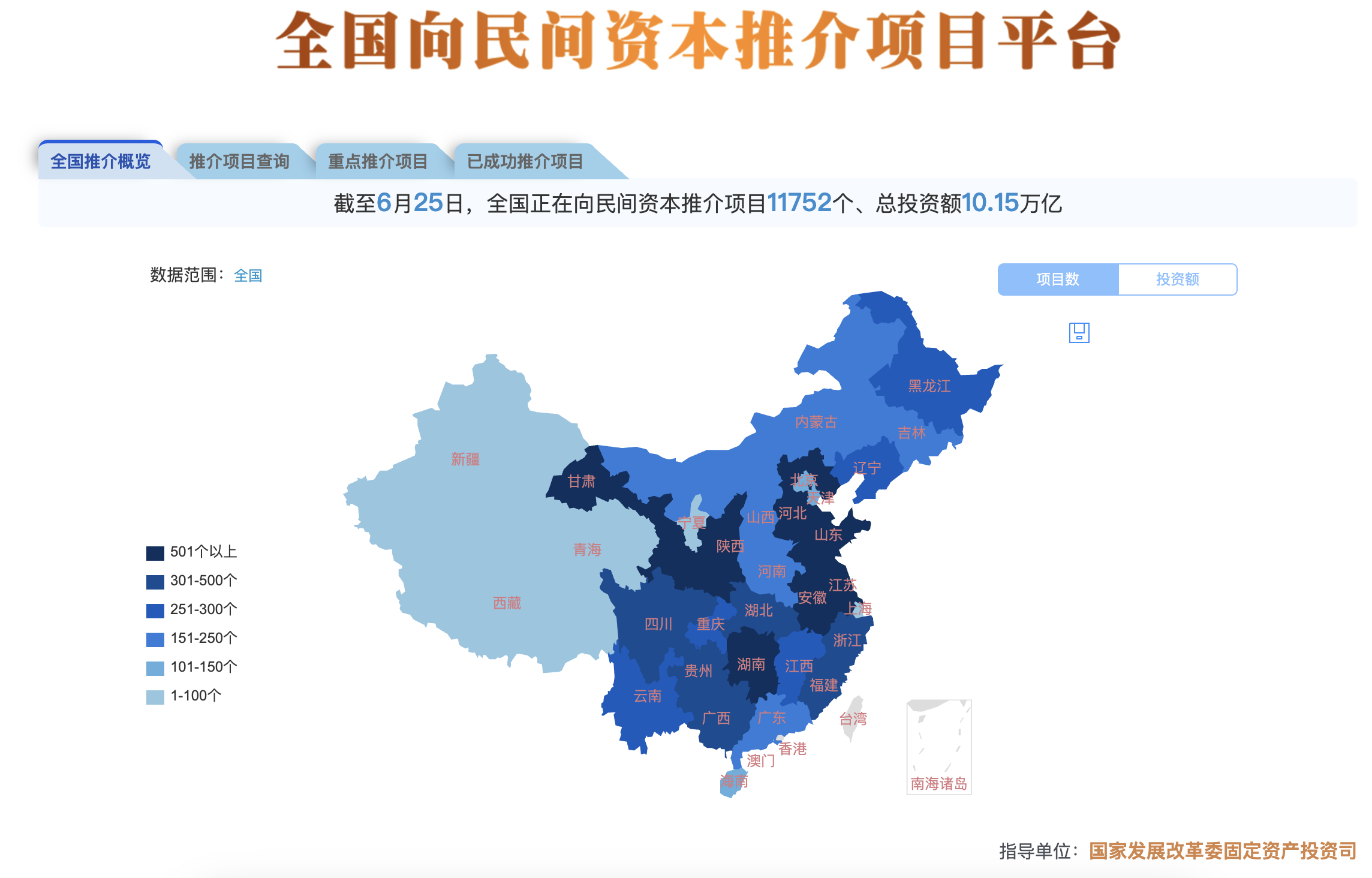
Core Viewpoint - The Chinese government is actively promoting private investment by optimizing the business environment and reducing barriers, with a focus on new infrastructure and emerging industries, leading to a significant increase in private investment confidence [1][6][10]. Group 1: Investment Projects and Amounts - As of June 25, over 10 trillion yuan in projects are being promoted to private capital, with more than 3,200 quality projects recommended by the National Development and Reform Commission (NDRC) [1][6]. - The total number of projects being promoted has reached 11,752, with a total investment amount of 10.15 trillion yuan [6]. - Local governments are also introducing supportive policies to attract private capital, with specific project lists being established in provinces like Tianjin and Hubei [6][7]. Group 2: Focus on Emerging Industries - The current project recommendations include key sectors such as transportation, energy, and new infrastructure, as well as emerging industries like artificial intelligence and low-altitude economy [4][10]. - Private investment is increasingly directed towards new projects, with significant interest in new infrastructure, artificial intelligence, and quantum information [10]. Group 3: Policy Support and Legislative Framework - The implementation of the Private Economy Promotion Law on May 20 has provided strong signals to support private investment in major national strategies and projects [9]. - The NDRC is establishing a special coordination mechanism to promote private capital participation in project construction and enhance support for land use, environmental assessments, and financing [4][8]. Group 4: Trends in Private Investment - Private investment in traditional industries is also experiencing a transformation, with a notable increase in industrial technological upgrades, particularly in sectors like steel and building materials [10]. - Data shows that from January to May, private investment remained stable, with a year-on-year growth of 5.8% in non-real estate private investment [15].