水晶鞋效应

Search documents
GPT-5.2实测:五大职场“牛马任务”,考验它的生存力
虎嗅APP· 2025-12-13 09:07
以下文章来源于快刀青衣 ,作者快刀青衣 快刀青衣 . 得到联合创始人,AI 学习圈主理人 产品经理出身,与罗胖脱不花创业十年 学习 AI, 使用 AI,只为解决问题 当时就有不少媒体猜测,他发警报的最终目的,其实是给这个新模型的宣传造势。但我们确实也能看 出,OpenAI在Gemini的强大攻势下,心态已经不像当初那么轻松了。 为什么这么说?从GPT-5.1到GPT-5.2,发布间隔只有30天。要知道,这可是OpenAI历史上迭代最快 的一次,以前这种级别的版本迭代,至少要一个季度才可以。 更关键的是,这次GPT-5.2主打的不是"通用智能""推理能力"这类高大上的概念,而是直截了当地 说:我们要强化"打工能力"。 什么是打工能力?就是你每天在办公室里干的活,比如做Excel表格、写PPT、改代码、回复客户邮 件。这次,OpenAI的很明确:先不谈理想和未来,先把大家手头的活干好再说。 一、30天迭代,为何这么急? 从GPT-5.1到GPT-5.2仅用30天,你可能觉得,版本号才涨了0.1,能有多大变化? 本文来自微信公众号: 快刀青衣 ,作者:快刀青衣,题图来自:AI生成 2015年12月11日,OpenA ...


100万亿Token揭示今年AI趋势,硅谷的这份报告火了
3 6 Ke· 2025-12-09 03:21
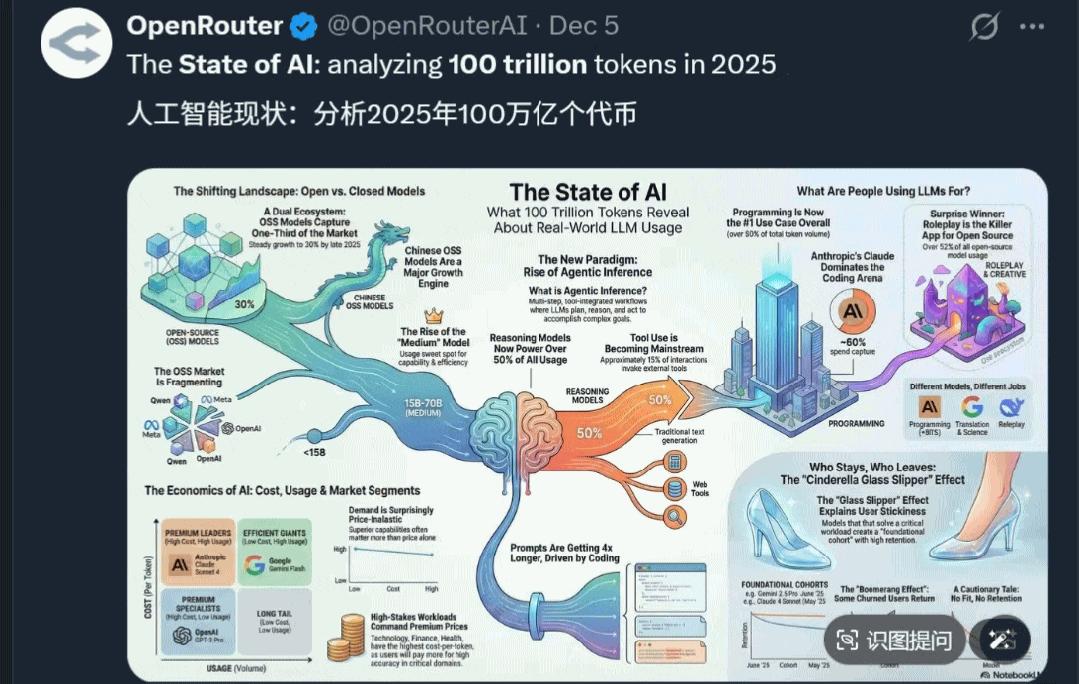
Core Insights - The report titled "State of AI: An Empirical 100 Trillion Token Study with OpenRouter" analyzes the usage of over 300 models on the OpenRouter platform from November 2024 to November 2025, highlighting significant trends in AI development and the growing importance of open-source models [3][5]. Group 1: Open Source vs. Closed Source Models - Open-source models are expected to reach approximately one-third of total usage by the end of the year, complementing rather than competing with closed-source models [5][7]. - The share of Chinese open-source models surged from 1.2% to 30% in weekly usage, indicating a strong preference for domestic models [9]. - The dominance of DeepSeek as the largest contributor is diminishing as more open-source models enter the market, leading to a more diversified landscape by mid-2025 [12]. Group 2: Model Characteristics and Trends - The report categorizes models into large (700 billion parameters or more), medium (150 to 700 billion), and small (less than 150 billion), noting a shift towards medium and large models as small models lose popularity [15]. - Language models are evolving from dialogue systems to reasoning and execution systems, with reasoning token usage exceeding 50% [18][19]. - The use of tools within models is increasing, indicating a more competitive and diverse ecosystem [24]. Group 3: Usage Patterns and User Retention - AI model usage has shifted from simple tasks to more complex problem-solving, with average input prompts increasing fourfold [26][30]. - The concept of "Cinderella effect" describes how users may quickly adopt new models that perfectly meet their needs, leading to high retention rates for successful models [57][59]. - Programming and role-playing are now the primary use cases for AI models, with programming queries rising from 11% to over 50% [36][40]. Group 4: Market Dynamics and Regional Insights - The paid usage of AI in Asia has doubled from 13% to 31%, while North America's market share has fallen below 50% [61]. - English remains the dominant language in AI usage at 82%, with Simplified Chinese holding a 5% share [61]. - The impact of model pricing on usage is minimal, with a 10% price drop resulting in only a 0.5%-0.7% increase in usage [61].
100万亿Token揭示今年AI趋势!硅谷的这份报告火了
Xin Lang Cai Jing· 2025-12-08 12:28
Core Insights - The report titled "State of AI: An Empirical 100 Trillion Token Study with OpenRouter" analyzes the usage of over 300 AI models on the OpenRouter platform from November 2024 to November 2025, focusing on real token consumption rather than benchmark scores [3][5][67] - It highlights the significant rise of open-source models, particularly from China, which saw weekly token usage share increase from 1.2% to 30%, indicating a shift towards a complementary relationship between open-source and closed-source models [2][10][74] - The report emphasizes the transition of AI models from language generation systems to reasoning and execution systems, with reasoning models becoming the new paradigm [18][83] Open-Source vs Closed-Source Models - Open-source models are no longer seen merely as alternatives to closed-source models; they have carved out unique positions and are often preferred in specific scenarios [6][70] - By the end of 2025, it is expected that open-source models will account for approximately one-third of total usage, reflecting a more integrated approach by developers who utilize both types of models [5][70] - The dominance of DeepSeek is diminishing as more open-source models enter the market, leading to a diversified landscape where no single model is expected to exceed 25% of token usage by the end of 2025 [13][77] Model Characteristics and Trends - The report identifies a shift towards medium-sized models, which are gaining market favor, while small models are losing traction [16][80] - The classification of models is as follows: large models (700 billion parameters or more), medium models (150 to 700 billion parameters), and small models (less than 150 billion parameters) [20][85] - The usage of reasoning tokens has surpassed 50%, indicating a significant evolution in how AI models are utilized for complex tasks [18][83] User Behavior and Model Utilization - AI model usage has evolved from simple tasks to more complex problem-solving, with user prompts increasing in length and complexity [27][92] - The concept of "crystal shoe effect" is introduced, where certain models lock in a core user base due to their unique capabilities, making it difficult for competitors to attract these users later [55][120] - Programming and role-playing have emerged as the primary use cases for AI models, with programming queries rising from 11% to over 50% [27][100] Market Dynamics - The report notes that the paid usage share of AI in Asia has doubled from 13% to 31%, while North America's share has fallen below 50% [129] - English remains the dominant language in AI usage at 82%, with Simplified Chinese holding nearly 5% [129] - The impact of model pricing on usage is less significant than anticipated, with a 10% price drop leading to only a 0.5%-0.7% increase in usage [129]

100万亿Token揭示今年AI趋势!硅谷的这份报告火了
量子位· 2025-12-08 11:36
Core Insights - The report titled "State of AI: An Empirical 100 Trillion Token Study with OpenRouter" analyzes the usage of over 300 models on the OpenRouter platform from November 2024 to November 2025, focusing on real token consumption rather than benchmark scores [3][6][8]. Group 1: Open Source vs. Closed Source Models - Open source models (OSS) have evolved from being seen as alternatives to closed source models to finding their unique positioning, becoming the preferred choice in specific scenarios [9]. - The relationship between open source and closed source models is now more complementary, with developers often using both types simultaneously [10]. - The usage of open source models is expected to reach approximately one-third by the end of 2025, with Chinese models experiencing significant growth from 1.2% to 30% in weekly usage share [12][13]. Group 2: Market Dynamics and Model Diversity - The dominance of DeepSeek as the largest contributor to open source model usage is diminishing as more models enter the market, leading to a diversified landscape [16]. - By the end of 2025, no single model is expected to maintain over 25% of token usage, with the market likely to be shared among 5 to 7 models [17][18]. - The report indicates a shift towards medium-sized models, which are gaining market favor, while small models are losing traction [20][21]. Group 3: Evolution of Model Functionality - Language models are transitioning from dialogue systems to reasoning and execution systems, with reasoning token usage surpassing 50% [22]. - The use of model invocation tools is increasing, indicating a more competitive and diverse ecosystem [29][31]. - AI models are evolving into "intelligent agents" capable of independently completing tasks rather than just responding to queries [43]. Group 4: Usage Patterns and User Retention - The complexity of tasks assigned to AI has increased, with users now requiring models to analyze extensive documents or codebases [35]. - The average input to models has quadrupled, reflecting a growing reliance on contextual information [36]. - The "glass slipper effect" describes how certain users become highly attached to models that perfectly meet their needs upon release, leading to high retention rates [67][70]. Group 5: Regional Insights and Market Trends - The share of paid usage in Asia has doubled from 13% to 31%, indicating a shift in the global AI landscape [71]. - North America's AI market share has declined to below 50%, while English remains dominant at 82%, with Simplified Chinese holding nearly 5% [80]. - The impact of model pricing on usage is less significant than expected, with a 10% price drop resulting in only a 0.5%-0.7% increase in usage [80].