汇率管控

Search documents
和讯投顾魏玉根:央行出手管控汇率可能带来什么影响?
Sou Hu Cai Jing· 2026-02-28 02:07
Core Viewpoint - The central bank has announced a reduction in the risk reserve ratio for forward foreign exchange sales from 20% to 0%, effective March 2, which will lower the cost of foreign exchange for enterprises and help mitigate the rapid appreciation of the Renminbi [1] Group 1 - The reduction in the risk reserve ratio will decrease the cost for enterprises when converting currency, as banks previously had to pay a 20% deposit to the central bank, which did not earn interest [1] - Rapid appreciation of the Renminbi can negatively impact exports, as it reduces profit margins for trading companies [1] - For example, a product that previously sold for 100 USD and converted to over 700 RMB now converts to only 680 RMB, resulting in a three-point decrease in profit [1]
泰国“锁死”国内黄金交易沪金飙涨
Jin Tou Wang· 2026-01-29 04:02
Group 1 - The Bank of Thailand has tightened regulations on gold trading, reducing the daily limit for online transactions to 50 million THB and banning short selling to address the appreciation pressure on the Thai Baht [2] - The Thai Baht has reached its highest level since March 2021, appreciating 9% cumulatively in 2025 and an additional 1% in 2026, which negatively impacts export competitiveness and increases costs for tourists [2] - Thailand is the seventh-largest gold trading market globally and the largest in ASEAN, with daily trading exceeding 50 billion THB, where 65% of transactions are conducted online in THB, making it crucial for exchange rate management [2] Group 2 - The new regulations aim to stabilize the exchange rate and protect exports while also preventing risks associated with speculative trading on online platforms, which could lead to price volatility and cross-border capital risks [3] - Experts predict that some short-term funds from Southeast Asia may shift to New York and London gold markets, potentially increasing volatility in the international precious metals market [3] Group 3 - The Shanghai gold futures market has shown strong performance, with the main contract AU2606 breaking through 1240 CNY per gram, closing at 1196.80 CNY per gram, marking a daily increase of over 3% and reaching a historical high [4] - The price has consistently remained above the 5-day and 20-day moving averages, with significant volume increases, indicating sustained bullish momentum [4] - The technical analysis suggests a continuation of the upward trend, with key resistance at 1250 CNY per gram and support at 1180 CNY per gram [4]
罕见!泰国央行:禁止黄金做空交易 线上黄金交易每日限额5000万泰铢
Qi Huo Ri Bao· 2026-01-29 00:28
Core Viewpoint - The Bank of Thailand has implemented strict regulations on gold trading to alleviate the appreciation pressure on the Thai Baht, which has been a significant factor in its recent strength against the US dollar [5][10]. Group 1: Regulatory Changes - The daily limit for online gold trading has been set at 50 million Thai Baht, and short-selling of gold has been completely banned [1][11]. - The central bank has also raised the threshold for foreign exchange income repatriation from 1 million USD to 10 million USD, aiming to restrict short-term capital flows that contribute to the Baht's appreciation [11]. Group 2: Economic Impact - The Thai Baht has reached its highest exchange rate against the US dollar since March 2021, appreciating by 9% in 2025 and an additional 1% since 2026 [5]. - The strong Baht has negatively impacted the price competitiveness of Thai exports and increased costs for foreign tourists, leading to a 9% year-on-year decrease in foreign tourist arrivals [6]. Group 3: Market Dynamics - Thailand is the seventh-largest gold trading market globally and the largest in ASEAN, with daily trading exceeding 5 trillion Thai Baht, of which 65% is conducted online [10]. - The concentration of international funds in online gold trading has increased demand for the Baht, creating a "appreciation feedback loop" due to high leverage effects from short-selling [10][11]. Group 4: Broader Implications - The new regulations are part of a broader strategy by the Bank of Thailand to stabilize the currency and protect key economic sectors while reducing volatility in the domestic gold market [11]. - There are concerns that these measures may lead some short-term funds in Southeast Asia to shift towards trading in New York and London, potentially increasing volatility in the international precious metals market [11].

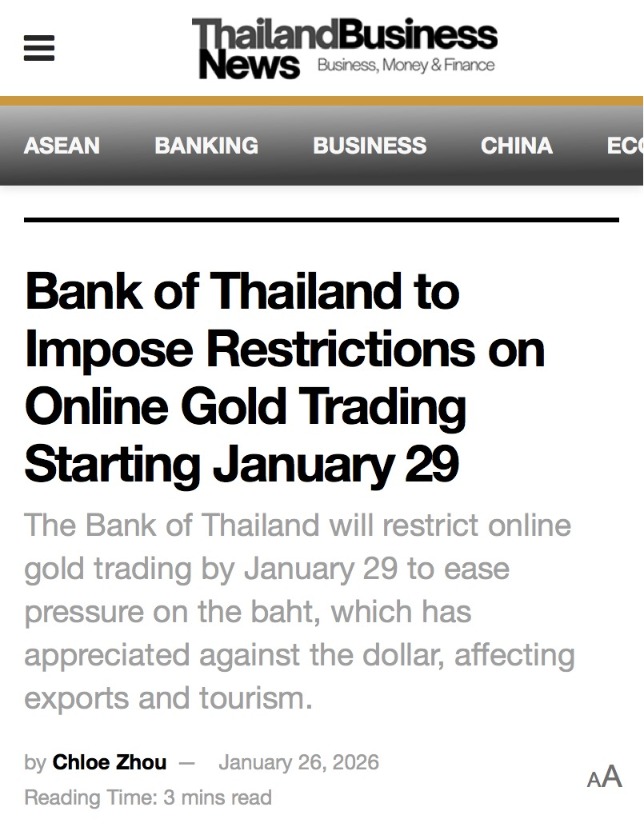
罕见!泰国央行:禁止黄金做空交易,线上黄金交易每日限额5000万泰铢
Qi Huo Ri Bao· 2026-01-28 23:26
Core Viewpoint - The Bank of Thailand has implemented new regulations to limit online gold trading and prohibit short selling to alleviate the appreciation pressure on the Thai Baht, which has been a significant factor in its recent strength [5][10]. Group 1: Regulatory Changes - The daily limit for online gold trading has been set at 50 million Thai Baht, following a broader trading limit announced on January 21 [1][11]. - The Bank of Thailand has also raised the threshold for reporting foreign exchange income from 1 million USD to 10 million USD to further control short-term capital flows that contribute to the Baht's appreciation [11]. Group 2: Economic Impact - The Thai Baht has appreciated by 9% in 2025 and an additional 1% since 2026, reaching its highest level against the US dollar since March 2021 [5]. - The strong Baht has negatively impacted the price competitiveness of Thai exports and increased travel costs for foreign tourists, leading to a 9% year-on-year decrease in foreign tourist arrivals [5]. Group 3: Market Dynamics - Thailand is the seventh-largest gold trading market globally and the largest in ASEAN, with daily trading volumes exceeding 5 trillion Thai Baht, of which 65% is conducted online [10]. - The concentration of international funds in online gold trading has increased demand for the Baht, creating a "appreciation feedback loop" due to high leverage effects from short selling [10]. Group 4: Regulatory Objectives - The new regulations aim to reduce volatility in the domestic gold market, protect key economic sectors, and prevent systemic risks associated with speculative trading [11]. - The measures are also intended to enhance market transparency and combat money laundering, tax evasion, and illegal capital flows [11].