汽车行业电动化

Search documents
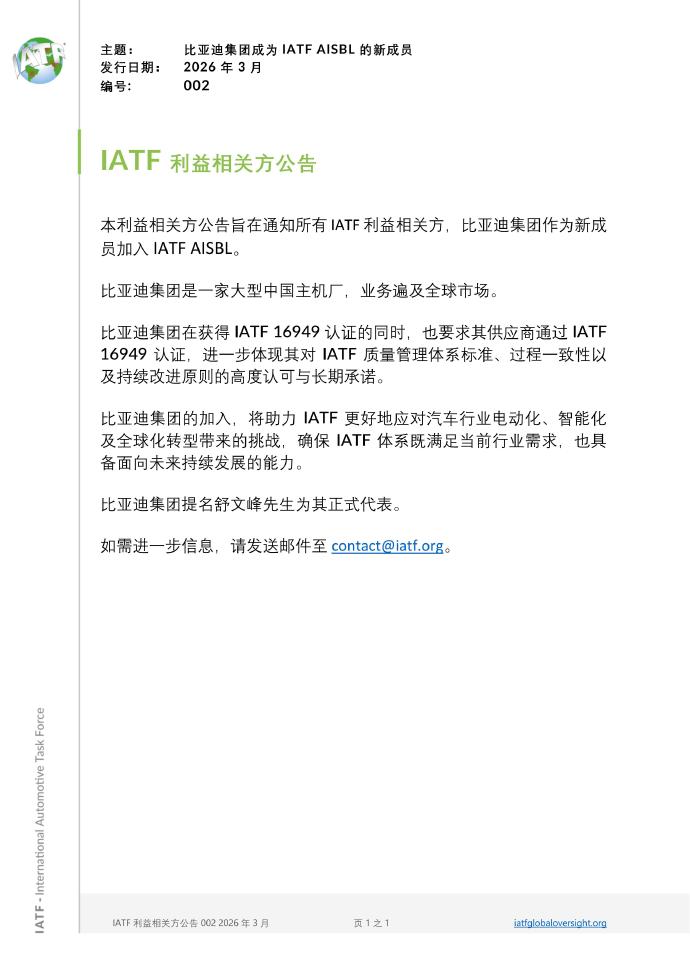
比亚迪集团成为 IATF AISBL 的新成员 。
Xin Lang Cai Jing· 2026-03-11 02:17
比亚迪集团成为 IATF AISBL 的新成员。 如需进一步信息,请发送邮件至 contact@iatf.org。 ternational Automotive 比亚迪集团是一家大型中国主机厂,业务遍及全球市场。 比亚迪集团在获得 IATF 16949 认证的同时,也要求其供应商通过 IATF 16949 认证,进一步体现其对 IATF 质量管理体系标准、过程一致性以 及持续改进原则的高度认可与长期承诺。 比亚迪集团的加入,将助力 IATF 更好地应对汽车行业电动化、智能化 及全球化转型带来的挑战,确保 IATF 体系既满足当前行业需求,也具 备面向未来持续发展的能力。 比亚迪集团提名舒文峰先生为其正式代表。 比亚迪集团成为 IATF AISBL 的新成员 主题: 2026年3月 发行日期: 002 编号: IATF 利益相关方公告 本利益相关方公告旨在通知所有 IATF 利益相关方,比亚迪集团作为新成 员加入 IATF AISBL。 IATF 利益相关方公告 002 2026年3月 iatfglobaloversight.org ...


朗博科技发布2025年业绩预告,净利润预增超57%
Jing Ji Guan Cha Wang· 2026-02-12 05:32
Group 1 - The core viewpoint of the article highlights the recent performance forecast and stock price fluctuations of Langbo Technology (603655) [1] Group 2 - The company announced its 2025 annual performance forecast on January 22, 2026, expecting a net profit attributable to shareholders of 44 million to 46.5 million yuan, representing a year-on-year increase of 57.58% to 66.53% [2] - The net profit excluding non-recurring gains and losses is expected to grow by 72.85% to 83.02% year-on-year, primarily driven by increased sales of sealing rings for new energy vehicles and improved gross margins [2] Group 3 - On February 6, 2026, Langbo Technology's stock price fell by 2.00% in a single day, closing at 43.52 yuan per share, with a net outflow of 1.66 million yuan in main funds and a turnover rate of 1.28%, indicating short-term capital fluctuations [3] Group 4 - In the long term, the trends of electrification and intelligence in the automotive industry may present order growth opportunities for the company, but there are concerns regarding intensified industry competition and high valuation risks [4]

2025年息税前利润率约2% 全球零部件巨头博世驶入“十字路口”
Zhong Guo Jing Ying Bao· 2026-02-10 01:28
中经记者方超 石英婧 上海报道 全球汽车零部件巨头博世集团,当下正步入"十字路口"。 博世集团日前发布的初步数据显示,2025年集团销售额微增至910亿欧元(2024年为903亿欧元),然 而,其息税前利润率仅为约2%,低于预期(2024年为3.5%)。 《中国经营报》记者注意到,除了连续下滑的利润率外,博世集团此前还因核心部门大裁员而引发市场 广泛关注。2025年9月份,博世集团计划在2030年前在智能出行业务部门裁员约1.3万人,而该部门是博世 集团的核心业务部门。 "业绩数据反映出当下的经济现实——2025年对博世而言是艰难的一年。"博世集团董事会主席史蒂凡· 哈通如此表示。而博世中国相关负责人日前向记者表示,对于集团此前的裁员动作,其表示主要集中在 欧洲部分,"我们在中国市场仍处于增长态势。" 高达31亿欧元的重组成本 年度利润率仅约2%,让博世集团近期成为汽车行业关注焦点。 据博世集团初步统计数据,2025年,博世集团息税前利润率约2%,低于预期,而在2024年,博世集团 的营业利润率已从2023年的4.8%降至3.5%。 此外,2025年,博世集团销售额为910亿欧元,而2024年这一数据为903 ...
全球最大的汽车供应商预警:利润率跌破2%
新华网财经· 2026-01-18 04:00
2024年,博世营业利润率已经从2023年的4.8%下降至3.5%。哈通在邮件中指出,2025年博世利润缩水部分源于高昂的高达31亿欧元的重组成本,即为裁 员等计划拨备的准备金,约占销售额的3.5%。 该报道还称,博世2025年营收约为910亿欧元,略高于2024年的900亿欧元。然而,这一增长主要得益于收购江森自控-日立公司所带来的约40亿欧元收 入。若剔除该并购影响,按可比口径计算,博世去年的实际营收实则出现下滑。 博世将于1月30日发布2025年财报数据。今年1月8日,哈通在接受媒体采访时就已对2025年财报发出预警,他预计,2025年博世盈利将出现大幅下滑,并 直言2026年也将充满挑战,公司至少要到2027年才有可能实现其设定的7%的长期营业利润率目标。他将原因归结于高昂的关税、疲软的经济增长抑制了 消费者支出。 为应对经营压力,博世的裁员措施也已启动。2025年10月,由于电动汽车需求未达预期、传统内燃机业务逐步退出以及中国市场竞争白热化等原因,博世 宣布在其核心的移动出行部门削减1.3万个工作岗位,并计划在2030年底前完成。这一轮裁员博世是继2024年宣布裁员9000人之后的又一次加码。 博世 ...

全球最大的汽车供应商预警:利润率跌破2%
第一财经· 2026-01-17 16:21
Core Viewpoint - Bosch is facing significant financial pressure in 2025, with profit margins expected to fall below 2%, far from the target [3][4] Financial Performance - Bosch's operating profit margin decreased from 4.8% in 2023 to 3.5% in 2024 [3] - The company anticipates revenues of approximately €91 billion in 2025, slightly above €90 billion in 2024, primarily due to the acquisition of Johnson Controls-Hitachi, contributing around €4 billion [3] - Excluding the impact of this acquisition, Bosch's actual revenue showed a decline [3] Cost and Restructuring - Bosch is incurring restructuring costs of €3.1 billion, accounting for about 3.5% of sales, related to layoffs and other plans [3] - The company has initiated layoffs, planning to cut 13,000 jobs in its core mobility solutions division by the end of 2030, following a previous announcement to lay off 9,000 employees in 2024 [5] Industry Context - Bosch, as the largest automotive parts supplier globally, is not alone in facing challenges; ZF Friedrichshafen, another major German supplier, is also experiencing financial difficulties [5] - ZF reported a 10.3% decline in sales to €19.7 billion in the first half of the year, with a net loss of €195 million compared to a net profit of €45 million in the same period last year [5] - The shift towards electric and smart vehicles is significantly impacting traditional parts suppliers like Bosch and ZF [5]

全球最大的汽车供应商预警:利润率跌破2%
Di Yi Cai Jing Zi Xun· 2026-01-17 15:30
Group 1 - Bosch is facing significant financial pressure in 2025, with CEO Stefan Hartung indicating that the profit margin will be well below 2%, far from the expected target [1] - In 2024, Bosch's operating profit margin is projected to decline from 4.8% in 2023 to 3.5% [1] - The profit decline is partly attributed to high restructuring costs of €3.1 billion, which accounts for approximately 3.5% of sales [1] - Bosch's revenue for 2025 is estimated at €91 billion, slightly above the €90 billion forecast for 2024, primarily due to the acquisition of Johnson Controls-Hitachi, contributing around €4 billion in revenue [1] - Excluding the impact of the acquisition, Bosch's actual revenue showed a decline year-over-year [1] - Hartung has warned that 2026 will also be challenging, with the company unlikely to reach its long-term operating profit margin target of 7% until at least 2027, citing high tariffs and weak economic growth as contributing factors [1] Group 2 - To address operational pressures, Bosch has initiated layoffs, planning to cut 13,000 jobs in its core mobility solutions division by October 2025, following a previous announcement to lay off 9,000 employees in 2024 [2] - Bosch, as the world's largest automotive parts supplier, is facing significant challenges due to the industry's shift towards electrification and smart technology, impacting traditional component manufacturers [2] - ZF Friedrichshafen, another major German automotive supplier, is also experiencing financial difficulties, with a 10.3% year-over-year decline in sales to €19.7 billion in the first half of the year, and a net loss of €195 million compared to a net profit of €45 million in the same period last year [2] - ZF's EBITDA decreased by 42% to €367 million, with the EBITDA margin dropping from 2.9% to 1.9% year-over-year [2] - As of June 30, 2025, ZF's net debt reached €10.462 billion, with a leverage ratio of 3.21 [2] - To alleviate debt pressure, ZF announced the sale of its Advanced Driver Assistance Systems (ADAS) business for €1.5 billion to Harman [2]
需求强劲、供应紧张,白银价格年内涨幅超90%
Sou Hu Cai Jing· 2025-12-04 12:25
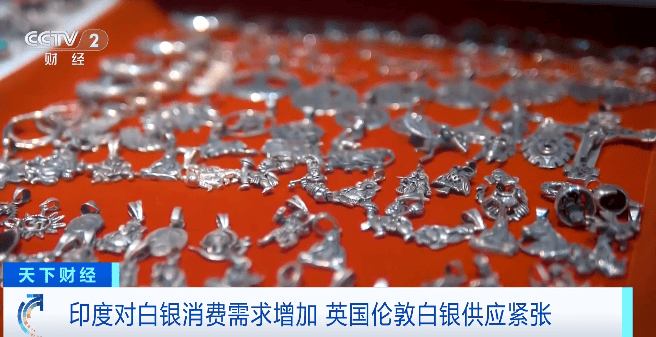
Core Viewpoint - Silver prices have surged significantly this year, with an increase of over 90%, surpassing traditional safe-haven asset gold [1] Group 1: Factors Driving Silver Price Increase - The rise in silver prices is attributed to multiple factors, including cultural and festive consumption, strong industrial demand, and ongoing supply constraints [3] - India, the largest consumer of silver, has seen a dramatic increase in demand, consuming approximately 4,000 tons annually, primarily for jewelry and decorative items [3] - The supply of silver has been under pressure, with London’s silver inventory decreasing from 31,000 tons in 2022 to 22,000 tons in March of this year, leading to a tight market [3] Group 2: Industrial Demand and Supply Dynamics - Silver's unique properties, such as high thermal and electrical conductivity, have made it increasingly important for industrial applications [5] - The shift from surplus to shortage in silver supply is driven by three main factors: the electrification of the automotive industry, advancements in artificial intelligence, and the growth of the photovoltaic industry [7] - The demand for silver in electric vehicles is significant, with an average vehicle requiring about 25 grams, and potentially up to 1 kilogram for solid-state batteries [9] Group 3: Future Outlook - The global silver mining output has been declining over the past decade, with only about 28% of silver production coming from primary silver mines, while the rest is a byproduct of copper or gold mining [11] - Predictions suggest that silver prices could reach $100 per ounce by the end of next year, although analysts caution that silver can experience rapid price declines just as quickly as it rises [13]
大明电子股份有限公司 首次公开发行股票主板上市公告书
Zhong Guo Zheng Quan Bao - Zhong Zheng Wang· 2025-11-05 23:25
Core Viewpoint - Daming Electronics Co., Ltd. is set to list its shares on the Shanghai Stock Exchange on January 6, 2025, and investors are advised to understand the risks associated with stock trading, especially during the initial phase of new stock listings [1][2]. Section 1: Important Statements and Reminders - The company guarantees the accuracy and completeness of the information disclosed in the listing announcement and assumes legal responsibility for any false or misleading statements [1]. - Investors are encouraged to read the full prospectus available on the Shanghai Stock Exchange website, particularly the "Risk Factors" section [2]. Section 2: Investment Risk Alerts - The company highlights the investment risks associated with new stock listings, urging investors to participate rationally [3]. - Specific risks include: - **Price Fluctuation Risk**: The absence of price limits during the first five trading days may lead to significant price volatility [4]. - **Limited Liquidity Risk**: Post-listing, only 3,103.76 million shares will be freely tradable, representing 7.76% of the total share capital, which may result in insufficient liquidity [5]. Section 3: Valuation Metrics - The issue price of 12.55 CNY per share corresponds to various price-earnings ratios (P/E): - 16.02 times based on pre-tax profit excluding non-recurring gains [7] - 16.18 times based on post-tax profit excluding non-recurring gains [7] - 17.80 times based on pre-tax profit including non-recurring gains [7] - 17.97 times based on post-tax profit including non-recurring gains [7] - The average static P/E ratio for the automotive manufacturing industry is 30.42 times, indicating that the company's P/E ratios are below the industry average [9]. Section 4: Industry and Market Risks - The company's main business is closely tied to the automotive industry, which is sensitive to macroeconomic fluctuations. Historical data shows a decline in automotive production and sales from 2018 to 2020, followed by a recovery in subsequent years [10][11]. - The automotive electronics industry is experiencing intensified competition, and the company must maintain product quality and innovation to retain market share [12]. - The rapid technological advancements in automotive electronics and the rise of electric vehicles pose risks of product obsolescence if the company fails to adapt [12]. Section 5: Operational Risks - The company has a high customer concentration, with the top five customers accounting for over 57% of revenue, which poses risks if relationships with these customers deteriorate [13]. - Quality control is critical, as any product quality issues could lead to significant liabilities [14]. - The company relies on outsourcing for certain production processes, which could lead to quality and supply chain risks if not managed properly [17]. Section 6: Financial Risks - The company faces risks from fluctuations in raw material prices, which constitute a significant portion of total procurement costs [21]. - The asset-liability ratio is relatively high, which may lead to financial strain if cash flow from customers is delayed [22]. - Inventory levels are substantial, and any market changes could lead to difficulties in inventory liquidation, impacting profitability [22].
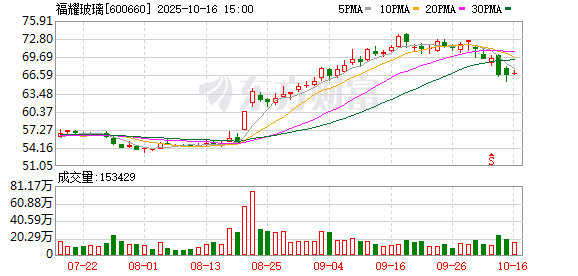
福耀玻璃换帅
Zheng Quan Ri Bao· 2025-10-16 16:12
Group 1 - The core point of the news is the resignation of Cao Dewang as the chairman of Fuyao Glass, with his son Cao Hui taking over the position, which is aimed at optimizing the company's governance structure and ensuring sustainable development [1][2] - Cao Dewang, the founder and key figure in Fuyao Glass's growth, will remain involved as a lifetime honorary chairman, ensuring continuity in strategic decision-making [1][2] - The company reported a third-quarter revenue of 11.855 billion yuan, a year-on-year increase of 18.86%, and a net profit attributable to shareholders of 2.259 billion yuan, up 14.09% [2] Group 2 - For the first three quarters of the year, Fuyao Glass achieved a revenue of 33.302 billion yuan, reflecting a year-on-year growth of 17.62%, and a net profit of 7.064 billion yuan, which is a 28.93% increase [2] - The transition in leadership is expected to provide a stable foundation for the company, as the new chairman Cao Hui has been involved in management as the former vice chairman [2] - The automotive industry is undergoing significant transformation towards electrification and intelligence, presenting opportunities for technological upgrades in automotive glass, which Fuyao Glass aims to leverage through its optimized governance structure [2]

福耀玻璃换帅 曹德旺辞任公司董事长其子曹晖接棒
Zheng Quan Ri Bao· 2025-10-16 16:10
Group 1 - The core point of the news is the resignation of Fuyao Glass's founder and chairman, Cao Dewang, and the appointment of his son, Cao Hui, as the new chairman, which aims to optimize the company's governance structure and ensure sustainable development [2][3] - Cao Dewang will continue to serve as the honorary chairman for life and will remain involved in company decision-making, ensuring a smooth transition and continuity in strategic direction [2][3] - The company reported a third-quarter revenue of 11.855 billion yuan, a year-on-year increase of 18.86%, and a net profit attributable to shareholders of 2.259 billion yuan, up 14.09% [3] Group 2 - Fuyao Glass has shown steady growth, with a total revenue of 33.302 billion yuan for the first three quarters of the year, reflecting a year-on-year increase of 17.62%, and a net profit of 7.064 billion yuan, up 28.93% [3] - The automotive industry is undergoing a critical transformation towards electrification and intelligence, presenting opportunities for technological upgrades in automotive glass, which Fuyao Glass aims to leverage through its governance restructuring [4] - The new management's continuity in global expansion and technological research and development will be key to the company's stable growth [4]