消费提振扩容

Search documents
放大赛事溢出效应!上海发布28条举措促进消费提振扩容联动发展
Sou Hu Cai Jing· 2026-01-22 07:26
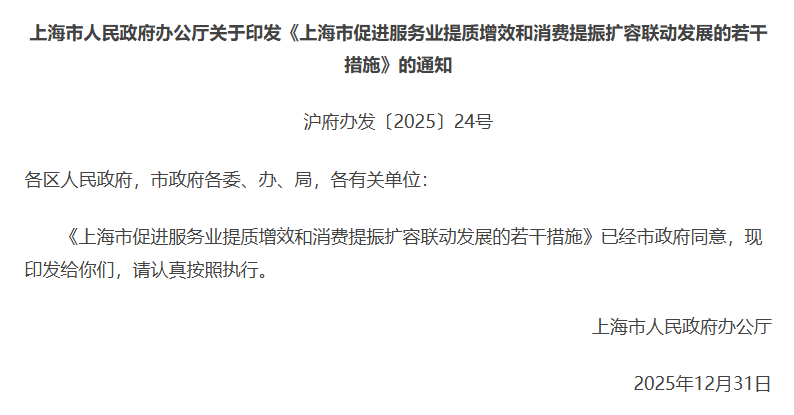
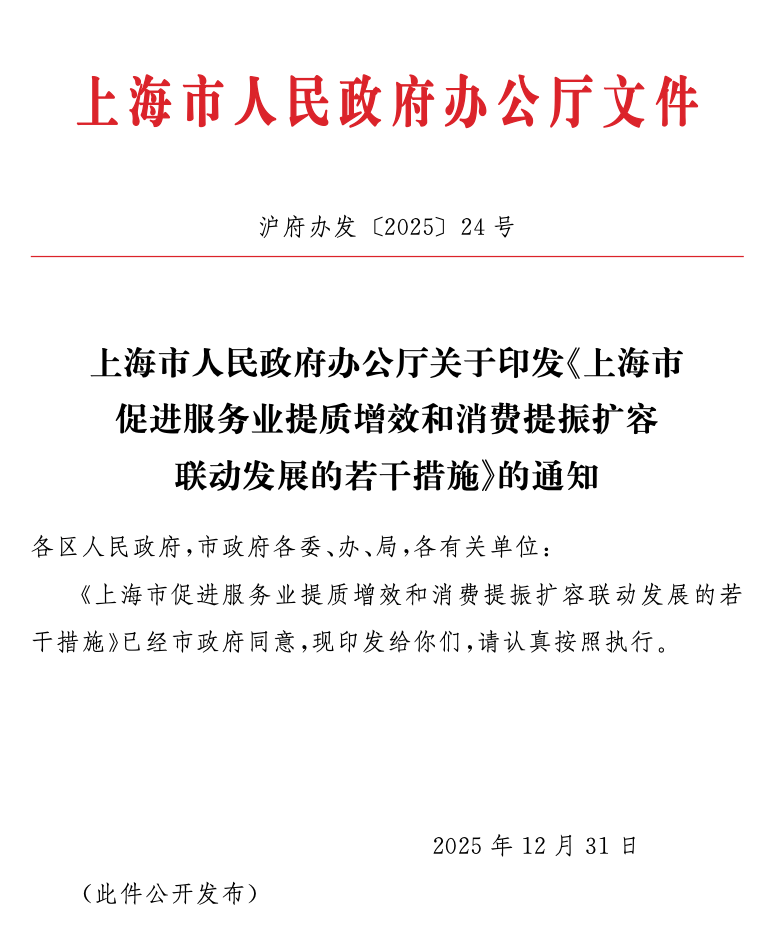
Core Viewpoint - Shanghai's Development and Reform Commission has introduced measures to enhance the quality and efficiency of the service industry while boosting consumption through coordinated efforts on both supply and demand sides [4] Group 1: Sports and Entertainment - Shanghai aims to host 182 international and domestic sports events by 2025, with a projected 35% year-on-year increase in sports consumption during major events [5] - The F1 China Grand Prix is expected to attract 220,000 spectators, generating a direct economic impact of approximately 2.47 billion yuan and an indirect impact of about 6.91 billion yuan [5] - The city plans to develop a globally influential esports ecosystem, becoming a leading hub for esports events and high-level clubs by 2025 [5] Group 2: Financial Innovation - Financial institutions are encouraged to innovate consumer finance products tailored to new consumption trends, including holiday, night-time, nostalgic, and anime economies [7] - Policies will be implemented to optimize personal consumption loans, including easing application conditions and enhancing credit products for large purchases like green smart home installations [7][8] Group 3: Infrastructure and Platform Economy - Financial support will be provided for the renovation of consumer infrastructure, including commercial facilities and community services, with an emphasis on real estate investment trusts (REITs) [10] - E-commerce and service platforms will be supported to develop specialized consumption platforms in sectors like maternal and child care, housekeeping, and elderly care [11] Group 4: Transportation and Connectivity - The city will enhance transportation services by encouraging airlines to open new international routes and improve the quality of travel services at airports and transport hubs [14] - Initiatives will be taken to create integrated consumption scenarios at transportation hubs, including commercial spaces and cultural exhibitions [15] Group 5: Quality of Life Services - Support will be provided to improve the quality of domestic services, including training and insurance for domestic workers, and enhancing the overall service quality in the elderly care sector [20][21] - The introduction of a pilot program for "no-accompaniment" care services in medical institutions is planned to improve healthcare accessibility [22] Group 6: Brand and Standards - The initiative includes the establishment of a recognizable "Shanghai brand" to enhance consumer trust and promote local products [24] - A focus on developing high-quality standards in emerging sectors such as e-sports and digital arts is emphasized to ensure competitive service quality [25] Group 7: Talent and Industry Development - Efforts will be made to attract talent in the service and consumption sectors, including international teams and specialized professionals [31] - The city aims to strengthen industry clusters by attracting high-growth companies and fostering a supportive ecosystem for startups [32]

上海新政激活六大行业吸金潜力 金融创新将成促消费重要手段
Di Yi Cai Jing· 2026-01-13 13:44
Core Viewpoint - The article discusses Shanghai's new measures to enhance the quality and efficiency of the service industry while boosting consumption, emphasizing a systematic approach to link supply and demand across various sectors [1][2]. Group 1: Policy Measures - The "Several Measures" document outlines 28 policy initiatives targeting six key sectors: finance, information services, transportation, cultural and entertainment, life services, and inspection and certification [1][6]. - The new policies aim to shift the focus from short-term stimulus to a long-term strategic layout that promotes service quality and consumption expansion [2][3]. - The measures highlight the importance of integrating financial services directly into consumption promotion, focusing on personal consumption finance, insurance product innovation, and financial support for service industry operators [1][9]. Group 2: Economic Context - The service industry and consumption in Shanghai have shown positive growth trends, with a 5.9% increase in service value added and a 5% rise in retail sales of consumer goods in the first eleven months of 2025, both exceeding national averages [2][6]. - The article emphasizes the need for a virtuous cycle of "supply upgrade - consumption boost - industry income - reinvestment," particularly through integrated sectors like cultural tourism and sports [2][3]. Group 3: Industry Focus - The six targeted sectors account for approximately 60% of Shanghai's service industry value added and about 70% of service consumption, making them critical for the linked development strategy [6]. - The measures encourage e-commerce platforms to transition from "price competition" to "quality competition," enhancing the connection between online and offline consumption [6][10]. - Specific initiatives include enhancing the quality of cultural and entertainment offerings, supporting high-level exhibitions, and promoting the gaming and esports industries [6][7]. Group 4: Financial Innovation - The measures stress the integration of "consumption scenarios + consumer finance," supporting the development of tailored financial products for various needs, including retirement and wealth management [9][10]. - Financial support is positioned as a key tool for stimulating consumption, with a focus on providing payment convenience through consumer credit products and easing financial pressures for service industry operators [10][11]. - The policy aims to create a dual support system, reducing consumer financial costs while simultaneously providing financing support to service industry businesses [10].
上海新政激活六大行业吸金潜力,金融创新将成促消费重要手段
Di Yi Cai Jing· 2026-01-13 13:31
Core Viewpoint - The new policy emphasizes systematic linkage and quality competition on the supply side, aiming to enhance service quality and stimulate consumption in Shanghai's service industry [1][2][3]. Group 1: Policy Measures - The "Several Measures" document outlines 28 policy initiatives targeting six key sectors: finance, information services, transportation, cultural and entertainment services, life services, and inspection and certification [1][6]. - The focus is on optimizing supply and expanding consumption to create new growth points in the service sector [1][2]. - The policy integrates finance directly into consumption promotion, addressing personal consumer finance, insurance product innovation, and financial support for service industry operators [1][9]. Group 2: Economic Strategy - The strategic shift in Shanghai's consumption promotion focuses on long-term structural changes rather than short-term stimulus, aligning with national directives to expand domestic demand [2][3]. - The service sector and consumption have shown positive growth trends, with service value added increasing by 5.9% and retail sales of consumer goods growing by 5% in the first eleven months of 2025, both surpassing national averages [2][6]. Group 3: Industry Focus - The six targeted industries account for approximately 60% of Shanghai's service sector value added and about 70% of service consumption [6]. - The policy aims to break down industry barriers and promote deep integration across various fields, creating a "service + consumption" ecosystem [3][4]. Group 4: Quality and Innovation - The measures highlight the importance of high-quality service supply to drive consumption demand, with a focus on digitalization and cross-industry integration [4][5]. - Specific initiatives include enhancing the quality of cultural and entertainment offerings, supporting high-level exhibitions, and promoting the gaming and esports industries [6][7]. Group 5: Financial Support - The policy emphasizes the integration of consumption scenarios with financial services, encouraging the development of tailored financial products for sectors like elderly care and wealth management [9][10]. - Financial support is aimed at easing payment pressures for consumers and providing funding assistance to service industry operators [10][11].
上海发布多项促进服务业和消费发展措施 涉游戏、旅游、养老等多方面
Xin Hua Cai Jing· 2026-01-13 08:37
Group 1: Gaming and E-sports Industry - The Shanghai Municipal Government has issued measures to promote the development of the gaming and e-sports industry, aiming to create a globally influential brand event system and attract top international e-sports events [1] - Support will be provided for projects that meet certain criteria, including the development of proprietary intellectual property (IP) in gaming, original high-quality games, and AI-native games, with rewards for hosting high-level gaming awards and international industry events [1] - The government will also support the incubation of gaming and e-sports startups, providing assistance to qualifying industrial parks and incubators [1] Group 2: Elderly Care and Services - The measures support the construction and renovation of dual-occupancy rooms in elderly care institutions, offering subsidies based on the number of beds [2] - There is encouragement for the conversion of existing commercial buildings into elderly care facilities, with one-time subsidies based on bed count [2] - The government aims to enhance the training of mid-to-senior level elderly care workers and promote the development of specialized day care and home service institutions, with rewards based on service quality monitoring results [2]
上海,利好来了!
Sou Hu Cai Jing· 2026-01-13 06:30
Core Viewpoint - The Shanghai Municipal Government has issued measures to promote the quality improvement and expansion of the service industry and consumption, focusing on optimizing supply and expanding demand to achieve mutual empowerment and progress [1][3]. Group 1: Financial Innovation and Support - Financial institutions are encouraged to innovate consumer finance products tailored to new consumption trends, such as holiday and night economies, and to implement personal consumption loan interest subsidy policies [3][4]. - Support for insurance product innovation includes enhancing coverage for specific groups and expanding commercial health insurance services [4]. - Financial support for service industry entities will be strengthened through various loan policies and innovative financing products based on expected revenue rights [4][5]. Group 2: Platform Economy Development - The development of platform economies will be regulated to ensure fair competition and prevent forced low-cost sales by platform operators [6][7]. - Platforms are encouraged to promote quality consumption through brand activities and support for quality merchants [7]. Group 3: Transportation and Connectivity - The government will enhance high-quality transportation services, including new international routes and improved travel experiences at transport hubs [8][9]. - Collaboration between airlines and travel agencies will be supported to create integrated travel products [9]. Group 4: Cultural and Entertainment Sector - Measures will be taken to enrich cultural and entertainment offerings, including support for high-quality exhibitions and performances [10][11]. - The gaming and esports industry will be promoted through the development of proprietary event systems and support for high-quality content creation [11][12]. Group 5: Improvement of Living Services - Initiatives to enhance the quality of domestic services and elder care will be implemented, including support for training and insurance for service personnel [13][14]. - The expansion of medical and health services will be encouraged, with a focus on high-end medical offerings and international medical tourism [15][16]. Group 6: Brand and Quality Standards - The establishment of a recognizable "Shanghai brand" will be promoted to enhance consumer trust and support for green product certifications [16][17]. - A comprehensive standard system will be developed to improve service quality across various sectors [17]. Group 7: Support and Talent Development - Financial support will be increased to enhance service quality and cultivate key consumption scenarios [19][20]. - Efforts will be made to attract talent in the service and consumption sectors, including support for international teams and skill evaluations [20][21].