清洁可再生能源

Search documents
云南省绿色电力装机量超1.55亿千瓦
Xin Lang Cai Jing· 2026-01-28 19:57
Core Viewpoint - Yunnan Province aims to accelerate the development of a modern industrial system, focusing on increasing green power capacity to over 155 million kilowatts by the end of 2025, positioning itself among the top provinces in China [1] Group 1: Renewable Energy Development - Yunnan Province is advancing the development of clean and renewable energy resources, particularly through the construction of large hydropower bases on the Jinsha and Lancang Rivers [1] - The province plans to integrate water, wind, and solar energy development, promoting multi-energy complementarity and deep integration [1] - There will be a steady push for the expansion and capacity enhancement of hydropower plants, while adhering to ecological protection guidelines [1] Group 2: Fossil Energy Transition - Yunnan Province is promoting the transformation of the fossil energy industry, focusing on balancing thermal power as both a foundational and regulatory energy source [1] - The province aims to implement clean carbon reduction modifications for coal-fired power units and enhance the performance indicators of new units [1] - There is an emphasis on the green transformation of coal mining, including the comprehensive utilization of coal gangue and the integrated development of coal mine gas governance and extraction [1]
绿色发展造福千家万户(我眼中的中国)
Ren Min Ri Bao· 2025-11-02 22:21
Group 1 - The core viewpoint emphasizes the significant role of clean renewable energy in driving local economic development and improving living standards in both China and Pakistan [1][2][3] - The Tongquan Wind Farm in Yunnan, China, has generated approximately 1.7 billion kilowatt-hours of electricity, saving over 450,000 tons of standard coal and reducing carbon dioxide emissions by more than 1.26 million tons since its operation [1] - In Pakistan, solar panel imports reached over 16 gigawatts in 2024, doubling the total from 2023, with 12.7 gigawatts imported in the first three quarters of the year [2] Group 2 - The adoption of solar energy in Pakistan is driven by the decreasing costs of Chinese solar panels, leading to installations in factories, schools, and rural areas, which reduces living costs and creates job opportunities [2] - China's support in renewable energy development is crucial, as it supplies over 80% of global photovoltaic components and 70% of wind power equipment, significantly lowering the cost of electricity generation worldwide [1][2] - The collaboration between China and Pakistan in clean energy is expected to enhance living standards, promote energy efficiency, and lay the foundation for sustainable growth in the future [3]
世卫报告:气候行动不力对人类健康造成严重影响
Xin Hua She· 2025-10-30 16:26
Core Viewpoint - The World Health Organization's report warns that reliance on fossil fuels and failure to adapt to global warming have severely impacted human health, leading to increased mortality and economic strain [1] Group 1: Health Impacts - The report indicates that the number of heat-related deaths has increased by 23% since the 1990s, with an average of 546,000 annual deaths attributed to high temperatures [1] - Out of 20 key health threat indicators monitored, 12 have reached historical highs, highlighting the urgent need for climate action [1] Group 2: Food Security - Climate events such as droughts and heatwaves have led to an increase of approximately 124 million people facing moderate to severe food insecurity in 2023 [1] Group 3: Economic Consequences - The report estimates that in 2024, heat exposure will result in potential labor time losses equivalent to $1.09 trillion, indicating significant economic pressure due to climate change [1] Group 4: Recommendations - The report emphasizes the need to eliminate fossil fuels in favor of clean renewable energy and efficient energy use as effective measures to mitigate climate change and protect lives [1] - Transitioning to healthier, more sustainable diets and agricultural systems could significantly reduce pollution, greenhouse gas emissions, and deforestation [1]
城市24小时 | 增速倒数 能源大省再提“转型”
Mei Ri Jing Ji Xin Wen· 2025-10-30 16:10
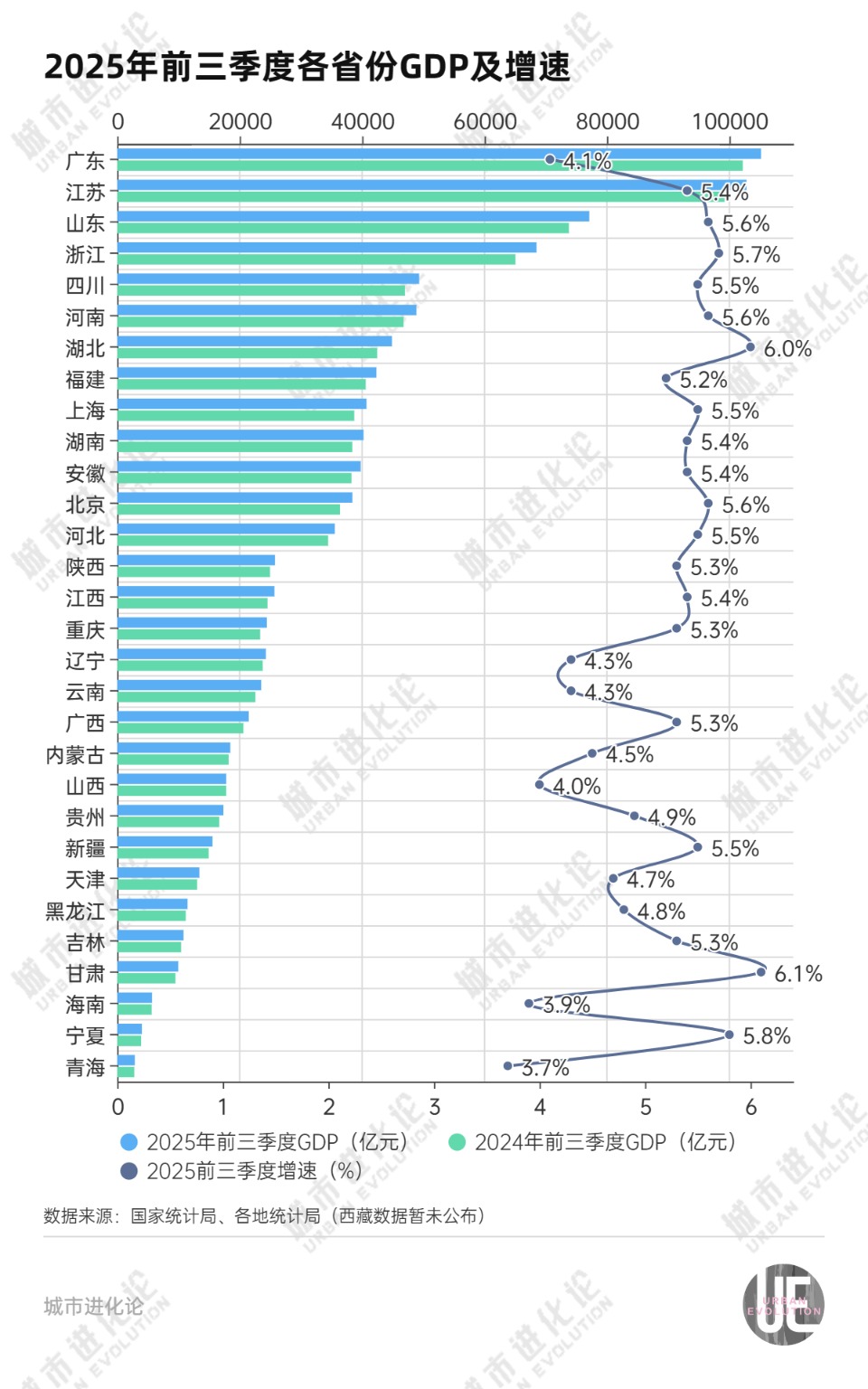
Economic Data Overview - As of now, 30 provinces in China have released their GDP data for the first three quarters, with only Tibet not reporting [1] - 19 provinces outperformed the national average GDP growth rate of 5.2%, with Gansu leading at 6.1% and Fujian matching the national rate [1] - 10 provinces lagged behind the national average, with Qinghai, Hainan, and Shanxi having the lowest growth rates at 3.7%, 3.9%, and 4.0% respectively [1] Shanxi Province Economic Performance - Shanxi's GDP growth remains weak, with a mere 1.8% growth in the same period last year, ranking it at the bottom nationally [4] - The province's GDP growth for the first three quarters of this year is reported at 4.0%, which is an increase of 0.2 percentage points from the first half of the year [4] - The industrial sector, particularly the secondary industry, is a significant drag on growth, with a reported increase of 3.5% in value added for the secondary industry [4] Coal Industry Impact - Shanxi, being a major energy province, has over 30% of its GDP and 50% of its fiscal revenue coming from the coal industry, making its economy highly sensitive to coal market fluctuations [5] - From January to September, the coal mining and washing industry saw a 20% decline in revenue and a 51% drop in total profits, despite a 13% decrease in operating costs [5] - The value added of the coal industry in Shanxi grew by 5.6% in the first three quarters, but this represents a decline of 1.5 percentage points from the first half of the year [5] Transition and Development Initiatives - Shanxi has been recognized as a national pilot for energy revolution reforms since 2019, focusing on transitioning from coal to smarter and higher-value products, including investments in wind, solar, and hydrogen energy [6] - The province's government emphasized the need for a robust transition strategy, highlighting the challenges of insufficient technological innovation and the small scale of emerging industries [6] - Notable growth in emerging sectors includes a 6.9% increase in the value added of equipment manufacturing, with renewable energy equipment manufacturing growing by 160% [6] - Investments in high-tech services, new energy vehicles, and renewable energy generation have also seen significant increases of 13.2%, 36.5%, and 26.4% respectively [6]